Code DD on W-2 reports the cost of applicable employer-sponsored health coverage. The amount generally combines the employer and employee portions. According to the IRS, reporting that cost does not make otherwise excludable health coverage taxable.
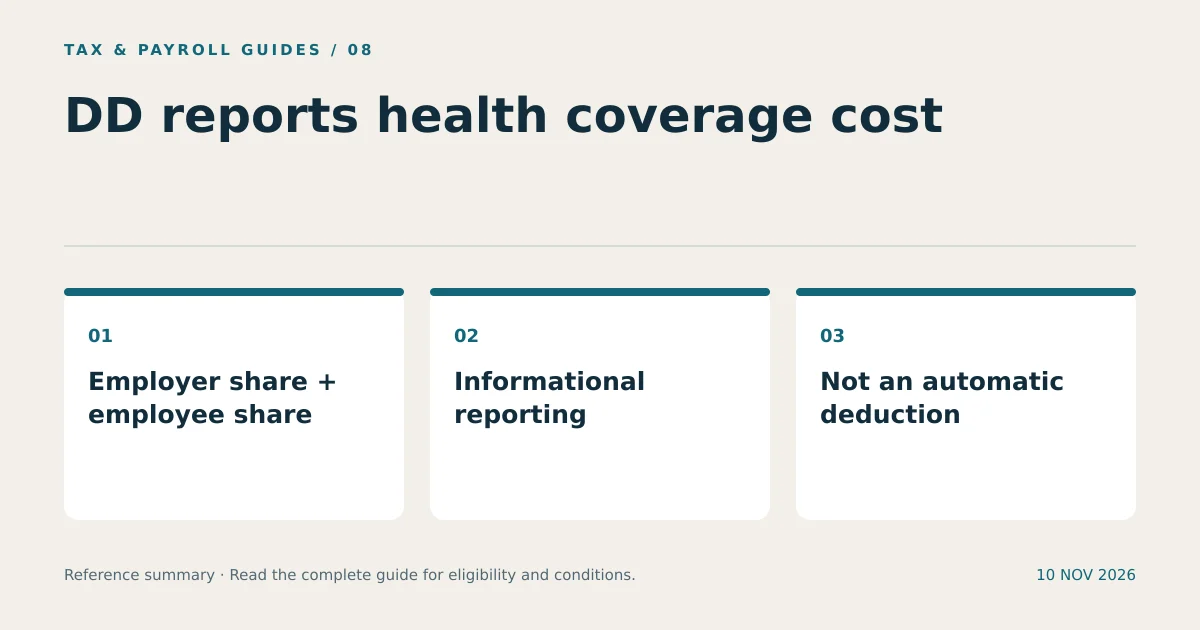
The amount is a disclosure about coverage provided during the reported year. It is not an additional paycheck, a medical bill, or a balance the employee owes to the IRS. Read it separately from wages in box 1 and federal income tax withheld in box 2.
What Does Code DD on W-2 Mean?
W-2 box 12a code DD means health coverage cost is reported in the first box 12 row. The DD code supplies the meaning. The 12a label only supplies its location.
The same code can appear in box 12b, 12c, or 12d. Moving the entry between those rows does not change its tax treatment. A hypothetical entry of DD $11,400 reports $11,400 of applicable coverage cost, regardless of the row used.
Do not confuse DD with D. Code D identifies employee traditional 401(k) elective deferrals. Two letters instead of one change the reported category completely. Confirm the code during manual entry, especially when a scanned form has small print.
Whose Payments Are Included in Code DD on a W-2?
The reported cost generally includes the employer-paid share plus the employee-paid share of reportable coverage. Employee contributions can be made before or after tax; code DD still describes the reportable coverage cost.
| Illustrative annual component | Amount |
|---|---|
| Employer-paid coverage cost | $8,400 |
| Employee-paid coverage cost | $3,000 |
| Total reportable cost in this example | $11,400 |
This hypothetical calculation explains why DD can exceed the premiums deducted from paychecks. The employee’s payroll record may show only $3,000, while the W-2 includes the full $11,400. Neither figure establishes the employee’s deductible medical expenses.
Coverage elections also affect the amount. Employee-only coverage, family coverage, a midyear enrollment change, and coverage during only part of the year can produce different totals. Compare equivalent coverage periods before concluding that an employer made an error.
Is Code DD Taxable or Deductible?
Code DD is informational reporting, not a new federal tax charge. The IRS states that reporting does not change the exclusion for qualifying employer-provided coverage.
The number also does not automatically create a deduction. An employee cannot claim the employer’s excluded premium contribution as a personal medical expense. Employee premiums paid through pretax payroll deductions already receive the relevant exclusion and cannot simply be deducted again.
Separately paid, eligible medical expenses follow their own rules. For an employee considering an itemized medical-expense deduction, the relevant facts include who paid, whether the amount was reimbursed, whether it was paid pretax, and whether the deduction threshold is met. A code DD total does not answer those questions.
Some coverage arrangements involve benefits taxable for independent reasons, such as certain domestic-partner coverage. Any such wage treatment arises from the applicable benefit rules, not from the presence of DD. Review the employer’s benefit explanation when the arrangement includes taxable coverage.
Which Health Benefits Belong in Code DD?
Major medical coverage generally belongs in reportable coverage cost. Other arrangements have different treatment under the IRS reporting chart, including reporting relief and exclusions.
| Coverage or account | General DD reporting treatment |
|---|---|
| Major medical coverage | Reportable, subject to applicable employer relief |
| Separate dental or vision coverage | May be optional under the IRS conditions |
| HSA contributions | Not DD; relevant employer and cafeteria-plan funding uses W |
| Health FSA funded solely through employee salary reductions | Not reported under DD |
| Health reimbursement arrangement | Optional under the cited transition relief |
| Accident or disability income coverage | Not reported under DD |
The table is not a test of whether an expense is tax-deductible. It describes W-2 coverage-cost reporting. A payment can be excluded from DD yet still appear elsewhere or require another tax form.
How Is Code DD Different from W, FF, and D?
DD describes coverage cost; W describes certain HSA contributions; FF describes permitted QSEHRA benefits; D describes traditional 401(k) salary deferrals. Keep each entry in its own category.
- Compare DD with the employer’s health-coverage cost records.
- Compare W with HSA contributions and the information required for Form 8889.
- Compare FF with the benefit permitted under the QSEHRA, rather than only reimbursements received.
- Compare D with employee retirement deferrals.
Combining these amounts into one health deduction or one retirement contribution produces an incorrect classification. Enter multiple codes as separate records when tax software requests them.
Why Might an Employer Leave Code DD Blank?
An employer can qualify for reporting relief even when an employee has health coverage. Under the IRS guidance, transition relief includes employers that filed fewer than 250 Forms W-2 for the preceding calendar year.
That test concerns the preceding year’s form count, not simply the current number of employees. Other coverage-specific and employer-specific exceptions also exist. A blank entry alone does not establish noncompliance, lack of insurance, or an unpaid premium.
An employer also is not required to create a W-2 solely to disclose coverage cost for a retiree or other person who would not otherwise receive one. Use enrollment and insurer records to confirm actual coverage.
How Do You Enter and Check Code DD?
Enter the DD code and its amount exactly as shown when your tax software requests W-2 box 12 information. Do not add it manually to wages or claim it as a separate deduction.
- Check the tax year and employer identification number.
- Confirm the entry says DD rather than D.
- Compare coverage dates and enrollment level with benefit records.
- Ask payroll to explain a total that still appears inconsistent.
- Keep any corrected statement with the original tax documents.
For example, a change from employee-only to family coverage in July can explain why an annual total differs from twelve times the January premium. Ask for the applicable monthly or period-based cost calculation before estimating a correction yourself. Code DD on a W-2 remains a coverage-cost disclosure throughout that review.
What Other Questions Do Employees Ask?
Does Code DD on a W-2 Increase Taxable Income?
No. Reporting excludable employer-sponsored coverage under code DD does not make that coverage taxable. The entry itself does not increase federal taxable wages.
Is W-2 Box 12a Code DD the Amount I Paid?
Not necessarily. Code DD generally combines the reportable cost paid by the employer and the employee. It can therefore be much larger than payroll deductions for premiums.
Can I Deduct the Full Code DD Amount?
No. Code DD is a coverage-cost disclosure, not a certificate of a personal deduction. Employer-paid amounts and employee premiums paid pretax cannot simply be deducted again.
Does a Missing Code DD Mean I Was Uninsured?
No. Reporting relief and other exceptions can apply. Confirm actual enrollment with the employer or insurer rather than treating an empty box as proof of no coverage.