W-2 Form records an employee’s annual wages and taxes withheld. Employers prepare this Wage and Tax Statement; employees use it to complete federal, state, and applicable local income tax returns. The form reports payroll information rather than the final tax bill.
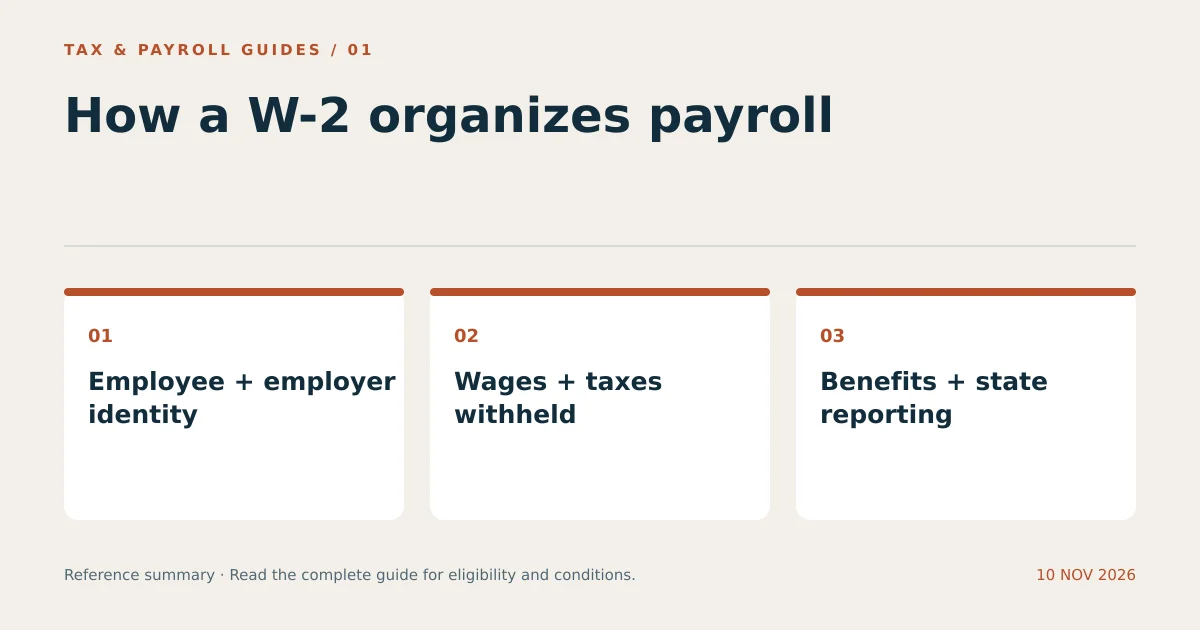
Form 1040 combines the W-2 information with other income, deductions, credits, and payments to calculate the employee’s federal tax result. Review the statement before transferring its amounts: gross pay, federal taxable wages, and Social Security wages can differ.
What Is the Purpose of a W-2 Form?
The purpose of a W-2 form is to report employee compensation and payroll taxes consistently to the employee and government agencies. It connects the employer’s payroll records with the employee’s annual income tax reporting and Social Security earnings record.
Reviewing the form also helps detect problems before filing. A missing employer, incorrect Social Security number, or duplicated wage entry can create a mismatch. The statement does not establish whether every payment is taxable under every jurisdiction. Federal, Social Security, Medicare, state, and local wage definitions can differ.
Who Prepares W-2 Forms, and Who Receives Them?
Employers prepare W-2 forms for employees whose wages meet the applicable reporting rules. Employees receive their copies from the employer or its authorized payroll service. The employer files the federal wage report with the Social Security Administration.
A payroll provider can process the document, but the employer remains responsible for correct reporting. Employees do not create their own ordinary W-2 by downloading a blank form. Someone with two employers generally receives separate statements. A single employer can also issue additional pages for state reporting or extra coded information.
Being employed for only part of a year does not remove the need to report wages. A former employee can receive a W-2 after resignation, dismissal, retirement, or a business closure.
What Does a W-2 Look Like?
A W-2 looks like a labeled grid containing employee identification, employer identification, wage amounts, tax amounts, and benefit information. Official and approved substitute layouts can differ while reporting the same fields.
The lettered boxes identify the parties. Box a contains the employee’s Social Security number. Box b contains the employer identification number. Other lettered fields contain the employer’s name and address, employee’s name and address, and an optional control number. The tax year is printed separately and is essential when filing.
Multiple copies do not represent multiple jobs. Copy B serves federal income tax filing, Copy C is for the employee’s records, and Copy 2 is used for applicable state or local filing. Electronic filing software collects the information rather than mailing a paper W-2 with the electronically filed return.
What Do the Main W-2 Boxes Mean?
The numbered boxes separate different kinds of wages, withholding, and benefit information. Read each label before entering an amount into tax software.
| Box | Information | Review point |
|---|---|---|
| 1 | Wages, tips, and other compensation | Federal taxable employee compensation, which can differ from gross pay. |
| 2 | Federal income tax withheld | Federal tax paid through payroll, not the final tax liability. |
| 3 and 4 | Social Security wages and tax | Separate payroll-tax reporting; do not add box 4 to box 2. |
| 5 and 6 | Medicare wages and tax | Another wage base and withholding category. |
| 7 and 8 | Social Security tips and allocated tips | Tip reporting categories with different treatment. |
| 10 and 11 | Dependent care benefits and nonqualified plans | Special compensation and benefit information. |
| 12 | Letter-coded items | Read the code and amount together; codes have different meanings. |
| 13 | Status checkboxes | Statutory employee, retirement plan, and third-party sick pay indicators. |
| 14a and 14b, 2026 form | Other information and Treasury tipped occupation codes | Use the instructions for the specific tax year. |
| 15 through 20 | State and local information | Check each jurisdiction and avoid duplicating federal wages. |
Why Can W-2 Wages Differ from Annual Salary?
W-2 wages can differ from salary because payroll reporting reflects payments, taxable benefits, and specific exclusions. A salary figure describes compensation terms; a wage box measures compensation under a particular tax rule.
Traditional employee 401(k) deferrals generally reduce federal income-tax wages but remain subject to Social Security and Medicare taxes. Certain qualifying cafeteria-plan benefits can affect those wage bases differently. Timing also matters: a payment normally belongs to the calendar year in which it was paid, rather than the month in which the work occurred.
Use the payroll reconciliation rather than subtracting every deduction. An after-tax insurance deduction or loan repayment does not automatically reduce box 1. Net pay is not the amount to enter as wages on a return.
What Is a Simple W-2 Example?
A hypothetical employee with $60,000 in gross wages and $3,000 in traditional 401(k) deferrals could have $57,000 in box 1 and $60,000 in boxes 3 and 5, assuming no other adjustments.
| Example field | Amount |
|---|---|
| Gross wages | $60,000 |
| Traditional 401(k) employee deferral | $3,000 |
| Box 1 | $57,000 |
| Box 2, assumed federal withholding | $5,400 |
| Box 12, code D | $3,000 |
This illustration does not calculate a refund. A refund depends on the complete tax return, including filing status, other income, deductions, credits, and payments. The $5,400 figure is an assumed payroll payment, not a recommended withholding amount.
How Do You Check a W-2 Before Filing?
Check identity, tax year, wages, withholding, and coded items against employer records before submitting a return. A short review can prevent an avoidable correction.
- Confirm the name and Social Security number.
- Confirm the employer and tax year.
- Compare totals with the final year-to-date payroll statement.
- Investigate differences using payroll deductions and taxable benefits.
- Review all state entries and retirement indicators.
- Request a correction from payroll when an actual error remains.
Keep the original form and any corrected W-2c. Do not silently replace employer-reported figures with estimates because a box appears unfamiliar. A W-2 form remains the starting record for wages and withholding; the tax return determines the final result.
What Other Questions Do Readers Ask?
Is a W-2 the Same as a W-4?
No. A W-4 tells an employer how to calculate federal income tax withholding. A W-2 reports wages and withholding after the year ends.
Does a W-2 Show My Tax Refund?
No. It shows wages, withholding, and related payroll information. A refund is calculated from the complete tax return.
Can I Receive More than One W-2?
Yes. Multiple employers, payroll changes, or additional reporting pages can produce multiple forms. Check whether each document adds information or duplicates an existing statement.