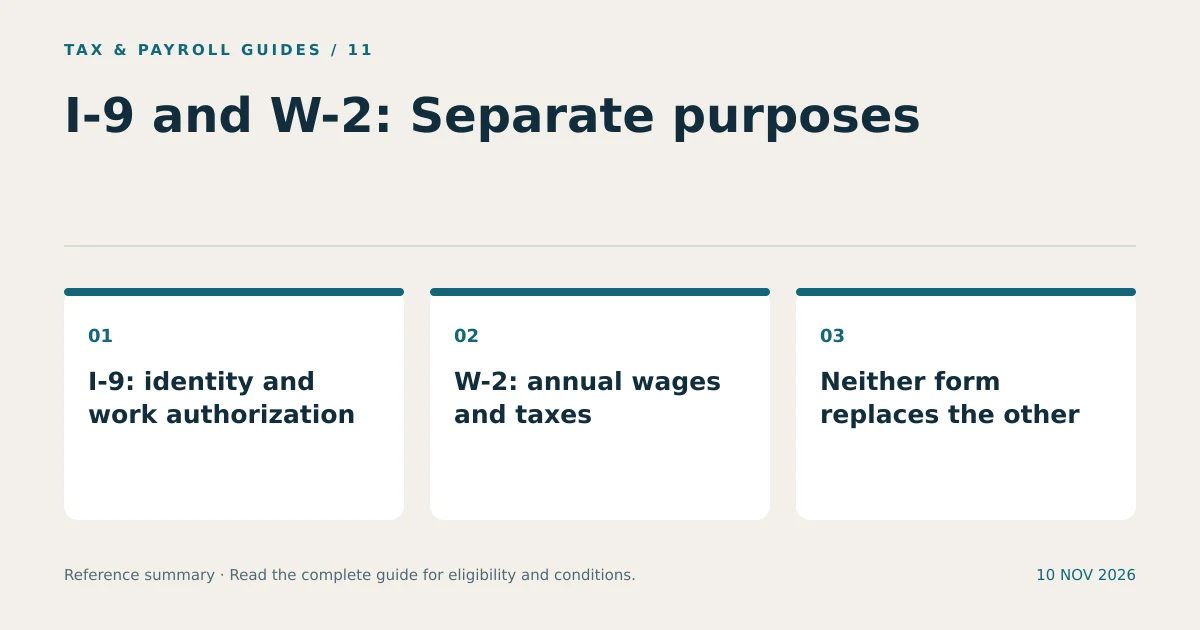
I-9 vs. W-2 compares employment verification with annual wage reporting. Form I-9 verifies a worker’s identity and employment authorization. Form W-2 reports wages and taxes. Employees can need both forms for the same job, and neither form replaces the other.
Form W-4 serves a third purpose: it gives the employer federal income tax withholding instructions. Keep identity-verification records, withholding instructions, and year-end wage statements separate when completing onboarding or preparing a tax return.
What Are the Main I-9 vs. W-2 Differences?
I-9 concerns authorization to work; W-2 concerns compensation already paid. The agencies, timing, required information, and recordkeeping responsibilities differ.
| Question | Form I-9 | Form W-2 |
|---|---|---|
| What is the official name? | Employment Eligibility Verification | Wage and Tax Statement |
| Who completes it? | Employee and employer or authorized representative | Employer |
| When is it used? | Hiring, with later updates when required | Annual wage reporting |
| What does it record? | Identity, status attestation, document examination | Wages, withholding, and other payroll items |
| Is it normally sent with a tax return? | No | Its wage and tax information is used in filing |
| Who maintains the employer record? | Employer | Employer, with required government reporting |
Who Needs to Complete Form I-9?
USCIS generally requires Form I-9 for each employee hired to work in the United States, including U.S. citizens. Citizenship does not remove the employer’s employment-verification responsibility.
The rule concerns an employment relationship. Independent contractors generally do not complete an I-9 for the business engaging their independent services. A label alone does not settle worker classification. Whether a worker is an employee depends on the applicable facts and legal standards.
The employee completes Section 1 after accepting an offer and no later than the first day of paid work. An employer or authorized representative completes Section 2 after examining acceptable documentation. Using an authorized representative does not transfer the employer’s responsibility for a properly completed form.
When Must the Employer Complete I-9 Verification?
The usual Section 2 deadline is within three business days after the first day of employment. A worker hired for fewer than three business days requires completion no later than the first day.
For a hypothetical employee who starts on Monday, the usual Section 2 deadline is Thursday of that week, assuming ordinary business-day conditions. This is different from saying the employer has three weeks or can wait until the first paycheck.
Some employers qualify for a DHS-authorized alternative document-examination procedure. Remote employment alone does not establish that eligibility. Follow the applicable procedure rather than assuming an uploaded photograph or informal video call always satisfies the verification requirement.
Which Documents Can an Employee Present for Form I-9?
An employee chooses acceptable documentation from List A, or a combination of List B and List C. List A establishes both identity and employment authorization. List B establishes identity. List C establishes employment authorization.
A qualifying U.S. passport is one possible List A document. A qualifying driver’s license paired with an unrestricted Social Security card is one possible List B and List C combination. Document restrictions, validity, and specific eligibility rules matter.
Employers cannot require a specific document merely because it is their preferred option. They also cannot demand both List A documentation and a List B/List C combination when acceptable List A documentation has been presented. Certain receipts and automatically extended documents have special rules; assess those under the current USCIS instructions.
Can a W-2 Serve as an I-9 Document?
No. Form W-2 is not an acceptable substitute for the required I-9 documentation. A wage statement does not establish the combination of identity and employment authorization required by the verification process.
A W-2 may display a name, address, employer identification number, and Social Security number. Those fields describe a payroll record. Their presence does not place the statement on an I-9 acceptable-documents list.
Likewise, a completed I-9 cannot prove the amount of federal income tax withheld during the year. Using one document for an unrelated purpose leaves the underlying requirement unanswered.
When Does an Employee Receive Form W-2?
An employee normally receives a W-2 after the calendar year in which wages were paid. The usual furnishing deadline is January 31, with a next-business-day adjustment when the deadline falls on a weekend or applicable holiday.
A worker hired near year-end may complete an I-9 immediately and receive a W-2 soon afterward for that short period of paid employment. A worker who leaves a job still receives the applicable annual wage statement. Leaving employment does not remove wages already paid from the employer’s annual reporting.
The employee reviews identifying information, wages, and tax withheld. Payroll handles questions about missing statements or suspected errors. The I-9 administrator may be a different person or department.
How Do I-9 and W-2 Recordkeeping Differ?
Employers retain I-9 records for the required employment-verification period and maintain payroll records under separate rules. The two retention systems should not be confused.
USCIS requires retention throughout employment. After employment ends, retain the I-9 until the later of three years after hiring or one year after termination. For example, an employee hired January 1, 2026, and leaving July 1, 2026, has a later retention date of January 1, 2029, under those two calculations.
Employees can keep W-2 copies with their tax records and use them to resolve filing or earnings questions. Avoid sending either document through an unverified email request. Both can contain personal identifiers that require careful handling.
What Is the Correct Onboarding and Reporting Sequence?
Complete employment verification and payroll setup first; review annual wage reporting after the year ends.
- Accept the job offer before completing the employee I-9 section.
- Complete the required I-9 sections within their deadlines.
- Provide the employer with the applicable withholding certificate.
- Review pay statements during employment.
- Obtain and review the annual W-2 for tax preparation.
The I-9 vs. W-2 distinction remains the same throughout employment: one verifies eligibility, and the other reports wages and taxes.
What Other Questions Do Employees Ask?
Do U.S. Citizens Complete Form I-9?
Yes. The general I-9 requirement applies to employees hired to work in the United States, including U.S. citizens.
Is an I-9 Normally Filed with the IRS?
No. Employers generally retain I-9 records for inspection rather than submitting them as part of an employee’s federal income tax return.
Does Receiving a W-2 Eliminate I-9 Requirements?
No. Wage reporting and employment-eligibility verification are separate obligations. Completing one does not satisfy the other.