IRS Form 1099-S – Proceeds from Real Estate Transactions

IRS Form 1099-S - Proceeds from Real Estate Transactions

IRS Form 1099-S – Proceeds from Real Estate Transactions – Real estate transactions—whether a home sale, land exchange, or commercial property transfer—often trigger federal reporting requirements to ensure accurate capital gains taxation. IRS Form 1099-S, Proceeds from Real Estate Transactions, is the essential information return that captures gross proceeds from these deals, helping the IRS verify seller income while allowing taxpayers to calculate exclusions like the $250,000/$500,000 primary residence gain exclusion. For 2025, with the form revised in April (Rev. 4-2025) and e-filing mandatory for 10+ returns, timely compliance avoids penalties up to $340 per form. This SEO-optimized guide, based on the latest IRS instructions, covers filing obligations, deadlines, and best practices for closing agents, attorneys, and sellers navigating 2025 transactions.

IRS Form 1099-S - Proceeds from Real Estate Transactions
IRS Form 1099-S – Proceeds from Real Estate Transactions


What Is IRS Form 1099-S?

IRS Form 1099-S reports the gross proceeds from the sale or exchange of real estate, including land, buildings, condominiums, stock in a real estate investment trust (REIT), or timber royalties under pay-as-cut contracts (per section 6050N). Issued by the person responsible for closing the transaction (e.g., attorney, title company, or escrow agent), it provides the IRS with key details like date of sale and proceeds amount, which sellers use to report capital gains on Schedule D (Form 1040).

Key features:

  • Gross Proceeds Only: Reports total sales price (not net after expenses or basis)—sellers calculate gain/loss separately.
  • No Threshold: File for all reportable transactions, even under $600; de minimis exceptions apply (e.g., < $600 with certainty).
  • Fillable Copy B: For 2025, Copy B is online fillable at IRS.gov/Form1099S, easing digital furnishing to transferors.

The April 2025 revision (Cat. No. 64292E) is a continuous-use form, incorporating e-filing guidance from Pub. 1220. Download the PDF and instructions from IRS.gov/Form1099S.

Who Needs to File IRS Form 1099-S in 2025?

The closing agent or responsible party must file Form 1099-S for each real estate sale or exchange where title passes, unless exempt. Sellers receive Copy B to report on their tax return; no filing if the transaction is non-reportable.

Filing Requirement Details for 2025
Reportable Transactions Sales/exchanges of land/buildings; REIT stock; timber royalties; condemnations.
Responsible Filer Attorney, title/escrow company, or mortgage lender handling closing.
Multiple Transferors One form per transferor; allocate proceeds if undivided interests.
Exemptions Personal property (e.g., furniture); cemetery plots; security interests; de minimis (<$600); foreign sellers (use Form W-8BEN).

For partnerships/LLCs, file one form if treated as a single entity. Use TINs from Form W-9; foreign transferors may need ITINs.

Filing Deadlines and Extensions for Form 1099-S

Deadlines for 2025 transactions (reported in 2026) emphasize recipient furnishing first. E-filing extends IRS submission.

Deadline Date for 2025 Transactions Notes
Furnish to Transferor (Copy B) February 18, 2026 Mail/email; use fillable PDF for ease.
File with IRS (Copy A) March 2, 2026 (paper) or March 31, 2026 (e-file) Include Form 1096; e-file if 10+ returns.
Extensions Automatic 30 days via Form 8809 (by original due) IRS filing only; no extension for recipients. Hardship adds another 30 days.
  • E-Filing: Required for 10+ info returns (aggregated); use FIRE/IRIS system.
  • Where to File: Paper to IRS per Pub. 1220 (state-based); e-file via approved providers.
  • State Requirements: Many states (e.g., CA, TX) require copies; check local rules.

File corrections promptly to minimize penalties.

Step-by-Step Guide to Completing IRS Form 1099-S

Gather closing statements, TINs, and property details. Use the April 2025 fillable form for accuracy.

  1. Filer Section: Enter closing agent’s name, EIN, address; account number if applicable.
  2. Transferor Info (Boxes 1–3): Name, address, TIN (truncate on Copy B); check “2nd TIN not” if notified of errors.
  3. Date of Closing (Box 4): Sale/exchange date (MM-DD-YYYY).
  4. Gross Proceeds (Box 5): Total sales price (money + FMV of property/services); exclude buyer financing.
  5. Box 6: Address or Legal Description: Property location or description.
  6. Box 7: Property or Service Description: E.g., “Single-family residence” or “Timber royalties.”
  7. Box 8: Buyer’s Part of Real Estate Tax – If buyer pays seller’s share.
  8. Box 9: Buyer’s Federal Tax ID Number – If Box 8 > $0.
  9. Box 10: Net/Basis Reported to IRS – Check if basis reported (rare).
  10. Sign & Distribute: Officer signs Copy A; furnish Copy B by February 18.

For multiple transferors, allocate proceeds proportionally. E-file includes Form 1096.

Key Boxes on IRS Form 1099-S Explained

Form 1099-S’s boxes focus on transaction essentials—sellers use them for Schedule D reporting.

Box Description 2025 Tip
2 Transferor TIN Validate via W-9 to avoid $340 penalties.
4 Date of sale Critical for gain exclusion timing (e.g., 2-of-5-year rule).
5 Gross proceeds Includes all payments; subtract selling expenses for net gain.
6 Property address Use legal description if no address (e.g., vacant land).
7 Description Specify type (e.g., “Co-op shares” for REITs).

No Box 10 check unless basis reported—most are unchecked.

E-Filing vs. Paper: Options for Form 1099-S in 2025

E-filing is required for 10+ returns and recommended for error reduction; paper for fewer.

  • E-Filing Pros: Deadline March 31; instant acknowledgment; bulk upload via IRIS.
  • Paper Pros: For <10 forms; mail with Form 1096 by March 2.
  • Threshold: Aggregates all info returns (e.g., 1099-MISC + 1099-S).

Providers like TaxBandits handle TIN matching and state filings.

Common Mistakes When Filing Form 1099-S and How to Avoid Them

Errors delay closings and invite audits—top 2025 pitfalls:

  • Missing TINs: No W-9 collected—request pre-closing.
  • Incorrect Proceeds: Including/excluding financing—use HUD-1/closing disclosure.
  • Wrong Date: Using contract vs. closing date—verify title transfer.
  • No Recipient Copy: Forgetting February 18 furnish—use certified mail/e-delivery.
  • Exempt Transaction Oversight: Reporting de minimis sales—confirm < $600 certainty.

Pre-validate data; software flags issues.

Penalties for Late or Incorrect Form 1099-S Filings

The IRS enforces via tiered penalties under sections 6721/6722, adjusted for 2025:

Violation Penalty per Form Max (Small Business, <$5M Gross Receipts)
Within 30 Days Late $60 $239,000/year
31 Days–Aug 1 Late $130 $683,000/year
After Aug 1/No File $340 $1,366,000/year
Intentional Disregard $680 or 10% of proceeds No max

Interest accrues; reasonable cause (e.g., disaster) waives. First-time abatement possible.

IRS Form 1099-S Download and Printable

Download and Print: IRS Form 1099-S

Frequently Asked Questions About IRS Form 1099-S

Do I file Form 1099-S for transactions under $600?

No, if de minimis and certain—otherwise, yes for all reportable sales.

What’s the 2025 furnish deadline for recipients?

February 18, 2026—earlier than prior years for some 1099s.

Is e-filing required if I file only 5 Form 1099-S?

No—but if total info returns ≥10, yes.

How do sellers use Form 1099-S on taxes?

Report proceeds on Schedule D; exclude up to $250K/$500K for primary homes (Pub. 523).

What if the transaction involves multiple sellers?

Allocate proceeds; file separate forms per transferor.

Visit IRS.gov/Form1099S for more.

Final Thoughts: Stay Compliant with IRS Form 1099-S Filings in 2025

IRS Form 1099-S streamlines real estate tax reporting, ensuring proceeds are tracked while empowering sellers with exclusion opportunities. With the April 2025 revision’s fillable Copy B and February 18 recipient deadline, closing agents can furnish efficiently—e-file for 10+ to hit March 31 IRS deadline and dodge $340 penalties. Download the form from IRS.gov today, collect W-9s pre-closing, and partner with tax software for seamless compliance.

Real estate moves markets—accurate reporting moves your filings forward.

This article is informational only—not tax advice. Consult IRS.gov or a professional.


IRS Form 1097-BTC – Bond Tax Credit

IRS Form 1097-BTC - Bond Tax Credit

IRS Form 1097-BTC – Bond Tax Credit – Tax credit bonds have long been a tool for funding public infrastructure and renewable energy projects, offering investors direct credits against their federal tax liability instead of taxable interest. But with issuance authority for most types expired after 2017, ongoing compliance for outstanding bonds remains essential. IRS Form 1097-BTC—Bond Tax Credit—is the information return that reports these credits to the IRS and recipients, ensuring accurate claims on tax returns. For calendar year 2025, issuers must furnish quarterly statements and file annually by March 31, 2026, if e-filing, with penalties up to $330 per form for late submissions. This SEO-optimized guide, based on the April 2025 revision (Cat. No. 54293T), covers filing requirements, deadlines, and step-by-step instructions to help issuers, agents, and recipients navigate Form 1097-BTC efficiently.

IRS Form 1097-BTC - Bond Tax Credit
IRS Form 1097-BTC – Bond Tax Credit


What Is IRS Form 1097-BTC?

IRS Form 1097-BTC reports tax credits allowed to holders of specified tax credit bonds, enabling them to claim nonrefundable credits on Form 1040, 1120, or other returns under IRC Sections 54A through 54F. Issued by bond issuers (e.g., states, localities) or their agents (e.g., trustees), the form details quarterly credit allowances—typically 25% of the annual credit—based on the bond’s outstanding principal. It’s an information return, not a payment form, but failure to file triggers IRS matching and potential audits.

Key purposes:

  • Credit Allocation: Tracks quarterly credits (March 15, June 15, September 15, December 15) for bonds held during allowance periods.
  • Recipient Reporting: Provides data for claiming credits, reducing tax liability dollar-for-dollar.
  • Intermediary Passthrough: Mutual funds, partnerships, or RICs use it to distribute credits to shareholders or partners.

The April 2025 revision introduces continuous use and online fillable PDFs due to low paper volume, per General Instructions for Certain Information Returns. Download the form and instructions from IRS.gov/Form1097BTC.

Who Needs to File IRS Form 1097-BTC in 2025?

Issuers of qualified tax credit bonds (or agents like bond trustees) must file for each recipient (e.g., bondholder) receiving $10+ in credits annually. Intermediaries (e.g., mutual funds, partnerships) file if redistributing credits received via Form 1097-BTC.

Bond Type Who Files Notes
Qualified Tax Credit Bonds (e.g., energy conservation, zone academy) Issuers/agents Credits up to 100% of interest equivalent; quarterly reporting required.
Clean Renewable Energy Bonds Issuers/agents 25% quarterly credits; no new issuances post-2010.
Build America Bonds (Tax Credit) Issuers/agents 35% direct credit; outstanding from ARRA 2009-2010.
Intermediaries (RICs, Partnerships) If passthrough Report proportionate shares; use Box 6 for additional info.

No filing for credits under $10 or non-qualifying bonds. Use EIN for issuers; validate recipient TINs via IRS matching.

Filing Deadlines and Extensions for Form 1097-BTC in 2025

Form 1097-BTC requires quarterly furnishing to recipients and annual IRS filing for 2025 credits. Credit allowance dates drive timing: March 15, June 15, September 15, December 15.

Period Furnish to Recipient File with IRS
Q1 (Mar 15, 2025) May 15, 2025 Annual only (see below)
Q2 (Jun 15, 2025) August 15, 2025 Annual only
Q3 (Sep 15, 2025) November 15, 2025 Annual only
Q4/Annual (Dec 15, 2025) February 16, 2026 March 2, 2026 (paper) or March 31, 2026 (e-file)
  • E-Filing Threshold: Mandatory if 10+ info returns (aggregate with other 1099s); use FIRE system.
  • Extensions: Automatic 30 days via Form 8809 (by original due); additional for hardship. No extension for recipient furnishing.
  • Where to File: Paper with Form 1096 to IRS per Pub. 1220; e-file via approved software.

The annual form summarizes all quarters; corrections for prior quarters go on the annual statement.

Step-by-Step Guide to Completing IRS Form 1097-BTC

Use the April 2025 fillable PDF; calculate credits as 25% of annual rate times principal held on allowance date, prorated for partial periods.

  1. Issuer Info: Name, EIN, address, phone; check if issuer/agent or intermediary.
  2. Recipient Info: Name, address, TIN (truncate on Copy B); account/CUSIP number.
  3. Box 1: Total Credit – Annual cumulative credit (100% for full year).
  4. Box 2a: Bond Type – Code (e.g., 1 for qualified tax credit bond, 4 for Build America).
  5. Box 2b: Unique ID – CUSIP or other bond identifier.
  6. Boxes 3–4: Date of sale/maturity (if applicable).
  7. Boxes 5a–5l: Quarterly credits (e.g., Box 5a for March 15; enter 0.25 × annual for full quarter).
  8. Box 6: Additional Info – Explanations or intermediary passthrough details.
  9. Sign & Distribute: Officer signs Copy A; furnish Copy B quarterly (or annual summary).

For annual: Box 5l = Q4 credit; explain prior corrections in Box 6. E-file includes Form 1096 transmittal.

Key Boxes on IRS Form 1097-BTC Explained

The form’s structure supports quarterly tracking while annualizing for IRS filing.

Box Description 2025 Tip
1 Total annual credit Sum of quarterly allowances; claimable on Form 3800.
2a Bond type code Select from 1–6; affects credit rate (e.g., 35% for BABs).
5a–5l Monthly/quarterly credits Prorate for bonds issued/redeemed (e.g., 0.25 for full Q1).
6 Supplemental data Use for passthrough shares or corrections.

Recipients use Box 1 for credit claims; document holdings for audits.

E-Filing vs. Paper Filing for Form 1097-BTC in 2025

E-filing is required for 10+ returns and preferred for speed; paper allowed for fewer due to low volume.

  • E-Filing: Via FIRE/IRIS; instant acknowledgment, error checks; deadline March 31, 2026.
  • Paper: Black-and-white Copy A with Form 1096; mail by March 2, 2026; scannable red ink for Copy A.
  • Threshold: Aggregates with other 1097/1099 forms.

Vendors like TaxZerone or Accountable offer bulk e-filing with TIN matching.

Common Mistakes When Filing Form 1097-BTC and How to Avoid Them

Compliance errors can delay credits—top issues for 2025:

  • Proration Oversights: Not adjusting for partial quarters—use bond records for exact days held.
  • Wrong Bond Codes: Misclassifying types—reference issuance docs for Box 2a.
  • Missed Quarterly Furnishing: Late Copy B—automate reminders for May 15, etc.
  • TIN Errors: Invalid recipient TINs—pre-validate via IRS system.
  • Annual Summary Gaps: Omitting Q1–Q3 corrections—consolidate in Box 6.

Map CUSIPs to codes early; review with trustees.

Penalties for Late or Incorrect Form 1097-BTC Filings

Penalties under IRC §6721/6722 are tiered and inflation-adjusted for 2025:

Violation Penalty per Form Annual Max (Small Business)
Within 30 Days Late $60 $239,000
31+ Days to Aug 1 $130 $683,000
After Aug 1/No File $340 $1,366,000
Intentional $680 + 10% of credit No max

Waivers for reasonable cause; e-filing reduces errors by 90%.

IRS Form 1097-BTC Download and Printable

Download and Print: IRS Form 1097-BTC

Frequently Asked Questions About IRS Form 1097-BTC

Who receives Form 1097-BTC in 2025?

Bondholders or intermediaries claiming $10+ in credits; furnished quarterly, summarized annually.

Is e-filing required for all Form 1097-BTC?

Only if 10+ info returns; paper OK otherwise, but e-file extends deadline to March 31.

What bonds qualify for 2025 reporting?

Outstanding qualified tax credit bonds, clean renewable energy bonds, Build America (tax credit), etc.—no new issuances.

How do recipients claim the credit?

On Form 3800; use Box 1 total from annual statement.

What’s the penalty for missing the quarterly furnish?

Up to $340 per form if intentional; focus on timely Copy B delivery.

Visit IRS.gov/Form1097BTC for more.

Final Thoughts: Ensure Seamless Bond Tax Credit Compliance with Form 1097-BTC in 2025

IRS Form 1097-BTC sustains the legacy of tax credit bonds by facilitating direct credits for investors in green and public projects, even as new issuances wane. With 2025’s quarterly deadlines and e-file mandates for larger filers, proactive tracking of allowance dates and CUSIPs keeps you penalty-free. Download the April 2025 form from IRS.gov today and consider FIRE system training to streamline annual submissions.

Tax credits fuel innovation—report them right to unlock full value.

This article is informational only—not tax advice. Consult IRS.gov or a professional.


IRS Form 1099-PATR – Taxable Distributions Received From Cooperatives

IRS Form 1099-PATR - Taxable Distributions Received From Cooperatives

IRS Form 1099-PATR – Taxable Distributions Received From Cooperatives – Agricultural producers, rural electric users, and other cooperative members often receive patronage dividends that boost their bottom line—but these payments come with tax reporting obligations. IRS Form 1099-PATR, Taxable Distributions Received From Cooperatives, ensures these distributions are accurately reported to the IRS, helping members claim deductions like the Qualified Business Income (QBI) under Section 199A while avoiding penalties. For tax year 2025, cooperatives must issue forms for payments of $10 or more, with e-filing mandatory for 10+ returns and deadlines approaching in early 2026. This SEO-optimized guide, drawing on the latest IRS instructions (Rev. April 2025), covers filing essentials, box-by-box breakdowns, and strategies for cooperatives and recipients to stay compliant amid rising patronage from sectors like farming and energy.

IRS Form 1099-PATR - Taxable Distributions Received From Cooperatives
IRS Form 1099-PATR – Taxable Distributions Received From Cooperatives


What Is IRS Form 1099-PATR?

IRS Form 1099-PATR reports patronage dividends, per-unit retain allocations, and other taxable distributions from cooperatives to their patrons, as required under IRC Section 6044(b). Issued by cooperatives (e.g., farm supply co-ops or credit unions), it captures cash, qualified written notices of allocation, and nonpatronage refunds—key for patrons deducting these as business expenses on Schedule F or C. Unlike Form 1099-DIV for corporate dividends, 1099-PATR focuses on cooperative-specific items, including Section 199A(g) deductions for eligible ag/horticultural co-ops.

Key purposes:

  • Income Tracking: Reports amounts eligible for QBI deduction (up to 20% of qualified income).
  • Patronage Reporting: Details deductible allocations, reducing co-op taxable income.
  • Backup Withholding: Flags federal tax withheld (24% in 2025) for non-compliant TINs.

The April 2025 revision (Cat. No. 14435F) adds Box 12 for sustainable aviation fuel mixture credits and emphasizes continuous use for 2025+. Download the form and instructions from IRS.gov/Form1099PATR.

Who Needs to File IRS Form 1099-PATR in 2025?

Cooperatives must file for each patron receiving $10+ in reportable distributions or subject to backup withholding, regardless of amount. Exceptions include payments to corporations, tax-exempt organizations, or foreign governments.

Filer Type Filing Threshold Notes
Agricultural Co-ops $10+ in patronage dividends/per-unit retains Includes Section 199A(g) items for QBI pass-through.
Non-Ag Co-ops (e.g., Electric, Housing) $10+ in nonpatronage distributions Report redemptions of nonqualified notices in Box 2.
Patrons (Recipients) N/A Report on Schedule F (farming), C (business), or E (rental); no filing required.
Small Co-ops (<10 Forms) Optional e-file Paper OK; e-file mandatory for 10+ info returns total.

Use EIN for the co-op; validate patron TINs via IRS TIN Matching System.

Filing Deadlines and Extensions for Form 1099-PATR in 2025

Deadlines for 2025 distributions (reported in 2026) prioritize recipient copies first. E-filing extends IRS submission but not furnishing.

Deadline Date Method
Furnish to Recipients (Copy B) January 31, 2026 Mail/email; include Pub. 970 summary if QBI-related.
File with IRS (Copy A) March 2, 2026 (paper) or March 31, 2026 (e-file) Include Form 1096; e-file via IRIS/FIRE.
Extensions Automatic 30 days via Form 8809 (by original due) IRS filing only; additional 30 days for hardship. No extension for recipients.
  • Where to File: Paper to IRS per Pub. 1220 state-based addresses; e-file required for 10+ returns.
  • State Filing: Many states (e.g., CA, TX) accept combined federal/state via CF/SF program.

Pre-file from November 2025 for queue priority.

Step-by-Step Guide to Completing IRS Form 1099-PATR

Gather patron records, allocation statements, and withholding data. Use the April 2025 fillable PDF for accuracy.

  1. Payer Section: Co-op name, EIN, address; account number if multiple per patron.
  2. Recipient Section: Patron name, address, TIN (truncate on Copy B); check “2nd TIN not” if notified of errors.
  3. Box 1: Patronage Dividends – Cash, qualified notices, or property (deductible under §1382(b)).
  4. Box 2: Nonpatronage Distributions – Refunds from nonpatronage sources (§1382(c)).
  5. Box 3: Per-Unit Retain Allocations – Share of cash/qualified certificates (§1382(b)(3)); deductible for patrons.
  6. Box 4: Federal Income Tax Withheld – Backup withholding (24%).
  7. Boxes 5–6: Refund/Investment Credits – Amounts reducing patron investment.
  8. Boxes 7–9: Section 199A Items – QBI-eligible income (Box 7), SSTB amounts (Box 8), W-2 wages (Box 9).
  9. Box 10: Section 199A(g) Deduction – Pass-through from ag co-ops.
  10. Box 11: Qualified Items – Non-SSTB QBI components.
  11. Box 12: Sustainable Aviation Fuel Credit – New for 2025 mixtures.
  12. Box 13: Ag/Hort Co-op Indicator – Check for §199A(g) eligibility.
  13. Sign & Distribute: Officer signs Copy A; furnish Copy B by January 31.

For e-file, use IRS-approved software like TaxBandits; paper requires red-ink scannable forms.

Understanding Key Boxes on IRS Form 1099-PATR

Form 1099-PATR’s boxes align with Subchapter T rules, enabling patrons to deduct distributions as cost of goods sold.

Box Description Tax Impact for Patrons
1 Patronage dividends (cash/qualified allocations) Deductible on Schedule F/C; QBI-eligible.
3 Per-unit retain allocations Deductible as business expense; report on line 23 of Schedule F.
7 Section 199A QBI-eligible income Up to 20% deduction; attach to Form 8995.
4 Backup withholding Creditable on Form 1040; reduces tax due.

Per-unit retains (Box 3) are based on units handled, not net margins—key for farmers.

IRS Form 1099-PATR Download and Printable

Download and Print: IRS Form 1099-PATR

E-Filing vs. Paper: Best Practices for Form 1099-PATR in 2025

E-filing is mandatory for 10+ info returns and offers error checks plus instant IRS acknowledgment.

  • E-Filing Pros: Reduces penalties (90% error drop); supports bulk uploads; free via IRIS.
  • Paper Pros: For <10 forms; mail with Form 1096.
  • Threshold: Aggregates with other 1099s (e.g., 1099-MISC).

Use vendors like TaxZerone for TIN validation and USPS address checks.

Common Mistakes When Filing Form 1099-PATR and How to Avoid Them

Avoid IRS notices with these tips:

  • TIN Mismatches: Use IRS TIN Matching—prevents $310 penalties.
  • Box Misclassification: Confusing patronage (Box 1) vs. nonpatronage (Box 2)—review §1382 rules.
  • Missing QBI Data: Omitting Boxes 7–11—calculate per Form 8995-A instructions.
  • Late Recipient Copies: Forgetting January 31—set e-delivery reminders.
  • No Account Numbers: For multi-account patrons—assign unique IDs.

Document allocations; consult Pub. 542 for co-op specifics.

Penalties for Late or Incorrect Form 1099-PATR Filings

Non-compliance triggers tiered fines under IRC §6721/6722, inflation-adjusted for 2025:

Violation Penalty per Form Max (Small Business) Max (Large Business)
Timely (Within 30 Days) $60 $194,500/year $556,500/year
31 Days–Aug 1 $120 $556,500/year $1,669,500/year
After Aug 1/No File $330 $1,291,000/year $3,873,000/year
Intentional Disregard $660+ or 10% of amount No max No max

Interest accrues monthly; reasonable cause (e.g., vendor error) waives via Notice 972CG response. First-time abatement available.

Frequently Asked Questions About IRS Form 1099-PATR

Do cooperatives file 1099-PATR for payments under $10?

No—threshold is $10+; backup withholding requires filing regardless.

Where do patrons report Box 1 dividends?

On Schedule F (line 6a for farming) or C (line 6); QBI via Form 8995.

Is e-filing required for 5 Form 1099-PATR?

No—but mandatory if total info returns ≥10.

What’s new in the 2025 Form 1099-PATR?

Box 12 for sustainable aviation fuel credits; continuous use revision.

How do per-unit retains (Box 3) differ from dividends?

Retains are unit-based (e.g., per bushel); both deductible but reported separately.

Visit IRS.gov/Form1099PATR for more.

Final Thoughts: Simplify Cooperative Tax Reporting with Form 1099-PATR in 2025

IRS Form 1099-PATR empowers cooperatives to distribute profits transparently while enabling patrons to maximize deductions like QBI on patronage income. With 2025’s April revision enhancing Section 199A tracking and e-filing thresholds at 10 forms, proactive preparation—from TIN validation to timely furnishing—avoids penalties up to $330 per form. Download the latest from IRS.gov today and consider e-filing tools for seamless compliance.

Cooperative success starts with accurate reporting—file right, deduct fully.

This article is informational only—not tax advice. Consult IRS.gov or a professional.


IRS Form CT-1X – Adjusted Employer’s Annual Railroad Retirement Tax Return or Claim for Refund

IRS Form CT-1X - Adjusted Employer's Annual Railroad Retirement Tax Return or Claim for Refund

IRS Form CT-1X – Adjusted Employer’s Annual Railroad Retirement Tax Return or Claim for Refund – Railroad employers face unique tax obligations under the Railroad Retirement Tax Act (RRTA), funding benefits for over 30,000 retirees through Tier 1 and Tier 2 payroll taxes. But errors in reporting compensation or withholding can lead to under- or overpayments, requiring corrections to avoid penalties up to 25% of unpaid taxes. IRS Form CT-1X—the Adjusted Employer’s Annual Railroad Retirement Tax Return or Claim for Refund—is your tool for fixing these issues on previously filed Form CT-1 returns. For 2025, with Tier 1 wages capped at $176,100 and Tier 2 at $130,800, timely adjustments ensure compliance amid rising earnings limits. This SEO-optimized guide, based on the April 2025 revision (Catalog No. 20339E), covers filing requirements, deadlines, and strategies to minimize liabilities for railroad employers.

IRS Form CT-1X - Adjusted Employer's Annual Railroad Retirement Tax Return or Claim for Refund
IRS Form CT-1X – Adjusted Employer’s Annual Railroad Retirement Tax Return or Claim for Refund


What Is IRS Form CT-1X?

IRS Form CT-1X is used to correct errors on Form CT-1, the Employer’s Annual Railroad Retirement Tax Return, or to claim refunds for overreported taxes. It adjusts Tier 1 (Social Security-equivalent) and Tier 2 taxes, including employee withholdings and employer shares, under Chapters 21 and 22 of the Internal Revenue Code. Unlike Form CT-1, which reports annual RRTA liabilities, CT-1X handles corrections like misreported compensation or deposit shortfalls.

Key features:

  • Adjustment vs. Refund: Use the adjustment process (faster, no refund check) for overpayments; claim refunds for larger amounts.
  • Tier 1/Tier 2 Corrections: Covers retirement (6.2%), Medicare (1.45%), and supplemental Tier 2 rates (4.9% employee, 13.1% employer in 2025).
  • No COVID Deferrals: The April 2025 revision removes lines for 2020-2021 deferrals, as limitations expired February 28, 2025.

Download the form and instructions from IRS.gov/FormCT1X for the latest PDF.

Who Needs to File IRS Form CT-1X in 2025?

Railroad employers who filed Form CT-1 for 2024 (due February 28, 2025) must use CT-1X to correct discovered errors, such as underreported wages or overwithheld taxes. Filing is required if adjustments affect total tax liability; no filing if errors don’t change taxes.

Scenario Filing Required? Details
Underreported Compensation Yes Correct Tier 1/Tier 2 taxes; pay additional by discovery date’s due date (e.g., March 2, 2026, for 2025 discoveries).
Overreported Withholding Yes Claim refund or adjustment; certify no W-2c needed if SSA-corrected.
Deposit Shortfalls Yes Adjust via Form 945-A; semiweekly depositors deposit by 15th of following month.
No Tax Change No E.g., offsetting errors; document internally.
Third-Party Sick Pay Yes Coordinate with Forms W-2/W-3c for consistency.

Use EIN; third-party payers file separately. Consult Pub. 15 (Circular E) for RRTA specifics.

Filing Deadlines and Extensions for Form CT-1X

No fixed deadline—file within the statute of limitations (3 years from CT-1 due date or 2 years from tax payment). For 2024 CT-1 errors discovered in 2025, file by March 2, 2026, to avoid interest.

  • Payment Due: Additional tax by original CT-1 due date or discovery date’s equivalent (e.g., February 28, 2026, for 2025 errors).
  • Refunds: Claim within 3 years; adjustments anytime before limitations expire.
  • Extensions: Request via Form 8809 (up to 30 days automatic); pay estimates to halt interest (0.5%/month).
  • Where to File: Mail to Department of the Treasury, Internal Revenue Service Center, Kansas City, MO 64999-0005 (no e-file; paper only).

For semiweekly depositors, makeup shortfalls by the 15th of the next month.

Step-by-Step Guide to Completing IRS Form CT-1X

Gather original CT-1, payroll records, and W-2s. Use the April 2025 form; explain changes in Part III.

  1. Line 1: Adjustment Election – Check for overpayment adjustment (faster) or refund claim.
  2. Header: EIN, name, address; tax year (e.g., 2024).
  3. Part I: Employee Taxes – Correct Tier 1 (lines 2-5), Medicare (6-9), Tier 2 (10-13); show original vs. corrected amounts.
  4. Part II: Employer Taxes – Mirror employee corrections for matching shares.
  5. Line 21: Total Correction – Net over/underpayment.
  6. Line 26: Balance Due/Refund – Pay or claim; attach Form 945-A if semiweekly.
  7. Part III: Explanation – Detail errors (e.g., “Underreported $1,000 wages”); certify lines 4/5 for withholding protection.
  8. Sign & Attach: Officer signs; include W-2c copies if filed.

Example: Underreported $1,000 RRTA wages in 2024—add $76.50 Tier 1 ($1,000 × 7.65%) on lines 2/3; pay by March 2, 2026.

2025 RRTA Tax Rates and Adjustments on Form CT-1X

Rates unchanged: Tier 1 mirrors FICA (7.65% total), Tier 2 at 4.9% employee/13.1% employer. Adjustments recalculate using original rates.

Tier Employee Rate Employer Rate 2025 Wage Base
Tier 1 Retirement 6.2% 6.2% $176,100
Tier 1 Medicare 1.45% 1.45% Unlimited
Tier 2 4.9% 13.1% $130,800

Additional Medicare (0.9%) on wages over $200,000 (single). Use Pub. 15 for sick pay adjustments.

IRS Form CT-1X Download and Printable

Download and Print: IRS Form CT-1X

Claiming Refunds or Adjustments on Form CT-1X

  • Adjustment Process: Line 1 box—recoup overpayments against future liabilities; notify employees via W-2c if withholding affected.
  • Refund Claims: For closed years; IRS issues check (6-8 weeks); no interest on refunds under $10.
  • Certifications: Lines 4/5 protect withheld taxes; attach SSA correspondence if no W-2c needed.

Offsets: Credit against other IRS debts; elect direct deposit on line 26.

Common Mistakes When Filing Form CT-1X and How to Avoid Them

Pitfalls can trigger audits—avoid these:

  • Wrong Year Rates: Using 2025 rates for 2024 corrections—stick to original.
  • Incomplete Explanations: Vague Part III—detail errors with payroll docs.
  • Missing W-2c Coordination: For employee impacts—file concurrently with SSA.
  • Late Payments: Ignoring discovery deadlines—calendar equivalents to February 28.
  • Form 945-A Oversights: Semiweekly filers must reconcile deposits.

Review with a payroll specialist; e-file Form CT-1 originally to ease adjustments.

Penalties for Late or Incorrect Form CT-1X Filings

Corrections mitigate but don’t erase:

  • Late Filing/Payment: 5%/month (max 25%) + 0.5%/month interest.
  • Failure to Deposit: 10% of underpayment for 15+ days late.
  • Negligence: 20% of underpayment; fraud 75%.
  • Relief: Reasonable cause waiver; first-time abatement via Form 843.

Document errors promptly—limitations start from original due date.

Frequently Asked Questions About IRS Form CT-1X

When should I file Form CT-1X for 2024 errors discovered in 2025?

By March 2, 2026; pay additional taxes timely to avoid interest.

Can I adjust Tier 2 taxes without refiling W-2s?

Yes, if no employee impact; certify on lines 4/5.

What’s the 2025 Tier 1 wage base?

$176,100, up from $168,600 in 2024.

Is e-filing available for CT-1X?

No—paper only; mail to Kansas City IRS Center.

How do I claim a refund over $10,000?

Via adjustment or direct claim; expect 6-8 weeks processing.

Visit IRS.gov/FormCT1X for more.

Final Thoughts: Correct RRTA Taxes Efficiently with Form CT-1X in 2025

IRS Form CT-1X safeguards railroad employers from error fallout, allowing seamless adjustments to RRTA liabilities amid 2025’s $176,100 Tier 1 cap and stable rates. With limitations expiring on older deferrals, act swiftly on discoveries to claim refunds or pay dues without excess interest. Download the April 2025 form from IRS.gov today and integrate with payroll software for accuracy.

Compliance funds retiree benefits—make it count.

This article is informational only—not tax advice. Consult IRS or a professional.


IRS Form 1099-Q – Payments from Qualified Education Programs (Under Sections 529 and 530)

IRS Form 1099-Q - Payments from Qualified Education Programs (Under Sections 529 and 530)

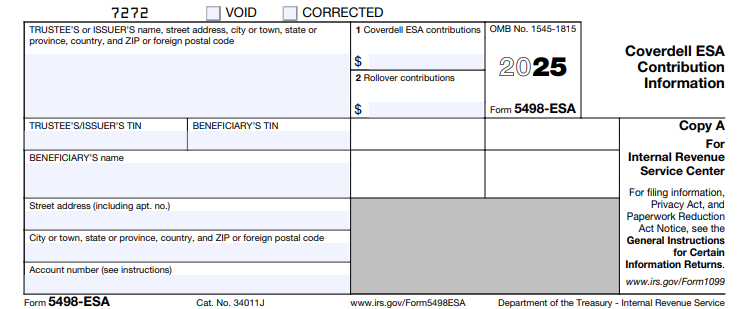
IRS Form 1099-Q – Payments from Qualified Education Programs (Under Sections 529 and 530) – Saving for education through tax-advantaged accounts like 529 plans or Coverdell Education Savings Accounts (ESAs) can provide significant benefits, but withdrawals require careful tracking to avoid unexpected taxes or penalties. IRS Form 1099-Q—Payments from Qualified Education Programs (Under Sections 529 and 530)—is the key document that reports these distributions, helping the IRS and recipients determine if earnings are taxable. For tax year 2025, with expanded qualified expenses under the One Big Beautiful Bill Act (e.g., up to $20,000 for K-12 tuition starting in 2026, but $10,000 in 2025), Form 1099-Q ensures compliance amid rising 529 assets exceeding $500 billion. This SEO-optimized guide, based on the latest IRS instructions (Rev. April 2025), covers filing requirements, tax implications, and common pitfalls to maximize your education savings.

IRS Form 1099-Q - Payments from Qualified Education Programs (Under Sections 529 and 530)
IRS Form 1099-Q – Payments from Qualified Education Programs (Under Sections 529 and 530)


What Is IRS Form 1099-Q?

IRS Form 1099-Q reports distributions from qualified tuition programs (QTPs), including 529 plans and Coverdell ESAs, under IRC Sections 529 and 530. Issued by program trustees or payers (e.g., state agencies or financial institutions), it breaks down gross distributions, earnings, and basis to calculate any taxable portion. Earnings grow tax-free, but non-qualified withdrawals trigger ordinary income tax on earnings plus a 10% penalty.

Key features:

  • Recipient Focus: Sent to the designated beneficiary (student) or account owner (e.g., parent) if the owner receives the funds.
  • Tax Calculation Aid: Box 2 (earnings) minus qualified expenses determines taxable amount; no reporting needed for fully qualified distributions.
  • Roth Rollover Support: Reports transfers to Roth IRAs (up to $35,000 lifetime limit, $7,000 annual for under-50s in 2025).

The April 2025 revision (Cat. No. 32223J) includes online fillable formats due to low paper volume and aligns with e-filing thresholds. Download the form and instructions from IRS.gov/Form1099Q.

Who Needs to File IRS Form 1099-Q in 2025?

Payers must file if they made any distribution from a 529 plan or Coverdell ESA in 2025, regardless of amount or taxability. Recipients use it to report on Form 1040.

Role Filing/Reporting Requirement
Payers/Trustees File for every distribution; e-file if 10+ info returns (aggregated).
Designated Beneficiary Report taxable portions on Form 1040, Schedule 1, line 8r; penalty on Schedule 2, line 8.
Account Owner Report if receiving non-direct distribution; rollover to Roth treated as distribution.
No Distribution No Form 1099-Q issued; internal transfers/rollovers exempt.

Even qualified distributions generate the form—recipients calculate taxability using Pub. 970. Nonresident aliens may require ITINs.

Filing Deadlines and Submission for Form 1099-Q

Timely filing avoids penalties up to $310 per form. Deadlines for 2025 distributions (reported in 2026):

Deadline Date Details
Furnish to Recipient (Copy B) January 31, 2026 Mail or electronic; include Pub. 970 summary.
File with IRS (Copy A) February 28, 2026 (paper) or March 31, 2026 (e-file) Use Form 1096 transmittal; e-file via IRIS system.
Extensions Automatic 30 days via Form 8809 (by original due date) For IRS only; furnish to recipients on time.
  • E-Filing: Required for 10+ returns; optional otherwise via IRS-approved software.
  • Where to File: Paper to IRS at addresses in Pub. 1220; e-file through FIRE/IRIS.
  • Corrections: File amended forms promptly; no penalty for inconsequential errors.

For 2025, low paper volume means online fillable forms are encouraged.

Step-by-Step Guide to Completing IRS Form 1099-Q

Payers use the April 2025 fillable PDF; recipients reference it for taxes. Gather distribution records, TINs, and expense details.

  1. Payer Info: Enter name, EIN, address; optional account number for multiples.
  2. Recipient (Boxes 1–3): Name, address, TIN of beneficiary (if direct) or owner (if indirect).
  3. Gross Distribution (Box 1): Total paid, including earnings and basis.
  4. Earnings (Box 2): Taxable portion; $0 if fully qualified.
  5. Basis (Box 3): Nontaxable contributions returned.
  6. Trustee-to-Trustee Rollover (Box 4): Check if full rollover; code if partial.
  7. Type of Program (Box 5): 1 for private QTP, 2 for state QTP/ESA.
  8. Sign & Distribute: Payer signs Copy A; furnish Copy B by January 31.

For recipients: Compare Box 1 to qualified expenses (tuition, books, up to $10,000 K-12 in 2025); report excess earnings on Form 1040.

Understanding Boxes on IRS Form 1099-Q

The form’s six boxes provide snapshot data for tax prep—use Pub. 970 for calculations.

Box Description 2025 Tax Tip
1 Gross distribution Total payout; subtract qualified expenses for tax-free portion.
2 Earnings Taxable if > qualified expenses; 10% penalty applies.
3 Basis Nontaxable return of contributions.
4 Rollover Indicates tax-free transfer (e.g., to another 529 or Roth).
5 Program type 2 for most 529s/ESAs; affects state tax rules.
6 Beneficiary TIN Student’s ID; mismatches trigger backup withholding.

FMV basis used; document expenses to avoid audits.

Tax Rules for 529 and Coverdell Distributions in 2025

Distributions are tax-free if used for qualified expenses; otherwise, earnings are income + 10% penalty (exceptions: scholarships, death/disability).

  • Qualified Expenses: Tuition, fees, books, supplies, room/board (half-time+), computers; up to $10,000 K-12 tuition; apprenticeships; student loans ($10,000 lifetime).
  • 2025 Updates: K-12 cap remains $10,000 (rises to $20,000 in 2026); new credentialing programs (WIOA-approved) from July 5, 2025; Roth rollovers up to $35,000 lifetime.
  • Rollover Rules: Tax-free to another 529/ESA or ABLE; Roth transfers count as distributions but penalty-free.
  • Gift Tax: Contributions up to $19,000/person ($38,000 couple) gift-tax free; superfund up to $95,000 over 5 years.

No double-dipping with credits like American Opportunity (coordinate via Form 8863). State taxes vary—check Pub. 970.

Common Mistakes with Form 1099-Q and How to Avoid Them

Errors can lead to IRS notices or overpayments—top issues for 2025:

  • Misreporting Recipient: Using owner vs. beneficiary—check distribution type.
  • Ignoring Box 2 Earnings: Assuming all tax-free—track expenses meticulously.
  • Late Furnishing: Missing January 31—use e-delivery for proof.
  • No Expense Matching: Forgetting receipts—use apps like Keeping.com.
  • Rollover Oversights: Treating as taxable—check Box 4.

Consult Pub. 970; e-file reduces errors.

Penalties for Form 1099-Q Non-Compliance in 2025

Payers face steep fines; recipients risk underpayment penalties.

Violation Penalty (2025)
Late Filing/Furnishing $60/form (timely), $120 (30+ days late), $310 (intentional); max $1,291,000/year.
Incorrect Info Same as above; $630 intentional disregard.
Non-Qualified Withdrawal (Recipient) 10% on earnings + income tax; exceptions apply.
Backup Withholding Failure 24% on payments if TIN mismatch.

Waivers for reasonable cause; first-time abatement available. E-filing mitigates risks.

IRS Form 1099-Q Download and Printable

Download and Print: IRS Form 1099-Q

Frequently Asked Questions About IRS Form 1099-Q

Do I owe taxes on all 1099-Q distributions?

No—only earnings exceeding qualified expenses; basis (Box 3) is always tax-free.

When is Form 1099-Q issued for 2025?

By January 31, 2026; access online via plan portals.

Can 529 funds roll over to a Roth IRA penalty-free?

Yes, up to $35,000 lifetime, subject to annual limits ($7,000 under 50).

What’s new for K-12 in 2025?

$10,000 cap; expands to credentialing post-July 5.

How do I report a non-qualified withdrawal?

On Form 1040, Schedule 1; penalty on Schedule 2.

For more, visit IRS.gov/Form1099Q or Pub. 970.

Final Thoughts: Navigate 1099-Q with Confidence for 2025 Education Savings

IRS Form 1099-Q demystifies 529 and Coverdell distributions, ensuring tax-free growth translates to real benefits amid 2025’s expansions like higher K-12 limits and Roth rollovers. With over $500 billion in assets, proper reporting safeguards your savings—download the April 2025 form from IRS.gov today and track expenses diligently. Consult a tax pro for personalized advice to avoid penalties and maximize deductions.

This article is informational only—not tax advice. Verify with IRS or a professional.


IRS Form 3922 – Transfer of Stock Acquired Through An Employee Stock Purchase Plan Under Section 423(c)

IRS Form 3922 - Transfer of Stock Acquired Through An Employee Stock Purchase Plan Under Section 423(c)

IRS Form 3922 – Transfer of Stock Acquired Through An Employee Stock Purchase Plan Under Section 423(c) – Employee stock purchase plans (ESPPs) offer a powerful way for workers to invest in their company’s future, often at a discount that can yield significant returns. But when it comes to taxes, accuracy is key—especially with IRS Form 3922, the Transfer of Stock Acquired Through an Employee Stock Purchase Plan Under Section 423(c). This form reports the transfer of discounted stock shares to employees, helping the IRS track potential bargain element income and ensuring employees have the data for correct cost basis reporting on their taxes. For 2025, with the form revised in April and e-filing mandatory for 10+ forms, staying compliant avoids penalties up to $310 per form. This SEO-optimized guide, based on the latest IRS instructions (Rev. April 2025), covers filing requirements, deadlines, and step-by-step completion to simplify your 2025 reporting.

IRS Form 3922 - Transfer of Stock Acquired Through An Employee Stock Purchase Plan Under Section 423(c)
IRS Form 3922 – Transfer of Stock Acquired Through An Employee Stock Purchase Plan Under Section 423(c)


What Is IRS Form 3922?

IRS Form 3922 is an information return that corporations must file to report the first transfer of legal title to shares acquired by employees through a qualified ESPP under IRC Section 423(c). It captures details like the grant date, exercise price, fair market value (FMV) at exercise, and number of shares, which inform the employee’s cost basis for future sales and any disqualifying disposition income. Unlike Form 3921 (for ISOs), Form 3922 focuses on ESPPs where the exercise price is less than 100% of the stock’s FMV on the grant date or isn’t fixed/determinable then.

Key elements:

  • Bargain Element Reporting: Helps calculate ordinary income on sales (up to 15% discount, max $25,000/year purchased).
  • Cost Basis Adjustment: Employees use Box 5 (FMV at exercise) minus Box 4 (price paid) for basis.
  • No Tax Withholding: ESPPs don’t trigger immediate withholding, but Form 3922 aids AMT or capital gains calculations.

The April 2025 revision (Cat. No. 41180P) includes fillable PDFs for Copies A/B and aligns with e-filing rules in Pub. 1220. Download the form and instructions from IRS.gov/Form3922.

Who Must File IRS Form 3922 in 2025?

Every corporation (or its agent, like a transfer agent) that records a transfer of ESPP stock in 2025 must file Form 3922 for each qualifying transfer. This applies to the first transfer of legal title, often when shares hit the employee’s brokerage account.

Filing Requirement Details for 2025
Trigger Event Transfer of shares under Section 423(c) ESPP where price <100% FMV at grant or not fixed.
Per Transfer One form per employee per transfer; aggregate if multiple accounts.
E-Filing Threshold Mandatory if 10+ Forms 3922 (or combined with other info returns like 3921).
Exceptions No filing for nonresident aliens without W-2 requirement; subsequent transfers after first.

Use EIN for the corporation; obtain employee TINs via Form W-9. Brokers may file if acting as agent.

Filing Deadlines and Extensions for Form 3922 in 2025

Deadlines are calendar-year based for 2025 transfers, reported in early 2026. Miss them, and penalties apply.

Deadline Type Date for 2025 Transfers Notes
Furnish to Employee (Copy B) January 31, 2026 Mail/email; fillable PDF eases delivery.
File with IRS (Copy A) February 28, 2026 (paper) or March 31, 2026 (e-file) Include Form 1096 transmittal.
Extensions Automatic 30 days via Form 8809 (file by original due date) For IRS filing only; employee furnish extension requires IRS letter approval.
  • Where to File: Paper to IRS at the address in Pub. 1220; e-file via FIRE system (requires Transmitter Control Code).
  • Disaster Relief: Automatic extensions in declared areas (e.g., hurricanes)—check IRS.gov for 2025 updates.

E-file for faster acknowledgment (3–7 days) and to meet the 10-form threshold.

Step-by-Step Guide to Completing IRS Form 3922

Gather employee details, grant/exercise records, FMV quotes, and brokerage confirmations. Use the April 2025 fillable PDF for accuracy.

  1. Copy A (IRS): Enter corporation name, EIN, address; check “3922” box.
  2. Employee Info (Boxes 1–3): Transferor’s name, address, TIN (SSN/ITIN); optional account number for multiples.
  3. Dates (Boxes 4–6): Option grant date (Box 4), exercise date (Box 5), transfer date (Box 6).
  4. Values (Boxes 7–9): FMV per share at grant (Box 7), exercise price per share (Box 8), FMV per share at exercise (Box 9)—use closing price or appraisal.
  5. Shares (Boxes 10–11): Number transferred (Box 10); if readily tradable, check Box 11.
  6. ESPP Details (Boxes 12–14): Aggregate shares purchased under plan (Box 12), FMV at grant for those (Box 13), aggregate exercise price (Box 14).
  7. Sign & Copies: Officer signs Copy A; prepare Copy B for employee (include instructions).

For e-file, use IRS-approved software like Tax1099; paper requires scannable red-ink forms. Round to whole dollars; truncate TINs on employee copies.

Key Boxes on IRS Form 3922 Explained

Form 3922’s boxes provide critical data for tax reporting—employees use them for Schedule D/Form 8949.

Box Description Tax Impact
1–3 Employee name/address/TIN Identifies recipient for IRS matching.
5 & 9 Exercise date & FMV at exercise Basis for ordinary income on disqualifying dispositions (FMV – price paid).
8 Exercise price per share Shows discount (up to 15%); ordinary income if sold too soon.
10 Shares transferred Total for the transaction; aggregate in Box 12 for plan totals.
11 Readily tradable stock Yes for public companies; affects basis rules.

FMV is the average between high/low trading prices; document sources for audits.

IRS Form 3922 Download and Printable

Download and Print: IRS Form 3922

E-Filing vs. Paper Filing for Form 3922 in 2025

E-filing is required for 10+ forms and recommended for all to avoid errors and get instant IRS acknowledgment.

  • E-Filing Pros: Faster (3–7 days), lower error rates, automatic extensions easier; use FIRE or vendors like TaxZerone.
  • Paper Pros: Simpler for <10 forms; mail with Form 1096.
  • Threshold Note: Counts separately from Form 3921 but aggregates with other info returns for the 10-form e-file rule.

Switch to e-file for 2025 to comply with updated Pub. 1220.

Common Mistakes When Filing Form 3922 and How to Avoid Them

Errors can trigger audits or penalties—top pitfalls for 2025:

  • Incorrect FMV/Price: Using wrong date or non-closing prices—verify with stock exchange data.
  • Missing TINs: Incomplete employee SSNs—collect via W-9 upfront.
  • Late Employee Copies: Forgetting January 31 furnish—use e-delivery for proof.
  • No Account Numbers: For multiples—assign unique IDs early.
  • Aggregation Errors: Wrong Box 12 totals—reconcile with plan records.

Use software validations; review with HR/stock admins before filing.

Penalties for Late or Incorrect Form 3922 Filings

The IRS enforces via Notice 972CG:

  • Failure to File/Furnish: $310 per form (up to $3,783,000/year; $1,261,000 small business).
  • Intentional Disregard: $630 per form, no cap.
  • Corrections: File amended with explanation; inconsequential errors (e.g., typos) may waive.
  • Relief: Reasonable cause (e.g., vendor error) via response to notice; first-time abatement possible.

Double penalties if both IRS and employee copies fail.

Frequently Asked Questions About IRS Form 3922

Do I need Form 3922 for every ESPP purchase?

Only for the first transfer of legal title under qualifying plans; exceptions for nonresident aliens.

How does Form 3922 affect my taxes?

It provides basis data—no direct tax, but errors lead to underreported income on sales.

Can I e-file Form 3922 for free?

No—use paid vendors; IRS FIRE is free but technical.

What’s the penalty for missing the January 31 deadline?

Up to $310 per statement; request relief for cause.

Is Form 3922 required for private companies?

Yes, if ESPP qualifies under Section 423(c).

Visit IRS.gov/Form3922 for more.

Final Thoughts: Ensure Compliant ESPP Reporting with Form 3922 in 2025

IRS Form 3922 is more than paperwork—it’s essential for transparent ESPP administration, protecting both your company from penalties and employees from tax surprises. With 2025’s April revision emphasizing e-filing and fillable copies, now’s the time to audit your processes and choose a reliable vendor. Download the form from IRS.gov today and consult a tax advisor to align with your equity strategy.

Equity compensation builds wealth—accurate reporting keeps it that way.

This article is informational only—not tax advice. Verify with IRS or a professional.


IRS Form 6112 – Order for Prior Year Tax Products

IRS Form 6112 - Order for Prior Year Tax Products

IRS Form 6112 – Order for Prior Year Tax Products – Tax time can bring surprises, especially when you need forms or instructions from previous years for amendments, audits, or historical records. Whether you’re correcting a 2022 return or supporting a 2023 audit, IRS Form 6112—Order for Prior Year Tax Products—streamlines the process of requesting these essential documents by mail. In 2025, with the IRS prioritizing digital access via IRS.gov, Form 6112 remains a vital tool for those without reliable internet or preferring paper copies, ensuring compliance without delays. This SEO-optimized guide, based on the latest IRS resources (Rev. July 2025), covers everything from eligibility to processing times, helping you secure prior year forms like 1040 or Schedules A efficiently.

IRS Form 6112 - Order for Prior Year Tax Products
IRS Form 6112 – Order for Prior Year Tax Products


What Is IRS Form 6112?

IRS Form 6112 is a simple order form used to request free paper copies of tax forms, instructions, and publications from prior years (generally back to 2018) that are no longer available for direct download in certain formats. It’s designed for taxpayers, tax professionals, or businesses needing physical versions for filing, record-keeping, or reference. Unlike the online ordering system at IRS.gov/Ordering, Form 6112 allows bulk or specific requests mailed directly to you.

Key features:

  • Free Shipping: No cost for up to 100 copies per product; excess may incur fees.
  • Product Coverage: Includes forms like 1040, W-2 instructions, and Pub. 17 (Your Federal Income Tax).
  • Limitations: Not for current year (2025) products or bulk employer forms (use Form 8508 for extensions).

The July 2025 revision (Catalog No. 37731M) updates mailing addresses and aligns with IRS’s push for e-delivery, per Publication 2053A. Download the PDF from IRS.gov/pub/irs-pdf/f6112.pdf for the most current version.

Who Needs IRS Form 6112 in 2025?

Anyone unable to access prior year products digitally—such as low-income filers, seniors, or those in remote areas—can use Form 6112. It’s ideal for amending returns (e.g., via Form 1040-X) or responding to IRS notices requiring specific year instructions.

User Type Common Scenarios
Individual Taxpayers Amending 2023 taxes; needing Pub. 501 for 2021 dependency tests.
Tax Professionals Bulk orders for client audits; historical Schedule C instructions.
Businesses Prior year employer forms like 941 for 2022 payroll disputes.
Libraries/Nonprofits Educational copies of Pub. 17 from 2019.

No SSN/EIN required, but provide contact info for delivery. For 2025, requests for 2024 products (filed in 2025) are treated as “prior year” after April 15. Avoid if digital suffices—IRS.gov/prior-year-forms-and-instructions offers free PDFs back to 1864.

Filing Deadlines and Processing for Form 6112

There’s no strict deadline—submit anytime—but allow 7–15 business days for processing and U.S. mail delivery. For urgent needs (e.g., audit deadlines), order early or use online alternatives.

  • Peak Season Delays: January–April requests may take 10–20 days due to volume; off-peak (May–December) averages 7 days.
  • No Extensions Needed: Continuous availability, but stock for very old years (pre-2010) is limited.
  • Where to Mail: Department of the Treasury, Internal Revenue Service, Austin, TX 73301-0015 (updated July 2025 for efficiency).
  • Tracking: No official tracking; certified mail recommended for high-value requests.

For 2025, IRS encourages online orders at IRS.gov/forms-pubs/forms-and-publications-by-us-mail, which processes in 7–10 days without a form.

Step-by-Step Guide to Completing IRS Form 6112

Form 6112 is a two-page checklist—easy to fill by hand or PDF. Gather product numbers from IRS.gov/catalog (e.g., Form 1040 is 1040, Pub. 17 is 50117).

  1. Section A: Requester Info – Name, address, phone, email; optional organization if applicable.
  2. Section B: Product Requests – List up to 10 items: Enter product number (e.g., “1040”), tax year (e.g., “2023”), quantity (1–100 free).
  3. Section C: Shipping Instructions – Confirm address; note if APO/FPO for military.
  4. Section D: Certification – Sign and date, affirming legitimate use (no resale).
  5. Optional Notes: Add comments for special requests (e.g., large print via Pub. 2053A).
  6. Mail It: Use USPS First-Class; photocopy for records.

For bulk (over 100), expect a call for payment. Use the accessible PDF for screen readers.

Available Prior Year Tax Products on Form 6112

Request a wide range, but availability varies—check IRS.gov first for digital.

Category Examples (Tax Year) Product Number
Individual Forms Form 1040 (2023), Schedule A (2022) 1040, Sch A
Instructions Instructions for Form 1040 (2021), Pub. 17 (2020) 1040-I, 50117
Business Forms Form 1120 (2019), Pub. 334 (Tax Guide for Small Business, 2018) 1120, 50334
Specialty Form W-4 (2023), Pub. 501 (Dependents, 2022) W4, 50501

Large print versions available for select items; Braille on request via (800) 829-4059. 2025 updates include more 2024 products post-filing season.

IRS Form 6112 Download and Printable

Download and Print: IRS Form 6112

Online Alternatives to IRS Form 6112 in 2025

While Form 6112 is mail-based, IRS promotes digital options for faster access:

  • IRS.gov Ordering: Search and order up to 100 free copies per product at IRS.gov/forms-pubs/forms-and-publications-by-us-mail—ships in 7–10 days.
  • Prior Year Archive: Free PDFs at IRS.gov/prior-year-forms-and-instructions; no shipping.
  • Employer Returns: Order paper info returns (e.g., W-2) via IRS.gov/businesses/order-paper-information-returns-and-employer-returns—15-day delivery.
  • Draft Forms: Preview 2025/2026 at IRS.gov/draft-tax-forms, but don’t file drafts.

For 2025, e-delivery via email is piloted for select users, reducing paper waste per IRS green initiatives.

Common Mistakes When Using Form 6112 and How to Avoid Them

Simple form, but errors delay shipments:

  • Wrong Product Numbers: Using “1040” for instructions—verify at IRS.gov/catalog.
  • Over-Ordering: Requesting >100 copies without prepayment—start small.
  • Outdated Addresses: Using pre-2025 mailing—always check the form’s header.
  • No Signature: Unsigned forms rejected—double-check Section D.
  • Current Year Requests: Form 6112 is prior only—use online for 2025.

Pro tip: Order in batches; track via USPS Informed Delivery.

Processing Times and What to Expect After Submitting Form 6112

  • Acknowledgment: None automatic; expect shipment notice if issues.
  • Delivery: 7–15 days post-processing; international adds 4–6 weeks.
  • If Lost: Reorder after 21 days; reference original date.
  • Post-Release Changes: Some products updated mid-year (e.g., 2025 Form 8830 per Notice 2025-32)—request revised versions.

For 2025, IRS aims for 95% on-time delivery amid supply chain improvements.

Frequently Asked Questions About IRS Form 6112

Can I use Form 6112 for current 2025 tax products?

No—use IRS.gov for 2025 forms; 6112 is prior years only.

How far back can I request products?

Typically to 2018; older via IRS.gov/prior-year archive or (800) 829-3676.

Is there a fee for Form 6112 orders?

Free up to 100 copies; contact IRS for bulk pricing.

What if I need large print or Braille?

Specify on form; or call Accessibility Helpline at (800) 699-7813.

Can tax pros order for clients?

Yes—list firm address; no client SSNs needed.

Visit IRS.gov/forms-instructions for more.

Final Thoughts: Simplify Prior Year Access with IRS Form 6112 in 2025

IRS Form 6112 bridges the gap for paper-based tax needs, ensuring you have the right prior year products without hassle—even as IRS.gov expands digital options. With the July 2025 updates streamlining mailings, it’s easier than ever to support amendments or audits. Download the form from IRS.gov today, verify your product numbers, and mail it confidently to stay compliant.

Tax history shouldn’t be a hurdle—order smart and file right.

This article is for informational purposes only and not tax advice. Consult IRS.gov or a professional for your situation.


IRS Form 4422 – Application for Certificate Discharging Property Subject To Estate Tax Lien

IRS Form 4422 - Application for Certificate Discharging Property Subject To Estate Tax Lien

IRS Form 4422 – Application for Certificate Discharging Property Subject To Estate Tax Lien – Estate administration can hit roadblocks when selling or transferring property, thanks to the automatic federal estate tax lien that attaches at death under IRC Section 6324. For executors, beneficiaries, or buyers dealing with estates required to file Form 706, IRS Form 4422—Application for Certificate Discharging Property Subject to Estate Tax Lien—offers a solution. This form requests IRS clearance to release specific assets from the lien, enabling smooth transactions without compromising the government’s interest in unpaid taxes. In 2025, with the federal estate tax exemption at $13.99 million, fewer estates face filing requirements, but those that do (about 0.1% of decedents) must navigate liens carefully to avoid delays. This SEO-optimized guide, updated with the May 2025 revision (Catalog No. 41642G), provides step-by-step filing advice, deadlines, and tips based on official IRS resources to keep your estate settlement on track.

IRS Form 4422 - Application for Certificate Discharging Property Subject To Estate Tax Lien
IRS Form 4422 – Application for Certificate Discharging Property Subject To Estate Tax Lien


What Is IRS Form 4422?

IRS Form 4422 is a one-page application allowing executors, administrators, beneficiaries, or purchasers to request a certificate discharging specific property from the statutory estate tax lien. The lien automatically arises upon death on all gross estate assets, lasting 10 years or until taxes are paid, to secure potential liabilities. Approval doesn’t forgive taxes—it simply clears title for the targeted property, often by escrowing proceeds or confirming adequate security elsewhere.

Key purposes:

  • Clear Title for Sales: Essential for real estate closings, refinancings, or transfers where title companies demand lien release.
  • Protect Buyer Interests: Ensures the purchaser takes property free of IRS claims.
  • Estate Liquidity: Allows monetizing assets to pay debts or taxes without full lien satisfaction.

The May 2025 revision (Rev. 5-2025) clarifies submission via fax and aligns with post-2016 procedural changes emphasizing escrow for taxable estates. Download the form and related guidance from IRS.gov/Form4422.

Who Needs to File IRS Form 4422 in 2025?

File if the estate requires Form 706 (gross estate + gifts > $13.99 million) or Form 706-NA (nonresidents with U.S. assets >$60,000), and you’re selling or transferring lien-attached property. No filing for small estates below thresholds—liens don’t apply.

Scenario Filing Required? Notes
Form 706 Estate Selling Real Estate Yes Executor applies; escrow proceeds if tax estimated > net sale.
Nonresident with U.S. Property Yes (Form 706-NA) Use transfer certificate if no U.S. executor.
Refinancing Estate Assets Yes Lender requires clean title.
No 706 Filing (Under Exemption) No, but optional Request Letter 1352 via Form 4422 for confirmation.
Income Tax Liens (Not Estate) No Use Form 14135 instead.

Appoint a U.S.-based executor; otherwise, seek a transfer certificate. Contact the Estate Tax Advisory Group at (669) 229-1504 for questions.

Filing Deadlines and Submission for Form 4422

No fixed statutory deadline, but submit at least 45 days before the needed certificate date (e.g., closing) for IRS review—processing takes 30–45 days. Delays risk transaction fallout.

  • No Extensions: File timely; late submissions may require escrow or payment to expedite.
  • Where to Submit:
    • Mail: Internal Revenue Service, Advisory Estate Tax Lien Group, 55 South Market St., Mail Stop 5350, San Jose, CA 95113-2324, Attn: Group Manager.
    • Fax: 877-477-9243 (preferred for speed).
  • Related Forms: Attach Form 4768 if extending 706 filing/payment; Form 15056 for escrow agreements.

For 2025 decedents, align with the 9-month 706 deadline—pre-file if sales are imminent.

Step-by-Step Guide to Completing IRS Form 4422

The form is simple but requires robust attachments. Use the May 2025 PDF; no e-filing—paper/fax only.

  1. Line 1: Decedent Info – Name, address, SSN, death date.
  2. Line 2: Applicant Details – Name, address, relationship (e.g., executor), phone; attorney info if applicable.
  3. Line 3: Property Description – Detailed info (e.g., “123 Main St., legal description”); value, valuation basis (attach appraisal, title report).
  4. Line 4: Transaction Details – Sale/refinance purpose; attach contract, proposed closing statement.
  5. Line 5: Gross Estate Estimate – Total value, deductions; attach draft Form 706 or asset inventory.
  6. Line 6: Tax Estimate – Projected liability; note payments/escrows.
  7. Line 7: Remaining Assets – List other lien-subject property/values to secure IRS interest.
  8. Signature: Applicant signs under perjury; date and title.

Attachments Checklist:

  • Letters testamentary/will.
  • Property appraisal/legal description.
  • Sale contract/closing statement.
  • Draft Form 706 or asset list.
  • Escrow agreement (Form 15056) if required.

Review IRM 5.5.8 for IRS considerations.

How the IRS Processes Form 4422 Requests

Upon receipt, the Advisory Estate Tax Lien Group reviews for adequate security (e.g., remaining assets ≥ 2x liability per IRC §6325(b)).

  • Approval: Issues Certificate on Form 792 if lien discharged; proceeds to escrow if partial.
  • Escrow Requirement: For taxable estates, net proceeds held via Form 15056 until 706 closing letter.
  • No Tax Due: Letter 1352 confirms no lien for sub-exemption estates.
  • Denial: Rare; if liability unsecured, pay/escrow full amount.

Processing: 30–45 days; fax for faster turnaround.

Escrow Agreements and Securing the Lien on Form 4422

Post-2016, taxable estates often escrow proceeds under Form 15056—a tri-party agreement (IRS, estate, agent) holding funds until tax clearance. If estimated tax > net proceeds, escrow 100%; otherwise, discharge without if other assets suffice.

Scenario Escrow Needed?
Tax > Proceeds Yes, full net amount.
Proceeds Cover Tax Optional; pay IRS directly.
No Tax Due No; Letter 1352 suffices.

Agents must be banks/attorneys; funds released post-closing letter.

IRS Form 4422 Download and Printable

Download and Print: IRS Form 4422

Common Mistakes When Filing Form 4422 and How to Avoid Them

Title freezes often stem from incomplete packets—avoid these:

  • Insufficient Lead Time: Submit <45 days—plan 60+ for safety.
  • Incomplete Attachments: Missing appraisals/contracts—use checklists from Pub. 783.
  • Inaccurate Valuations: Over/understating estate—attach professional appraisals.
  • Wrong Lien Type: Using for income liens—reserve for estate only.
  • No Escrow Plan: For taxable sales—draft Form 15056 upfront.

Engage estate attorneys early; fax submissions cut wait times.

Penalties and Risks of Delaying Form 4422 Approval

No direct penalties for Form 4422, but unresolved liens risk:

  • Transaction Delays: Closings halted, buyers walk.
  • Interest Accrual: On unpaid estate taxes (0.5%/month post-due).
  • Lien Enforcement: IRS seizure after 10 years if unpaid.
  • Personal Liability: Executors liable for negligence under §6324.

Mitigate with timely 706 filing and escrow—reasonable cause waives some interest.

Frequently Asked Questions About IRS Form 4422

Do I need Form 4422 if the estate is under $13.99 million?

No lien exists—request Letter 1352 via the form for confirmation.

How long does IRS approval take in 2025?

30–45 days; fax to expedite.

What’s the difference between Form 4422 and Form 14135?

4422 for estate liens; 14135 for general federal tax liens.

Can buyers file Form 4422?

Yes, purchasers may apply jointly with executors.

Is e-filing available?

No—mail or fax only.

For more, visit IRS.gov/Form4422.

Final Thoughts: Streamline Estate Closings with IRS Form 4422 in 2025

IRS Form 4422 empowers executors to unlock estate assets without full tax resolution, safeguarding transactions amid the $13.99 million exemption. With the May 2025 updates emphasizing fax submissions and escrow clarity, proactive filing prevents costly stalls. Download the form from IRS.gov today, assemble your packet 60 days early, and consult an estate tax specialist to navigate liens seamlessly.

Estate planning is about legacy—don’t let liens derail it.

This article is informational only—not tax advice. Verify with IRS or a professional.


IRS Form 13981 – VITA Grant Agreement

IRS Form 13981 - VITA Grant Agreement

IRS Form 13981 – VITA Grant Agreement – Securing funding to provide free tax preparation services can transform communities, especially for low-income families navigating complex returns. The IRS Volunteer Income Tax Assistance (VITA) Grant Program empowers nonprofits, faith-based organizations, and community centers to deliver these services, and IRS Form 13981—the VITA Grant Agreement—is the binding document that formalizes your award. For the 2025 grant cycle, with $53 million awarded to 315 VITA recipients from 445 applications, this agreement ensures compliance while supporting over 2.7 million tax returns annually. This SEO-optimized guide, based on the latest IRS resources (Rev. June 2025), demystifies Form 13981, from terms to execution, helping grant recipients maximize impact under the $68,675 income threshold for VITA eligibility.

IRS Form 13981 - VITA Grant Agreement
IRS Form 13981 – VITA Grant Agreement


What Is IRS Form 13981?

IRS Form 13981 is the official grant agreement for recipients of the VITA Matching Grant Program, outlining the terms, conditions, and performance expectations for using federal funds to provide free tax preparation and electronic filing to underserved populations. It incorporates by reference the detailed provisions in Publication 5247, Volunteer Income Tax Assistance (VITA) Terms and Conditions (Rev. August 2025), ensuring alignment with federal regulations under 2 CFR 200.

The form binds the recipient to non-discriminatory practices, accurate return preparation, and reporting requirements, while specifying the grant period (typically January 1–December 31, 2025) and award amount. Signing signifies acceptance of all conditions, including matching funds (100% cash or in-kind) and adherence to the IRS Volunteer Standards of Conduct.

Key sections:

  • Grant Details: Award amount, period of performance, and recipient obligations.
  • Compliance Certifications: Affirmations on drug-free workplaces, trafficking prohibitions, and Buy American provisions.
  • Termination Clauses: IRS rights to end the agreement for non-compliance, with seven days’ notice.

Download the June 2025 revision (Catalog No. 51540F) from IRS.gov for the current template.

Who Needs IRS Form 13981 in 2025?

Form 13981 is mandatory for all VITA grant awardees—new, renewing, or multi-year—following successful applications submitted via Grants.gov from May 1–31, 2025. It’s issued after IRS review and requires signature by an authorized representative (e.g., executive director) and return within the specified timeframe.

Recipient Type Requirements
New Grantees Sign upon award notification; demonstrate need via Form 13978 (Projected Operations).
Renewing Recipients Check prior Form 13981 for cycle year; submit abbreviated application if in years 2–3.
Sub-Awardees Primary recipient oversees; sub-sites agree to terms via sponsor documentation.
Multi-Site Sponsors One agreement covers all sites; ensure uniform compliance.

Eligible organizations include nonprofits, universities, and faith-based groups certified by the IRS. Awards prioritize underserved areas, with a focus on electronic filing and accuracy rates above 90%.

IRS Form 13981 Download and Printable

Download and Print: IRS Form 13981

Signing and Submission Process for Form 13981

Once awarded (notifications typically by December 2025), review the pre-filled Form 13981 sent via email to your Authorized Official Representative (AOR) contact on Standard Form 14335.

  • Review Period: Examine Publication 5247 in full—non-review voids claims of unawareness.
  • Execution: Sign, date, and return with supporting docs (e.g., matching fund pledges) by the deadline (usually 20–30 days post-notification).
  • Submission: Email scanned PDF to [email protected]; retain originals for records.
  • Post-Signing: Access funds via SF-270 (Request for Advance); report progress via Form 13980 (Year-End Report) by July 31, 2026.

For revisions (e.g., budget changes), submit updated Form 13977 within 20 days. Failure to sign timely risks fund suspension.

Step-by-Step Guide to Reviewing and Executing IRS Form 13981

Form 13981 is concise but legally binding—treat it as a contract. Use Publication 4883, Grant Programs Resource Guide, for context.

  1. Verify Details (Section I): Confirm award amount, grant period (e.g., 1/1/2025–12/31/2025), EIN, and site info.
  2. Review Terms (Section II): Cross-reference Publication 5247 for specifics like 100% matching, non-discrimination, and FAPIIS reporting (for awards >$10M cumulative).
  3. Certify Compliance (Section III): Affirm adherence to drug-free policies (31 CFR Part 20), anti-trafficking (22 U.S.C. 7104), and Buy American (except IT/commercial items under $10K).
  4. Performance Commitments: Note minimum returns (e.g., based on prior year) and accuracy targets.
  5. Sign and Date: Authorized rep signs; IRS countersigns.
  6. Attach Exhibits: Include Form 13978 projections and volunteer agreements (Form 13615).

Exhibit 2 in Pub. 4883 provides a sample; consult IRS webinars for walkthroughs.

Key Terms and Conditions in Form 13981 for 2025

The agreement enforces federal standards via Publication 5247 (Rev. August 2025):

  • Matching Funds: Equal federal request (e.g., $50K grant needs $50K match via cash, donated space at FMV, or volunteer hours at minimum wage).
  • Allowable Costs: Salaries, training (Pub. 4491), software; no indirect overhead or luxuries.
  • Reporting: Quarterly progress (Form 14655), final expense (Form 13979) by July 31, 2026; 90%+ electronic filing.
  • Non-Discrimination: Adopt policies for race, gender, disability; sub-recipients must comply.
  • Termination: IRS may end with 7-day notice for cause (e.g., misuse); recipients get appeal rights under 2 CFR 200.340.
  • Buy American: Prefer U.S. products unless unavailable or excepted (e.g., trade agreements).

For 2025, emphasis on financial education (up to 10% funds) and VITA’s $68,675 AGI cap.

Recent Updates to IRS Form 13981 for 2025

The June 2025 revision (Catalog No. 51540F) reflects post-award feedback:

  • FAPIIS Integration: Mandatory for high-value recipients (> $10M cumulative federal awards).
  • Addendum Expansions: Item IV in Pub. 5247 details new reporting for sub-awards and anti-trafficking certifications.
  • Digital Signing: Encouraged via DocuSign for faster processing.
  • Threshold Adjustments: Aligns with VITA’s updated $68,675 income limit and $53M total awards.

These changes support IRS goals for 3M+ returns in 2026, per Pub. 6086.

Common Mistakes When Handling Form 13981 and How to Avoid Them

Delays in execution can halt funding—top errors:

  • Overlooking Pub. 5247: Signing without full review—dedicate a team meeting.
  • Insufficient Matching Docs: Vague pledges—attach bank statements or valuations.
  • Missed Deadlines: Late returns—calendar notifications from Grants.gov.
  • Non-Compliance Oversights: Ignoring Buy American—audit purchases quarterly.
  • Sub-Award Gaps: Forgetting to bind partners—include MOUs.

Engage a grants specialist; IRS’s VITA helpline (800-906-9887) offers free support.

Consequences of Non-Compliance with Form 13981

Breach risks severe actions under 2 CFR 200:

  • Fund Suspension/Reduction: For under-matching or low performance (e.g., <90% e-filing).
  • Termination and Clawback: Full repayment plus 25% penalty for misuse.
  • Debarment: Barred from future federal grants; FAPIIS reporting for fraud.
  • Audits: Single audits for >$750K awards; IRS spot-checks.

Reasonable cause (e.g., disasters) allows appeals—document proactively.

Frequently Asked Questions About IRS Form 13981

When do I receive Form 13981 for 2025?

Post-award, typically December 2025 via email to your AOR.

Can I revise terms after signing?

Yes—submit changes (e.g., budget) within 20 days via email.

What if my organization has sub-sites?

The primary agreement covers them; enforce via sub-agreements.

Is Form 13981 the same as Form 9661?

No—9661 is for TCE; 13981 is VITA-specific.

Where can I find a sample Form 13981?

In Exhibit 2 of Publication 4883 on IRS.gov.

Visit IRS.gov/vita-grant for more.

Final Thoughts: Seal Your 2025 VITA Success with Form 13981

IRS Form 13981 isn’t just paperwork—it’s the foundation for delivering equitable tax services, keeping refunds in communities that need them most. With 2025’s $53 million in awards and heightened focus on electronic filing, signing this agreement positions your organization for sustainable impact. Download the June 2025 version from IRS.gov today, review Pub. 5247 thoroughly, and connect with fellow recipients via the IRS partner network.

Empowering taxpayers starts with strong partnerships—make yours unbreakable.

This article is for informational purposes only and not legal or grant advice. Consult IRS.gov or a grants expert for your situation.


IRS Form 720 – Quarterly Federal Excise Tax Return

IRS Form 720 - Quarterly Federal Excise Tax Return

IRS Form 720 – Quarterly Federal Excise Tax Return – Federal excise taxes fund essential programs like highway infrastructure and environmental protection, but compliance can be tricky for businesses dealing in regulated goods and services. IRS Form 720—the Quarterly Federal Excise Tax Return—is the key document for reporting and paying these taxes on time. For calendar year 2025, with updates including inflation-adjusted rates for air travel ($22.90 segment tax) and the Patient-Centered Outcomes Research (PCOR) fee ($3.47 per covered life), accurate filing prevents penalties that can reach 25% of unpaid taxes. Whether you’re in fuel distribution, air transportation, or vaccine manufacturing, this SEO-optimized guide draws on the latest IRS instructions (Rev. June 2025) to cover eligibility, deadlines, steps, and pitfalls for seamless 2025 compliance.

IRS Form 720 - Quarterly Federal Excise Tax Return
IRS Form 720 – Quarterly Federal Excise Tax Return


What Is IRS Form 720?

IRS Form 720 is a quarterly return used to calculate, report, and pay federal excise taxes on specific goods, services, and activities under Chapters 31, 32, 33, and 34 of the Internal Revenue Code. It includes environmental taxes, fuel taxes, communications and air transportation taxes, and fees like the PCOR charge. Businesses file to remit collected taxes or claim credits/refunds via Schedule C.

Key components:

  • Part I: Environmental and related taxes (e.g., fuel, chemicals).
  • Part II: Other excise taxes (e.g., air travel, vaccines).
  • Schedule A: Tracks semimonthly deposits.
  • Schedule C: Fuel and alternative fuel credits.

The June 2025 revision incorporates T.D. 9948 for aircraft exemptions and Rev. Proc. 2023-20 for taxable substances. Download the form and instructions from IRS.gov/Form720.

Who Needs to File IRS Form 720 in 2025?

File Form 720 if your business incurs excise tax liability exceeding $1,000 in a quarter, or even if zero due for certain one-time filers (e.g., gas guzzler imports). Exemptions apply for small liabilities under $2,500 with timely deposits.

Tax Category Examples for 2025 Filers
Environmental Taxes Coal ($1.10–$1.45/ton), inland waterways ($0.29/gallon diesel), ODCs (up to $9.02/lb).
Fuel Taxes Gasoline ($0.184/gallon), diesel ($0.244/gallon); biodiesel credits expired post-2024.
Communications & Air Local phone (3.0%), air passenger ($4.80–$22.90/segment, inflation-adjusted).
Health-Related Vaccines ($0.41–$0.94/dose), PCOR fee ($3.47/life for Q2 filers).
Other Indoor tanning (10%), arrow shafts ($0.49 each, adjusted).

Foreign insurers use it for policies (1.0–2.0%). No filing if only zero-liability PCOR in non-Q2 quarters. Use EIN; apply via IRS if needed.

Filing Deadlines and Extensions for Form 720 in 2025

Form 720 is due the last day of the month following each calendar quarter. Semimonthly deposits (days 15 and last day) are required for most taxes—use Schedule A even if under $2,500.

Quarter Period Filing Deadline Deposit Windows
Q1 Jan–Mar April 30, 2025 Mar 16–31 (Apr 7), Apr 1–15 (Apr 30)
Q2 Apr–Jun July 31, 2025 May 16–31 (Jun 13), Jun 1–15 (Jul 14); Special Jun 16–30 (Jul 25)
Q3 Jul–Sep October 31, 2025 Aug 16–31 (Sep 12), Sep 1–15 (Sep 30); Special Sep rule if weekend
Q4 Oct–Dec January 31, 2026 Nov 16–30 (Dec 9), Dec 1–15 (Dec 31)
  • Extensions: No automatic; request via letter to IRS (up to 6 months) but pay/deposit on time to avoid interest (0.5%/month).
  • E-Filing: Optional but encouraged via IRS e-file providers; paper to: Internal Revenue Service, P.O. Box 94221, Kansas City, MO 64194-4221 (or PDS equivalent).
  • Special Rules: PCOR fee only in Q2; air travel alternative method for June collections due July 25.

Pay via EFTPS; new IRS Direct Pay option from October 2024.

Step-by-Step Guide to Completing IRS Form 720

Gather sales records, deposit logs, and Pub. 510 for rates. Use e-file software for accuracy.

  1. Header: Enter EIN, quarter/year (e.g., 2025-2 for Q2), address; check final/amended if applicable.
  2. Part I (Environmental Taxes): Report gallons/tons by IRS No. (e.g., No. 60 gasoline: gallons × $0.184); attach Form 6627 for ODCs.
  3. Part II (Other Taxes): Line-by-line (e.g., No. 26 air passenger: segments × rate); gas guzzler via Form 6197.
  4. Schedule A (Deposits): Detail semimonthly periods; net liability per box.
  5. Part III (Claims): Complete Schedule C for fuel credits (e.g., off-highway use); total on line 4.
  6. Line 3 (Total Tax): Sum Parts I/II minus prior overpayments (line 6).
  7. Line 10 (Balance Due): Pay if >$2.50; overpayments apply to next.
  8. Sign & File: Under perjury; attach statements for claims.

For PCOR (No. 133), report only in Q2 at $3.47 × average lives.

Key Excise Tax Rates and Calculations for 2025

Rates are mostly stable, with inflation tweaks. Use Pub. 510 for full details.

IRS No. Tax Type 2025 Rate
26 Air Passenger (Domestic) $4.80/segment
27 Air Passenger (International) $22.90/segment
108 Gasoline $0.184/gallon
109 Diesel $0.244/gallon
120 PCOR Fee (Q2 only) $3.47/covered life
97 Vaccines (e.g., MMR) $1.23/dose
140 Indoor Tanning 10% of payment

Prorate for partial quarters; reduced bus credits apply (type 5 use). Example: 1,000 gallons diesel = $244 tax.

IRS Form 720 Download and Printable

Download and Print: IRS Form 720

Claiming Credits and Refunds on Form 720

Use Schedule C for:

  • Fuel Credits: $0.183/gallon off-highway (No. 1); biodiesel expired post-2024.
  • Alternative Fuels: $0.50/gallon mixtures (if eligible).
  • Overpayments: Carry to next quarter or refund via Form 8849.

Attach explanations; one-time filers for gas guzzlers attach Form 6197.

Common Mistakes When Filing Form 720 and How to Avoid Them

Errors trigger audits—top issues for 2025:

  • Missed Deposits: Semimonthly lapses despite timely filing—use EFTPS reminders.
  • Wrong Quarter: Reporting stock repurchases or PCOR in non-Q2—standardize processes.
  • Incomplete Schedule A: Omitting even low liabilities—always include if Part I taxes.
  • Rate Misapplication: Using outdated inflation adjustments—check Pub. 510 quarterly.
  • Unsigned Returns: Forgetting perjury declaration—double-check before e-file.

E-file reduces math errors by 90%; review with a CPA.

Penalties for Late or Incorrect Form 720 Filings

The IRS enforces strictly:

  • Late Filing: 5%/month (max 25%) of unpaid tax.
  • Late Payment/Deposit: 0.5%/month + interest (0.54%/month).
  • Trust Fund Recovery: 100% personal liability for willful nonpayment.
  • Negligence/Fraud: 20–75% of underpayment.

Safe harbor: Pay underpayment by due date and check line 5. Reasonable cause waives via response to notice.

Frequently Asked Questions About IRS Form 720

Do I file Form 720 if my excise liability is under $1,000?

No, but deposit semimonthly and file if over in any quarter.

Can I e-file Form 720?

Yes—via IRS-approved providers; instant acceptance.

What’s new for PCOR fee in 2025?

$3.47 per life (up from $3.22); report only in Q2.

How do I handle semimonthly deposits?

Via EFTPS by 8 p.m. ET on due dates; special September rules for weekends.

Is there an extension for Form 720?

Request in writing; no automatic, but pay timely.

Visit IRS.gov/Form720 for more.

Final Thoughts: Master IRS Form 720 Compliance for 2025

IRS Form 720 ensures your business contributes fairly to public goods while claiming rightful credits—noncompliance risks thousands in penalties. With 2025’s adjusted rates and e-pay options, quarterly reviews keep you audit-proof. Download the June 2025 version from IRS.gov today and consult a tax advisor for tailored strategies.

This article is informational only—not tax advice. Verify with IRS or a professional.