Table of Contents
IRS Instruction 706-QDT – Instructions for Form 706-QDT, U.S. Estate Tax Return for Qualified Domestic Trusts – In an increasingly global world, international marriages add layers of complexity to U.S. estate planning. If your spouse isn’t a U.S. citizen, claiming the unlimited marital deduction under IRS Form 706 requires a Qualified Domestic Trust (QDOT) to defer estate taxes until distributions or death. But managing the tax on those events demands precision—enter IRS Instructions for Form 706-QDT, the U.S. Estate Tax Return for Qualified Domestic Trusts. Revised in August 2025, these instructions guide trustees and designated filers through reporting taxable distributions, remaining trust assets, and annuity payments, potentially saving heirs from immediate tax burdens.
This SEO-optimized guide demystifies the Form 706-QDT instructions, drawing from the latest IRS resources. Whether you’re a trustee handling a QDOT for a non-citizen surviving spouse or an estate planner, learn eligibility, filing steps, elections, and pitfalls to protect cross-border legacies. With estate tax exemptions at $13.99 million for 2025, proper QDOT compliance ensures seamless wealth transfer.
What is Form 706-QDT and Why Use a Qualified Domestic Trust?
A Qualified Domestic Trust (QDOT) allows non-citizen surviving spouses to qualify for the federal estate tax marital deduction, deferring taxes on assets passing to them until a “taxable event” occurs. Without a QDOT, the decedent’s estate faces immediate taxation on those assets, even if the spouse is the beneficiary.
Form 706-QDT computes and reports the deferred estate tax triggered by:
- Corpus (principal) distributions from the QDOT (excluding income or hardship payments).
- The fair market value (FMV) of QDOT property at the surviving spouse’s death.
- The corpus portion of certain annuity payments.
The August 2025 instructions emphasize electronic filing and payments for efficiency, including direct deposit for overpayments. QDOTs must meet strict rules: at least one U.S. citizen or domestic corporate trustee, withholding rights for taxes on distributions, and an election on the decedent’s Form 706.
Who Must File Form 706-QDT? Key Eligibility and Responsibilities
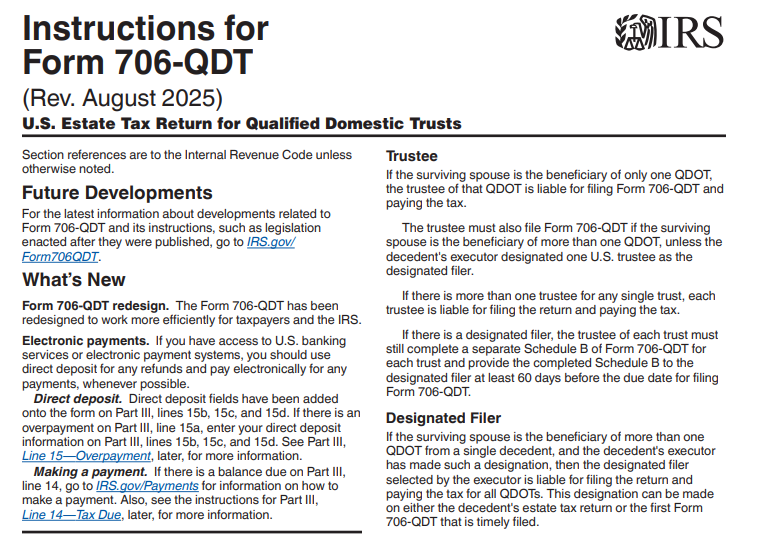
Filing Form 706-QDT is mandatory for any calendar year with a taxable event or hardship distribution. The trustee files if the surviving spouse benefits from a single QDOT. For multiple QDOTs from the same decedent, the executor designates a designated filer on the original estate tax return or first Form 706-QDT, who consolidates reporting and payments.
| Role | Responsibilities |
|---|---|
| Trustee | Files for single QDOTs; completes Schedule B for each QDOT (detailing distributions and assets); provides Schedule B to designated filer 60+ days before due date for multiples. Liable for taxes on their QDOT. |
| Designated Filer | Handles consolidated filing for all QDOTs from one decedent; attaches all Schedule Bs; pays taxes. |
| Surviving Spouse | Non-U.S. citizen beneficiary; hardship distributions allowed for health, education, or support needs (no tax if qualified). |
Taxable events include QDOT disqualification (e.g., failure to withhold taxes). Same-sex spouses qualify per Rev. Rul. 2013-17. No filing if the spouse becomes a U.S. citizen and elects exemption (noted on Line 4).
Filing Deadlines, Locations, and Penalties: Stay Compliant in 2025
When to File: Annual returns are due April 15 of the year following a taxable event or hardship distribution. For the surviving spouse’s death, file within 9 months (e.g., death on June 14, 2025, due March 14, 2026), including all 2025 events. If disqualification occurs, same 9-month rule applies. Request a 6-month extension via Form 4768 (filing only, not payment).
Where to File: Mail to Department of the Treasury, Internal Revenue Service Center, Kansas City, MO 64999. Use IRS-designated private delivery services (PDS) for timely proof.
Who Signs: The trustee or designated filer signs under perjury penalties; multiple trustees verify. Authorize representatives via Form 2848.
Penalties loom large:
- Late filing/payment: Up to 25% under section 6651 (waivable for reasonable cause).
- Underpayment: 20% for negligence or substantial undervaluation (reported value ≤65% of actual).
- Preparer penalties: $1,000+ for unreasonable positions.
Round all amounts to whole dollars per instructions.
Key Elections on Part II: Optimize Your QDOT Strategy
Part II allows irrevocable elections to potentially lower taxes:
| Election | Details | 2025 Thresholds/Notes |
|---|---|---|
| Alternate Valuation (Line 1) | Value distributed property at distribution date; undistributed at 6 months post-death. Decreases gross estate if values fall. | Applies to all QDOTs if elected; no mix-and-match. |
| Special Use Valuation (Line 2) | For farms/closely held businesses: Value at actual use (not FMV). Attach Schedule T from Form 706. | Max reduction: $1,420,000 for 2025 decedents. Meets 5-of-8-year use test. |
| Installment Payments (Line 3) | Defer up to 14 years under section 6166 for closely held business interest >35% of estate. | Protective election possible; recompute tax using business value substitute. |
| Spousal Election (Line 4) | If spouse naturalizes as U.S. citizen, elect to end QDOT taxation or shift unified credit. | Notify IRS for exemption; attach proof of citizenship. |
These elections require attachments like statements and appraisals.
IRS Instruction 706-QDT Download and printable
Download and Print: IRS Instruction 706-QDT
Completing Schedules A and B: Detailing Distributions and Assets
Schedule B (Per QDOT): Core of the return—file one per trust.
- Part I: Trust EIN (apply via SS-4), trustee details.
- Part II (Taxable Distributions): List corpus payouts (e.g., FMV of stocks via mean prices); exempt hardship amounts. Include tax withheld from QDOT.
- Part III (Property at Death): Inventory remaining assets (FMV); include accrued income.
- Parts IV-V: Marital/charitable deductions if applicable (mirror Form 706 Schedules M/O).
Schedule A: Designated filer summarizes Schedule Bs; totals transfers for single trusts.
Attach the trust instrument (first filing) and death certificate if death-triggered.
Tax Computation on Part III: Step-by-Step Breakdown
Part III recalculates the decedent’s estate tax, substituting QDOT events for the original taxable estate:
- Line 7: Pull decedent’s taxable estate from Form 706/706-NA.
- Line 8: FMV of QDOT property at spouse’s death.
- Line 9: Total taxable distributions (prior + current).
- Lines 10-11: Recompute tax using Lines 8-9 in place of taxable estate; apply highest marginal rate (40% for post-2012) if multiple unqualified QDOTs.
- Line 12: Add foreign death taxes/credits (attach Schedule P).
- Line 14: Balance due; pay electronically.
- Line 15: Overpayments eligible for direct deposit.
Post-2004 rates: 40% top rate since 2013. For security on deferred taxes (> $2M assets), post bond or letter of credit (65% FMV); exclude up to $600,000 personal residence.
Security Requirements and Supplemental Filings
For unpaid QDOT taxes exceeding thresholds, provide security: U.S. bank trustee, bond, or irrevocable letter of credit. Aggregate multiple QDOTs; foreign realty ≤35% without extra security. File supplements for changes (marked “Supplemental Information”) to IRS in Florence, KY.
Common Mistakes and Tips for 2025 QDOT Filers
- Forgetting to withhold tax on distributions—triggers disqualification.
- Incomplete Schedule Bs for multiples—designated filer needs them early.
- Overlooking hardship exemptions—document needs thoroughly.
- Tip: Use software for computations; consult international tax experts for non-citizen nuances.
Conclusion: Safeguard International Legacies with Form 706-QDT
Mastering the IRS Instructions for Form 706-QDT ensures QDOTs deliver on their promise: tax deferral for non-citizen spouses without eroding family wealth. With 2025’s redesigned form and $1.42 million special use cap, proactive planning is key. Download the latest from IRS.gov and partner with a tax professional to navigate elections and filings seamlessly.
FAQs on IRS Form 706-QDT Instructions
Who files Form 706-QDT for multiple QDOTs?
The designated filer selected by the executor consolidates all QDOTs from the decedent.
What is a taxable event under QDOT rules?
Corpus distributions, surviving spouse’s death, or QDOT disqualification.
Can I extend the filing deadline for Form 706-QDT?
Yes, 6 months via Form 4768 for filing (not payment).
What security is required for deferred QDOT taxes in 2025?
Bond or letter of credit at 65% FMV for >$2M assets; personal residence exclusion up to $600,000.
Where do I find the 2025 Form 706-QDT instructions?
Download the PDF or HTML from IRS.gov/Form706QDT.