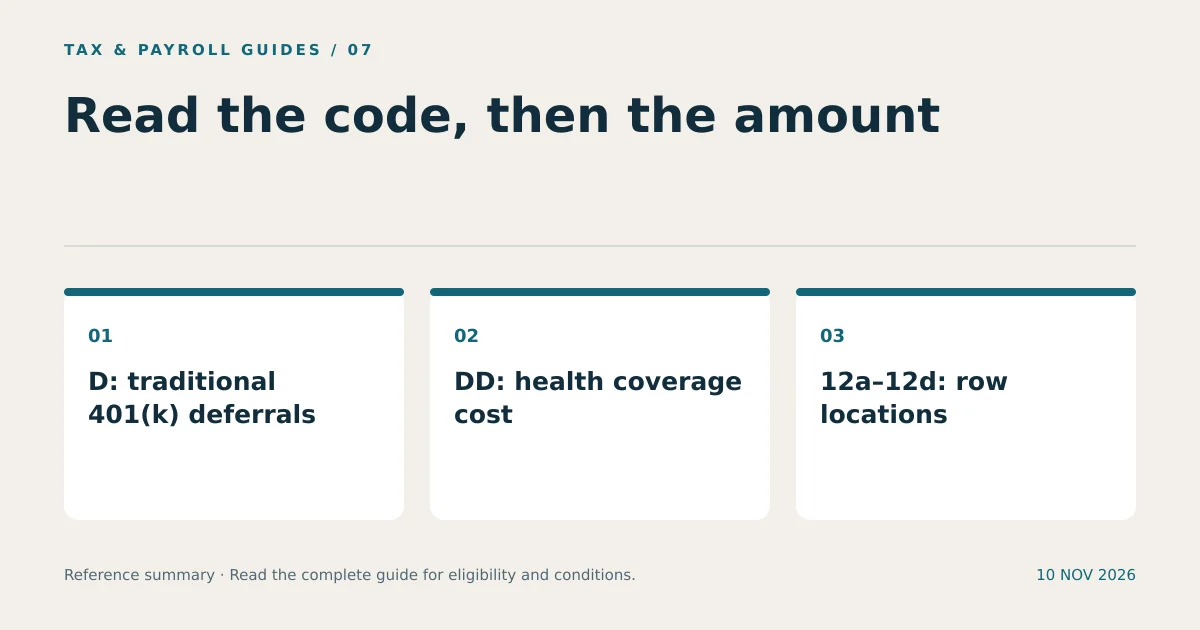
W-2 Box 12 Codes identify specific benefits, retirement contributions, deferred compensation, and tax items. Read each letter code with its dollar amount. The row label, such as 12a or 12d, identifies a location and does not determine the entry’s tax treatment.
This guide covers the 2026 Form W-2. That form reports calendar-year 2026 compensation and is generally furnished in early 2027. A W-2 received in early 2026 normally reports 2025 compensation, so its code list and reporting rules require the 2025 instructions.
How Do You Read W-2 Box 12 Codes?
Read each entry as a two-part record: the code identifies the item, and the number reports its amount. For example, an illustrative entry of D 4800.00 means $4,800 of traditional 401(k) elective deferrals.
The form provides rows 12a through 12d. Those lowercase row labels are locations. The uppercase codes are classifications. A code DD in row 12a has the same meaning as DD in row 12c. Never replace the actual code with the row letter when entering a W-2 into tax software.
- Confirm the tax year printed on the statement.
- Record every uppercase code exactly as shown.
- Copy the corresponding amount, including cents.
- Preserve a separate year designation if a military-service make-up contribution includes one.
- Compare the entries with the appropriate benefit or payroll records.
What Does Each W-2 Box 12 Code Mean in 2026?
The IRS 2026 reference guide lists the following 33 codes. This table separates each reported item from the common interpretation error that can affect a return.
| Code | What it reports | How to interpret it |
|---|---|---|
| A | Social Security or railroad retirement tax on tips that the employer could not collect. | An additional tax item; it is not income tax already withheld. |
| B | Uncollected Medicare tax on tips. | This code does not include uncollected Additional Medicare Tax. |
| C | Taxable value of employer group-term life insurance above $50,000 of coverage. | The taxable benefit is already included in applicable wage boxes. |
| D | Employee elective deferrals to a traditional 401(k), including a SIMPLE 401(k). | Do not confuse this amount with Roth 401(k) contributions or employer matching. |
| E | Employee elective deferrals under a 403(b) salary-reduction agreement. | Keep separate from Roth 403(b) amounts reported under BB. |
| F | Salary-reduction SEP elective deferrals under section 408(k)(6), including applicable Roth SEP IRA deferrals. | The plan type determines this code; ordinary SEP employer funding is different. |
| G | Employee deferrals and employer contributions to an eligible section 457(b) plan. | This reporting can include nonelective employer contributions. |
| H | Elective deferrals to a section 501(c)(18)(D) tax-exempt organization plan. | Unlike ordinary code D deferrals, these amounts are included in box 1; separate deduction rules apply. |
| J | Nontaxable sick pay. | The reported amount is excluded from applicable wage boxes. |
| K | The 20% excise tax on excess golden parachute payments. | This is a specialized excise-tax entry, not a retirement contribution. |
| L | Substantiated employee business-expense reimbursements in specified allowance arrangements. | The code identifies the substantiated portion; it is not a general deduction for unreimbursed expenses. |
| M | Uncollected Social Security or railroad retirement tax on taxable group-term life insurance for a former employee. | Review the return instructions for reporting the additional tax. |
| N | Uncollected Medicare tax on taxable group-term life insurance for a former employee. | Additional Medicare Tax is not included in this code. |
| P | Excludable moving-expense reimbursements paid directly to qualifying Armed Forces or intelligence-community members. | The 2026 exception is specific; it does not make ordinary employee moving costs tax-free. |
| Q | Nontaxable combat pay. | Special earned-income-credit rules may make this amount relevant despite its exclusion from wages. |
| R | Employer contributions to an Archer medical savings account. | An Archer MSA is distinct from an HSA. |
| S | Employee salary-reduction contributions to a SIMPLE IRA, including applicable Roth SIMPLE IRA contributions. | A SIMPLE 401(k) uses D for traditional elective deferrals instead. |
| T | Adoption-assistance benefits. | Eligibility and any exclusion are determined separately; the reported amount is not automatically fully excluded. |
| V | Income from exercising nonstatutory stock options. | The wage amount is already included in applicable wage boxes; stock-sale basis requires separate attention. |
| W | Employer HSA funding, including employee contributions through a section 125 cafeteria plan. | Reconcile with HSA records and Form 8889 rather than deducting the whole entry again. |
| Y | Deferrals under a section 409A nonqualified deferred-compensation plan. | This is not a qualified 401(k) contribution. |
| Z | Income from a nonqualified deferred-compensation plan that fails section 409A requirements. | The amount is included in box 1 and can trigger additional tax. |
| AA | Designated Roth contributions to a 401(k). | These are after-tax employee contributions, separate from D. |
| BB | Designated Roth contributions to a 403(b). | These are separate from traditional 403(b) deferrals under E. |
| DD | Reportable cost of employer-sponsored health coverage. | The entry is informational and does not itself create taxable income. |
| EE | Designated Roth contributions to a governmental 457(b) plan. | This code is for governmental plans, not tax-exempt nongovernmental 457(b) plans. |
| FF | Permitted benefits under a qualified small employer health reimbursement arrangement. | The reported entitlement can differ from actual reimbursements received. |
| GG | Income recognized from qualified equity grants under section 83(i). | This concerns recognized income, unlike the deferred total under HH. |
| HH | Aggregate income deferred under section 83(i) elections at year-end. | Do not treat the whole balance as a new cash payment. |
| II | Medicaid waiver payments excluded under Notice 2014-7. | These payments are not included in box 1; separate earned-income rules can matter. |
| TA | Employer contributions under a section 128 Trump account contribution program. | New for 2026 reporting; do not classify this as a 401(k) contribution. |
| TP | Total cash tips reported to the employer. | New for 2026; the reported total is not automatically the allowable qualified-tips deduction. |
| TT | Total qualified overtime compensation. | New for 2026; generally the qualifying FLSA premium portion, not all overtime wages. |
Which Box 12 Codes Are New for 2026?
The 2026 instructions introduce TA for specified employer Trump account contributions, TP for reported cash tips, and TT for qualified overtime compensation. These entries support distinct reporting provisions and do not remove all tax obligations on the underlying payments.
For TP, employers also report Treasury Tipped Occupation Codes in new box 14b. The cash-tip amount and occupation information help identify potential eligibility, but the employee’s deduction still depends on the relevant income and qualification rules.
For TT, distinguish the qualifying overtime premium from total earnings during overtime hours. In a hypothetical example, an employee has a $20 regular hourly rate and receives $30 per overtime hour. The $10 premium is the potentially qualifying component when the applicable FLSA conditions are met. It is not the whole $30 payment. Reported tips and overtime generally remain subject to Social Security and Medicare taxes.
Which W-2 Box 12 Entries Are Taxable?
Taxability depends on the code and the underlying benefit, not merely on whether an amount appears in box 12. Code DD is informational. Code C identifies a taxable benefit already included in applicable wage boxes. Code Z can involve both wage income and additional tax.
Do not total box 12 and add that sum to box 1. Doing so can duplicate taxable wages or turn excluded benefits into taxable income. Similarly, do not subtract every retirement or health-related entry from wages. Tax software needs the exact classifications to apply the correct return calculations.
How Do Retirement and Health Codes Differ?
Retirement codes describe a plan and contribution type; health codes describe coverage costs, account contributions, or reimbursement benefits. Similar letters do not mean similar transactions.
In a hypothetical W-2, D $6,000, AA $2,000, W $1,200, and DD $9,600 represent four separate records. D reports traditional 401(k) salary deferrals. AA reports Roth 401(k) employee contributions. W reports HSA funding of the relevant type. DD reports coverage cost. None of those four amounts is interchangeable.
Reconcile D and AA with retirement contribution records. Reconcile W with HSA records. Review DD against the employer’s coverage-cost calculation, which can include employer-paid premiums absent from the employee’s payroll deductions.
What Happens When More than Four Codes Apply?
An employer can issue another W-2 to report additional coded items. Under the IRS paper-form rules, Copy A contains no more than four box 12 entries per form. Approved substitute employee copies can display more entries.
Keep all statements from the same employer together. A second statement may contain additional benefits without repeating wages, while a corrected statement serves a different purpose. Compare the employer identification number, tax year, and correction markings before entering records. Do not assume that every additional page represents a separate job or duplicate income.
How Do You Correct an Incorrect Box 12 Code?
Ask the employer’s payroll department to review the entry and issue the appropriate correction. Provide the disputed code, amount, tax year, and supporting payroll or benefit record through a secure channel.
Describe the transaction precisely. For example, explain that payroll shows traditional 401(k) deductions while the statement shows AA. The employer determines whether the classification is wrong and whether Form W-2c or another corrected statement is required. Employees do not edit an employer-issued W-2 themselves.
Keep the original and corrected records together. A correction may affect wages, contributions, or an additional form even when the dollar amount in box 12 looks small. Review an already-filed return after a correction instead of assuming every correction requires, or never requires, an amendment.
What Other Questions Do Employees Ask?
Can Box 12 Be Blank on a W-2?
Yes. A blank box 12 can be correct when the employer has no items that require a box 12 code. It does not mean the wage statement is incomplete.
Is Code D the Same as Box 12d?
No. Code D identifies traditional 401(k) elective deferrals. Box 12d is the fourth available row. Code D can appear in any box 12 row.
Should I Add Every Box 12 Amount to My Wages?
No. Many entries are excluded benefits, contributions, or amounts already reflected elsewhere. Enter each code and amount as shown, and let the applicable tax rules determine its treatment.