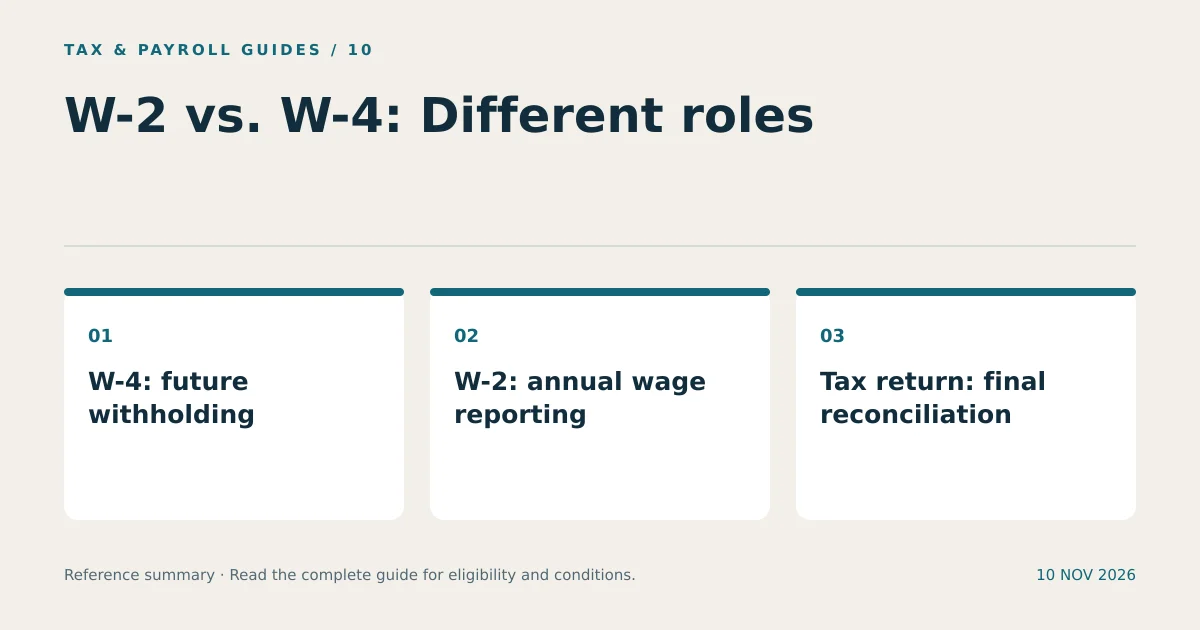
W-2 vs. W-4 describes two different payroll functions. Form W-2 reports annual wages and taxes after the year ends. Form W-4 gives an employer the employee’s federal income tax withholding instructions. Employers prepare W-2s; employees complete W-4s.
Choosing the correct form matters when starting a job, changing withholding, or preparing a return. Updating a W-4 affects later paychecks. A correction to previously reported wages requires the employer to review the W-2.
What Are the Main W-2 vs. W-4 Differences?
The difference is reporting versus instruction. A W-2 documents completed payroll activity. A W-4 supplies information that payroll uses to calculate upcoming federal income tax withholding.
| Feature | Form W-2 | Form W-4 |
|---|---|---|
| Official name | Wage and Tax Statement | Employee’s Withholding Certificate |
| Prepared by | Employer | Employee |
| Main purpose | Report annual wages and taxes | Set federal withholding instructions |
| Typical timing | After the calendar year | At hiring and when circumstances change |
| Key entries | Wages, tax withheld, benefit codes | Filing status, credits, adjustments |
| Employee action | Review and use when filing | Complete, sign, and give to payroll |
When Do You Complete a W-4 Form?
Complete a W-4 when beginning a job and submit an updated form when your withholding instructions change. Events such as marriage, a second job, or a dependent becoming ineligible for a credit can change the appropriate entries.
One employer cannot automatically see another employer’s payroll. A household with multiple jobs therefore needs coordinated withholding instructions. Selecting a filing status alone does not account for every household income source. The multiple-jobs section addresses that gap.
A new W-4 is not generally required every January merely because the year changed. However, a previous midyear adjustment may not fit a full new calendar year. Exemption from withholding follows separate annual renewal rules.
When Do You Receive a W-2 Form?
Receive a W-2 after the year in which the employer paid the reported wages. For example, a statement labeled 2026 generally reports compensation paid during 2026 and becomes available during the following filing season.
The normal employee furnishing deadline is January 31, with a next-business-day adjustment for weekends or applicable holidays. Electronic availability depends on the employer’s payroll arrangements and the applicable consent process. A final pay statement is useful for comparison, but it does not automatically replace the employer’s completed W-2.
Employees with several employers commonly receive several W-2s. Keep each statement associated with its employer and tax year. Multiple copies of the same W-2 are not separate income documents.
How Does a W-4 Affect the Figures on Your W-2?
The W-4 primarily influences federal income tax withheld, reported in W-2 Box 2. It does not directly set your salary, create a tax deduction on the return, or determine the ordinary Social Security and Medicare tax rates.
Consider a hypothetical employee who requests an additional $50 of federal withholding for each of 20 remaining paychecks. That instruction adds $1,000 of withholding if payroll applies it to all 20 checks. It reduces the cash received in those checks. It does not reduce the employee’s taxable wages by $1,000.
Actual payroll deductions require separate treatment. A traditional retirement deferral, for example, can affect federal taxable wages under the applicable plan rules. That is a benefit election, not the same action as requesting extra withholding on a W-4.
Does a W-4 Determine Your Final Tax Bill?
No. Your tax return determines final federal income tax using the applicable tax rules. Withholding is a payment toward that liability. The return reconciles payments, credits, and tax.
In a simplified hypothetical example, a taxpayer has $6,000 of total federal tax and $6,800 of withholding, with no other payments or refundable credits. The difference is an $800 refund. With $5,500 withheld instead, the same $6,000 tax produces a $500 amount due. The tax itself did not change between these examples.
Other income, deductions, credits, and additional taxes can change this calculation. A larger refund therefore does not automatically mean that a taxpayer received a larger deduction or paid less total tax.
Which Form Do You Change When Information Is Wrong?
Update the W-4 for future withholding instructions. Request employer review of the W-2 for inaccurate historical wage or tax reporting.
- Identify the issue: incorrect payroll facts or an unsuitable withholding choice.
- Compare the W-2 with the final payroll statement and relevant benefit records.
- Ask payroll to explain differences before treating them as errors.
- Request a corrected W-2, generally Form W-2c, when employer reporting requires correction.
- Submit a new W-4 separately when future withholding also needs adjustment.
Changing a W-4 today does not rewrite last year’s W-2. Likewise, a corrected W-2 does not necessarily change payroll instructions for the current year. Each action has a separate purpose.
What Documents Help When Reviewing W-2 vs. W-4 Information?
Use current pay statements for withholding planning and the completed W-2 for annual wage reporting. The previous tax return supplies useful context, but it may not reflect a new job or changed household circumstances.
- Collect year-to-date wages and federal withholding from every job.
- Record expected remaining pay dates and any irregular payments.
- Review anticipated filing status, dependents, deductions, and credits.
- Keep a copy of the W-4 submitted and confirm its payroll effective date.
For W-2 vs. W-4 decisions, first identify whether the problem concerns future withholding or a completed year’s wage statement. That distinction leads directly to the correct form.
What Other Questions Do Employees Ask?
Do Employees Fill Out Their Own W-2?
No. The employer prepares the employee’s W-2 using payroll records. Employees review the statement and use its information when preparing their returns.
Can a W-4 Replace a Missing W-2?
No. A W-4 contains withholding instructions, not the year’s actual wages and taxes. Request the missing W-2 from the employer or payroll provider.
Do W-4 Entries Change State Withholding?
Not automatically. State withholding requirements differ. An employer may require a separate state withholding certificate even when a federal W-4 is on file.