1040 Tax Form refers to Form 1040, the annual federal income tax return used by individual U.S. taxpayers. It combines income, deductions, credits, and payments to calculate a refund or remaining tax balance. Your employer supplies a W-2; you file Form 1040.
This guide explains the filing process without relying on line numbers that can change between revisions. A return for tax year 2026 generally reports 2026 income and is filed during 2027. A return filed during 2026 commonly concerns tax year 2025.
What Is the Purpose of a 1040 Tax Form?
A 1040 tax form reconciles the income tax you owe for a year with the payments and refundable credits credited to that year. It also records your filing status, dependents, and identity information.
Income documents provide inputs; they do not replace the return. For example, a W-2 supplies wages and payroll withholding, while a Form 1099-INT supplies interest information. Reporting both on one return gives the IRS a combined picture. Income can still be reportable when no information document arrives.
| Document | Who generally prepares it? | Main function |
|---|---|---|
| Form W-2 | Employer | Reports employee wages and withheld taxes |
| Form W-4 | Employee | Gives an employer federal withholding instructions |
| Form 1040 | Taxpayer or preparer | Reports annual income and calculates individual income tax |
| Form 1040-X | Taxpayer or preparer | Amends a previously filed individual return |
Who Uses Form 1040, and Who May Need a Different Return?
U.S. citizens and resident aliens generally use Form 1040 when they have a federal individual filing requirement. Filing requirements depend on income, filing status, age, dependency, and special circumstances.
A taxpayer with low income can still benefit from filing to recover withheld income tax or claim an eligible refundable credit. A separate filing requirement can arise from self-employment or other special taxes. Do not assume that a small W-2 amount alone answers whether a return is required.
Form 1040-SR is an optional alternative for eligible taxpayers age 65 or older. It uses the same underlying tax rules and schedules. Nonresident aliens generally use Form 1040-NR instead; residency for tax purposes is a separate determination from nationality.
What Information Do You Need Before Filling Out Form 1040?
Gather identity details, all income records, eligible deduction and credit records, and evidence of tax payments before preparing the return. Using a complete set reduces omitted-income and duplicate-entry errors.
- Collect names, taxpayer identification numbers, dates of birth, and dependent details.
- Collect every W-2 and relevant 1099, including documents from jobs left during the year.
- Collect business, rental, investment, retirement, and other income records that apply.
- Collect receipts or statements supporting eligible education, childcare, health, and other tax benefits.
- Collect estimated-payment confirmations and the prior-year return.
- Confirm bank routing and account numbers before requesting direct deposit.
Keep a document checklist by payer and year. Two jobs normally mean two separate wage records. Two copies of the same employer’s W-2 normally represent one wage record, not twice the income.
How Does Information Move Through a 1040 Tax Form?
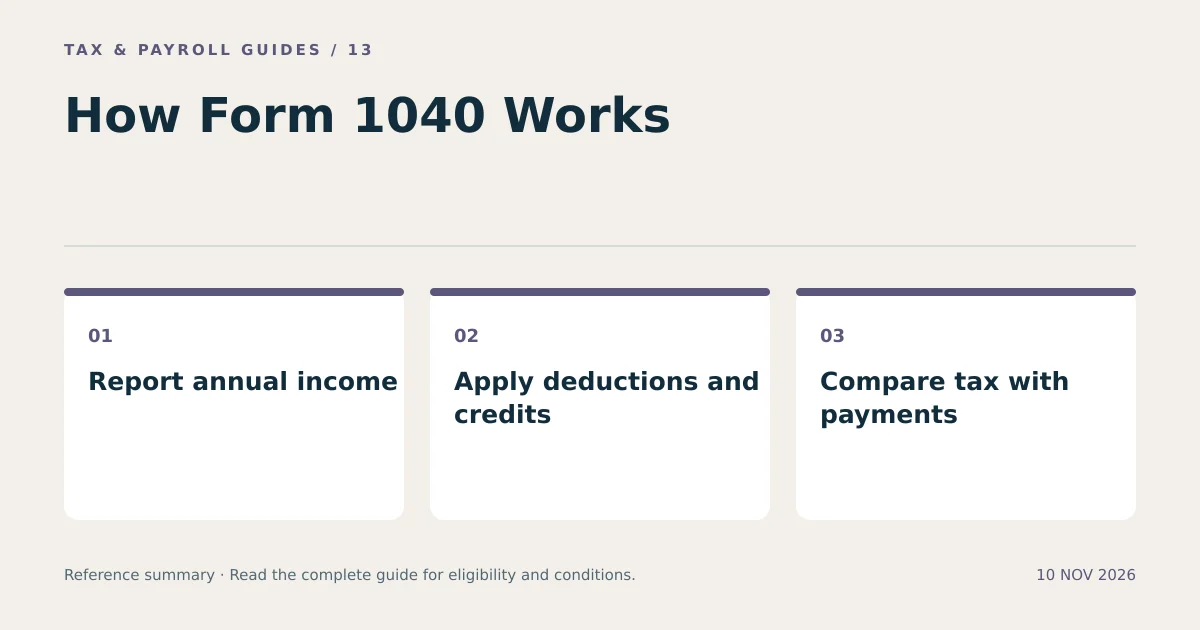
Form 1040 moves from income to adjusted gross income, then taxable income, tax, credits, and payments. Each stage answers a different question.
- Report income. Enter wages and other taxable income in the appropriate categories.
- Apply eligible adjustments. Calculate adjusted gross income using the applicable schedules.
- Determine deductions. Use the permitted standard or itemized deduction, plus other deductions that apply under the year’s rules.
- Calculate tax. Follow the appropriate tax table, worksheet, or rate calculation.
- Apply credits and additional taxes. Complete supporting forms when required.
- Compare payments with tax. Calculate the refund or amount owed.
W-2 Box 2 contains federal income tax withheld. Boxes 4 and 6 contain Social Security and Medicare tax. Do not add those three boxes together as ordinary federal income tax withholding; payroll-tax adjustments have separate rules.
Which Schedules Can Accompany Form 1040?
Additional schedules supply details that the main return cannot contain. The correct combination depends on the transactions and benefits being reported.
| Schedule | Typical subject |
|---|---|
| Schedule 1 | Additional income and adjustments |
| Schedule 1-A | Eligible deductions for qualified tips, overtime, vehicle loan interest, and seniors |
| Schedule 2 | Additional taxes |
| Schedule 3 | Additional credits and payments |
| Schedule A | Itemized deductions |
| Schedule C | Sole-proprietor business income and expenses |
| Schedule D | Capital gains and losses |
| Schedule E | Rental and certain other supplemental income |
A schedule’s presence does not establish eligibility for its deductions. For example, entering overtime income does not automatically establish the qualified overtime deduction. Check the definitions, limits, and documentation requirements for the tax year.
What Does a Simple Form 1040 Calculation Look Like?
A hypothetical taxpayer with $6,000 of total federal income tax and $7,500 of federal withholding has a $1,500 overpayment before other adjustments. The calculation is $7,500 minus $6,000.
Now assume the same tax but only $5,200 of withholding. The balance becomes $800 owed. These examples demonstrate reconciliation; they do not establish anyone’s tax from income alone. Credits, additional taxes, estimated payments, and prior-year amounts applied forward can change the result.
How Do You Review and File Form 1040 Correctly?
Review the completed return against original records, sign it, and submit it using an accepted electronic or paper filing method. E-filing does not remove your responsibility to check the numbers.
Verify the tax year, filing status, dependent information, imported W-2 data, bank details, and payment instructions. Read the complete return before authorizing a preparer to file. Keep the filed return and submission or mailing evidence together.
Use the final IRS form for the correct year. Draft forms are not filing copies. Check the applicable filing deadline and any disaster or special relief separately. An extension generally extends filing time, not the time to pay tax.
Retain a copy even when a filing service stores the return online. A local record avoids dependence on a service account when applying for a loan, answering a notice, or preparing a later 1040 tax form.
What Else Should You Know?
Is a 1040 Tax Form the Same as a W-2?
No. A W-2 reports one employer’s wage and withholding information. Form 1040 combines the taxpayer’s annual information and determines federal income tax.
Can I File Form 1040 with More than One W-2?
Yes. Include every applicable W-2 for that tax year. Review imported records to avoid entering the same form twice.
Does Filing Form 1040 Guarantee a Refund?
No. A refund depends on the relationship between tax, payments, and eligible refundable credits. Some returns show no balance or an amount owed.