Table of Contents
IRS Form 5695 – Residential Energy Credit – With energy costs soaring and sustainability on everyone’s mind, upgrading your home with solar panels, heat pumps, or energy-efficient windows isn’t just smart—it’s rewarding. The IRS Residential Energy Credit, claimed via Form 5695, Residential Energy Credits, lets you offset up to 30% of those costs against your federal taxes. But here’s the urgency: Due to the One Big Beautiful Bill Act signed in July 2025, this 30% credit expires for most installations after December 31, 2025—no phase-down, just a hard stop. If you’re googling “IRS Form 5695 2025 instructions” or “residential clean energy credit eligibility,” this SEO-optimized guide has you covered with the latest IRS updates.
Whether you’re eyeing solar tax credits or efficient home improvements, Form 5695 covers two key incentives: the Residential Clean Energy Credit (Part I) and the Energy Efficient Home Improvement Credit (Part II). Both are nonrefundable but can carry forward unused amounts (with limits post-2025). Download the 2025 Form 5695 PDF from IRS.gov and file with your 2025 tax return by April 15, 2026. Act fast—installations must be completed and “placed in service” by year-end to qualify.

What Is IRS Form 5695?
Form 5695 is the IRS worksheet for calculating and claiming federal tax credits for residential energy-efficient improvements and clean energy property. Updated for 2025, it reflects Inflation Reduction Act enhancements now curtailed by recent legislation. The form has two parts:
- Part I: Residential Clean Energy Credit – 30% of costs for solar, wind, geothermal, battery storage, and fuel cells (no annual cap, except fuel cells).
- Part II: Energy Efficient Home Improvement Credit – 30% of costs for windows, doors, insulation, audits, and certain appliances (up to $3,200 annually).
File even if your credit is zero—it’s required for carryforwards. New for 2025: Include Qualified Manufacturer (QM) codes for eligible products on your return. These credits reduce your tax bill dollar-for-dollar but can’t exceed your liability. Excess from Part I carries forward; Part II does not.
Pro Tip: Use the IRS Tax Withholding Estimator or software like TurboTax to preview your savings before filing.
Who Qualifies for the Residential Energy Credit in 2025?
U.S. taxpayers (owners or renters) who install qualifying property in a U.S. residence used as a main home qualify. Second homes work for Part I but not Part II. Joint filers claim jointly; separate filers split based on ownership.
Key eligibility:
- Property must be new and meet energy standards (e.g., ENERGY STAR certified).
- Installation date: Placed in service (operational) by December 31, 2025.
- No business use: Primarily for personal residence.
- Manufacturer certification: Rely on written QM docs; report 4-digit QM code for 2025 claims.
Exclusions: Leased systems (owner claims credit), financed costs (only principal qualifies), or rebates (reduce basis). Nonresidents or foreign homes? Ineligible.
| Credit Type | Eligible Taxpayers | Key Deadline |
|---|---|---|
| Residential Clean Energy | Homeowners/renters with clean energy installs | Dec. 31, 2025 |
| Energy Efficient Improvements | Main home owners with efficiency upgrades | Dec. 31, 2025 |
Farmers or multi-unit dwellers? See IRS Pub. 525 for nuances.
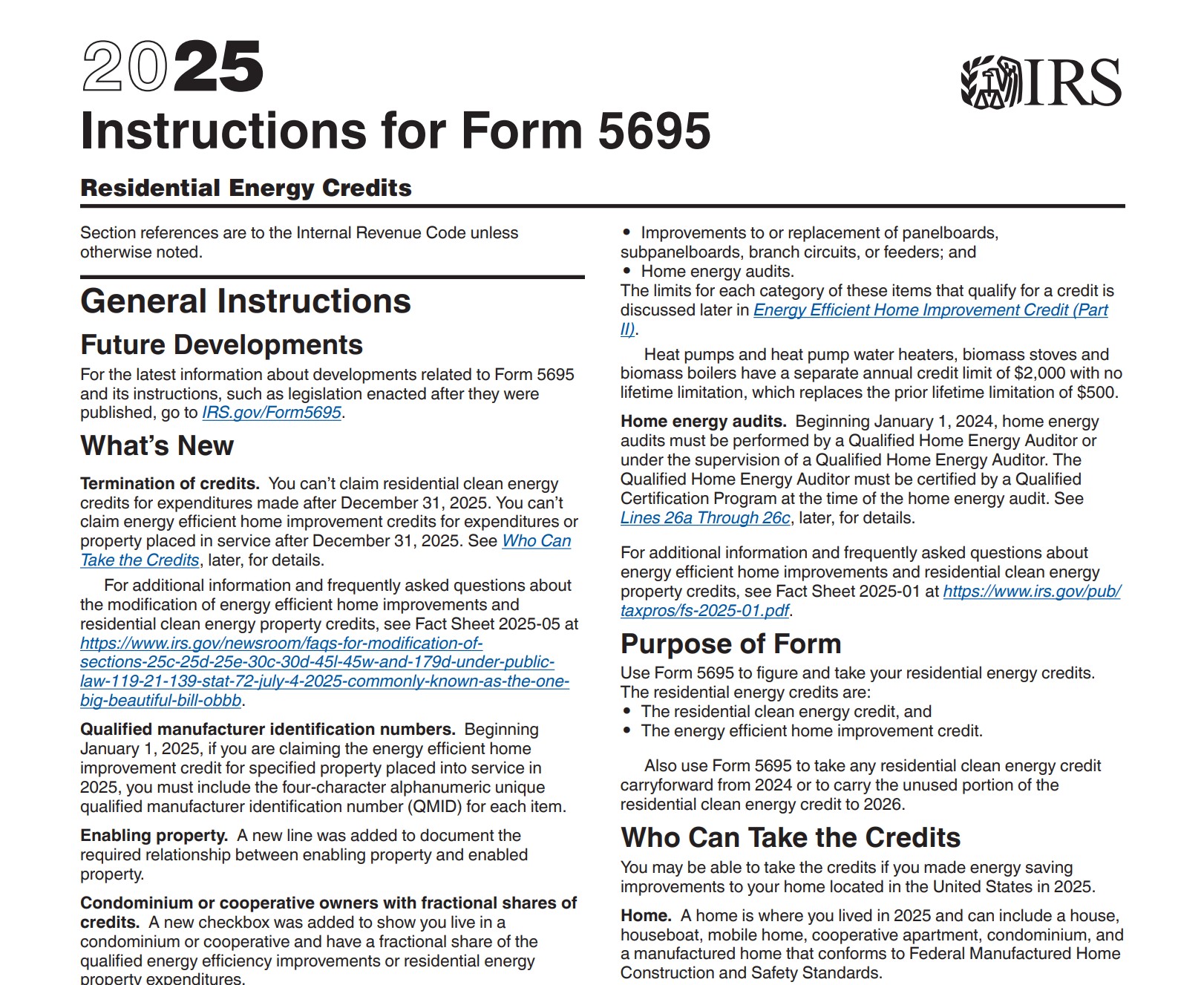
IRS Form 5695 Download and Printable
Download and Print: IRS Form 5695
Eligible Property and Credit Amounts for Form 5695 in 2025
Focus on 2025’s final year for full 30% rates. Costs include equipment, labor for installation, and piping/wiring—but not roofing unless integral to solar.
Part I: Residential Clean Energy Credit (30%, No Annual Cap)
- Solar electric property: Panels, inverters, wiring (e.g., $20,000 system = $6,000 credit).
- Solar water heaters: 80%+ solar-heated.
- Small wind turbines: Up to 100 kW.
- Geothermal heat pumps: ENERGY STAR certified.
- Battery storage: ≥3 kWh capacity (standalone or paired with renewables).
- Fuel cells: $500 per 0.5 kW (max $1,000/item; joint max $1,667).
Example: $15,000 solar + $5,000 battery = $6,000 credit.
Part II: Energy Efficient Home Improvement Credit (30%, Up to $3,200/Year)
- Qualified improvements: Exterior doors ($250/door, $500 total), windows/skylights ($600 total), insulation (IECC standards), electrical panels ($600 if with heat pump).
- Qualified property: Heat pumps/heat pump water heaters ($2,000 cap), biomass stoves/boilers ($2,000 cap), central AC ($600/item).
- Home energy audits: Up to $150.
Total Cap Breakdown: | Category | Annual Limit | |———-|————–| | Windows/Doors/Skylights/Insulation/Audits | $1,200 | | Heat Pumps/Water Heaters/Biomass | $2,000 | | Overall Max | $3,200 |
QM code required for 2025 claims—check manufacturer labels.
How to Complete IRS Form 5695 for 2025: Step-by-Step Guide
Gather receipts, QM codes, and basis (costs minus rebates). Use the 2025 instructions for worksheets. Here’s the flow:
Part I: Residential Clean Energy Credit (Lines 1–16)
- Line 1: Solar electric costs.
- Line 5a: Geothermal costs.
- Line 6a: Small wind costs.
- Line 7a: Fuel cell costs (include kW capacity).
- Line 8: Solar water heater costs.
- Line 9: Battery storage costs.
- Line 10: Total qualified costs (sum 1+5b+6b+7c+8+9).
- Line 11: Multiply by 30% (fuel cells: Line 7c × 30%).
- Line 12: Carryforward from 2024 (Line 16 prior year).
- Line 13: Total available (11+12).
- Line 14: Tax liability limit (from worksheet: Form 1040 tentative tax minus other credits).
- Line 15: Credit claimed (smaller of 13/14).
- Line 16: Carryforward to 2026 (13-15; note: post-2025 limits may apply).
Part II: Energy Efficient Home Improvement Credit (Lines 17–32)
- Lines 17–22: Check boxes for main home, new property.
- Line 23a: Exterior doors/windows/skylights costs.
- Line 24: Insulation/air sealing.
- Line 25: Electrical panels (with heat pump?).
- Line 26a–c: Heat pumps/water heaters/biomass.
- Line 27: Central AC.
- Line 28: Audit costs.
- Line 29: Total (sum qualified).
- Line 30: Multiply by 30% (apply caps: $600/item for most; $2,000 aggregate for heat pumps/etc.).
- Line 31: Tax limit (Form 1040 minus Part I and other credits).
- Line 32: Credit claimed (smaller of 30/31).
Final Steps
- Transfer: Part I Line 15 to Schedule 3, Line 5; Part II Line 32 to Schedule 3, Line 6l.
- Attach: Form 5695 to Form 1040.
- E-File: Recommended for accuracy; paper to your IRS center.
Tools: IRS Form 5695 worksheet automates math; apps like EnergySage track eligibility.
2025 Filing Deadlines and Key Changes
- Claim Year: File with 2025 taxes (due April 15, 2026; extend to October).
- Installation Cutoff: December 31, 2025—full 30% if operational.
- Post-2025: Credits expire; no carryforward for Part II; Part I limited.
Changes: OBBBA ends credits after 2025; QM/PIN requirements start (4-digit code suffices for 2025). Rebates reduce basis—check state incentives.
Common Mistakes to Avoid When Filing Form 5695
- Forgetting QM codes (audit trigger).
- Including non-qualifying costs (e.g., maintenance).
- Missing labor allocation.
- Overlooking joint occupancy rules (each files separately).
5 Tips for Maximizing Your 2025 Residential Energy Credit
- Install ASAP: Beat the Dec. 31 deadline—permits take time.
- Get Certified: Demand QM docs from installers.
- Stack Credits: Pair solar (Part I) with windows (Part II).
- Track Rebates: Subtract from basis to avoid IRS adjustments.
- Consult a Pro: Use a CPA for complex installs or audits.
Frequently Asked Questions (FAQs) About IRS Form 5695
Does the solar tax credit expire after 2025?
Yes—30% Residential Clean Energy Credit ends for installs after Dec. 31, 2025, per OBBBA.
Can renters claim Form 5695 credits?
Yes, for Part I if you improve your residence; Part II limited to main homes.
What’s the max credit on Form 5695 for 2025?
Up to $3,200 (Part II) + unlimited Part I (less fuel cell caps).
Do I need receipts for Form 5695?
Yes—keep 3+ years; include QM codes for 2025.
Where do I download 2025 Form 5695?
IRS.gov/forms-pubs/about-form-5695—available now.
Seize your IRS Form 5695 opportunity in 2025 to slash energy bills and taxes. For custom advice, visit IRS.gov or a tax expert. Share your green upgrade wins below!
This guide is informational based on 2025 IRS rules—not tax advice. Consult professionals for your situation.