IRS Form 1099-K – Payment Card and Third Party Network Transactions

IRS Form 1099-K - Payment Card and Third Party Network Transactions

IRS Form 1099-K – Payment Card and Third Party Network Transactions – In today’s digital economy, selling goods online, freelancing via apps, or accepting payments through platforms like PayPal, Venmo, or Stripe has never been easier. But with convenience comes responsibility—especially when it comes to taxes. Enter IRS Form 1099-K, the key document for reporting payment card and third-party network transactions. If you’re a small business owner, gig worker, or casual seller, understanding this form is crucial to avoid surprises during tax season.

As of 2025, the IRS has reinstated familiar reporting thresholds, providing relief from earlier proposed changes. This guide breaks down everything you need to know about Form 1099-K, from who files it to how it impacts your taxes. Whether you’re searching for “1099-K threshold 2025” or “what is Form 1099-K,” we’ve got you covered with the latest from trusted IRS sources.
IRS Form 1099-K - Payment Card and Third Party Network Transactions
IRS Form 1099-K – Payment Card and Third Party Network Transactions


What Is IRS Form 1099-K?

Form 1099-K, officially titled “Payment Card and Third Party Network Transactions,” is an information return filed with the IRS to report certain payments made to you for goods or services. It’s not a tax bill—it’s simply a record of gross payments processed through payment settlement entities (PSEs), like credit card companies or online marketplaces.

The form helps the IRS track income to promote voluntary compliance, but it doesn’t calculate your actual taxable income. For example, if you sell a used item for a loss, the gross amount on the 1099-K isn’t your profit—you’ll need your own records to figure that out.

Key purposes:

  • Reports gross payments from credit/debit cards, stored-value cards (e.g., gift cards), payment apps, and online platforms.
  • Ensures sellers report business income accurately on their tax returns.

If you’re new to this, think of it as the IRS’s way of saying, “We know you got paid—now show us how it fits into your taxes.”

Who Must File Form 1099-K?

Not everyone handling payments needs to worry about filing Form 1099-K—that’s on the PSEs. Here’s who is responsible:

  • Payment Settlement Entities (PSEs): These include:
    • Merchant acquiring entities for payment card transactions (e.g., banks processing Visa or Mastercard payments).
    • Third-party settlement organizations (TPSOs) for network transactions (e.g., PayPal, Venmo, or eBay).
  • When They File: A PSE must issue the form if your payments meet the reporting thresholds (more on that below). They file with the IRS and send you a copy.
  • Special Cases:
    • If a PSE uses a third-party facilitator (like an electronic payment facilitator), the entity submitting fund transfer instructions handles the filing.
    • Governmental units and foreign PSEs must also report.
    • Franchisors in aggregated payee setups report to banks, then allocate to franchisees.

PSEs can’t charge you fees for preparing or filing the form, so watch for that in your agreements.

Current Reporting Thresholds for Form 1099-K in 2025

One of the most searched topics is the “1099-K threshold 2025.” Good news: Recent legislation has rolled back aggressive changes, keeping things manageable for most users.

Under the One, Big, Beautiful Bill (OBBB), enacted retroactively, the thresholds revert to pre-2021 levels for tax year 2025:

Transaction Type Threshold for Reporting Notes
Payment Card Transactions (e.g., credit/debit cards) No minimum—report all, even $0.01 No de minimis exception; every transaction counts.
Third-Party Settlement Organization (TPSO) Transactions (e.g., PayPal, Venmo for goods/services) More than $20,000 AND more than 200 transactions De minimis exception: No penalties if below this. States may have lower rules.
  • Why the Change? The American Rescue Plan Act of 2021 aimed to lower the TPSO threshold to $600 with no transaction minimum, but implementation was delayed multiple times (via IRS Notices 2023-10, 2023-74, and 2024-85). The OBBB fully reinstates the $20,000/200 rule for 2025, with phased relief leading to potential $600 implementation in 2026.
  • Voluntary Reporting: PSEs can still send forms below thresholds to help with your deductions (e.g., tracking tips).

If your payments are for personal items like family reimbursements, they often don’t trigger reporting—more on that later.

What Information Does Form 1099-K Report?

The form captures gross payments—not your net profit. Here’s what you’ll see:

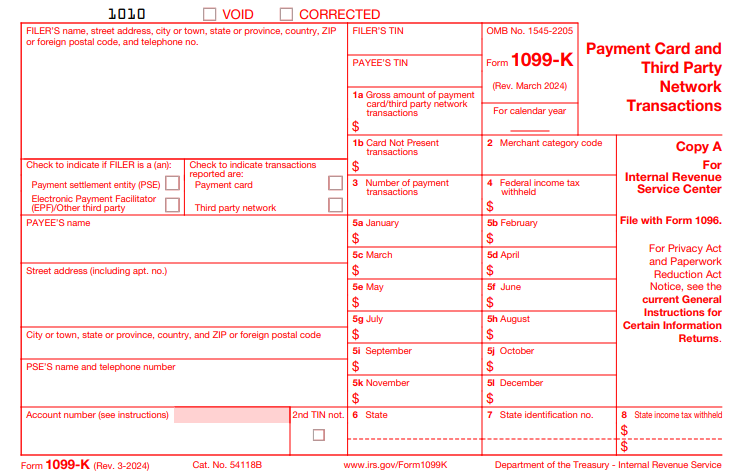
  • Box 1a: Gross Amount of Payment Card/Third Party Network Transactions – Total dollars from reportable sales, excluding fees, refunds, shipping, or discounts. It doesn’t subtract your cost basis.
  • Box 2: Merchant Category Code (MCC) – A four-digit code for payment cards only (e.g., 5732 for Electronics Stores). TPSOs don’t report this. Use the primary MCC if multiple apply.
  • Box 4: Federal Income Tax Withheld – If backup withholding applies (e.g., missing TIN), this shows amounts withheld.

Other details include your name, address, TIN (SSN or EIN), and the PSE’s info.

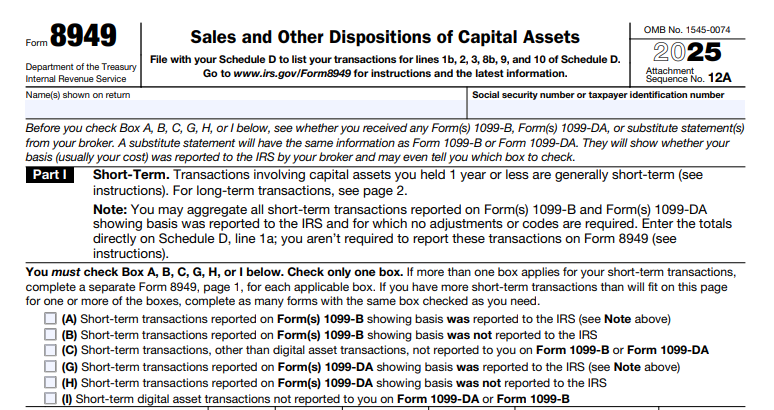
Important: This gross figure isn’t your taxable income. For business sales, report on Schedule C. For personal sales, calculate gain (proceeds minus basis) on Form 8949/Schedule D—losses aren’t deductible.

Filing and Furnishing Deadlines for 2025

Timelines are strict to keep the IRS wheels turning:

  • Furnish to Payee (Copy B): By January 31, 2026, for 2025 payments. Can be paper or electronic (with consent).
  • File with IRS:
    • Paper: Due February 28, 2026.
    • Electronic: Due March 31, 2026 (mandatory if filing 10+ returns; use FIRE or IRIS systems).

Extensions are available, but plan ahead. TIN verification via the IRS Matching Program is required to avoid backup withholding.

Common Situations: When Do You Get a 1099-K?

Wondering if that side hustle will trigger a form? Here are real-world scenarios:

  • Gig Economy Workers: If you earn over $20,000 from 200+ Uber rides or Etsy sales via PayPal, expect one.
  • Online Sellers: eBay or Facebook Marketplace payments count if thresholds hit; personal item sales (e.g., garage sale via Venmo) may not if not for goods/services.
  • Family and Friends Payments: Gifts or reimbursements (e.g., splitting dinner) aren’t reportable. If you get a form by mistake, contact the PSE or zero it out on your return (e.g., on Schedule 1, line 8z).
  • Crowdfunding: Rewards-based (taxable); pure donations (often not). Track carefully.
  • Children/Dependents: If they sell items or provide services, they may need to file.
  • Ticket Scalping: Post-2025, interacts with Executive Order 14254—report gains if thresholds met.
  • Abroad Sellers: U.S. citizens report worldwide income.

For multiple 1099-Ks, combine totals but track separately for gains/losses.

IRS Form 1099-K Download and Printable

Download and Print: IRS Form 1099-K

Recent Changes and Updates for Form 1099-K in 2025

The landscape shifted in 2025:

  • OBBB Impact: Retroactively sets $20,000/200 for TPSOs, easing burdens on small sellers.
  • FAQ Revisions: IRS Fact Sheet 2025-08 (October 23, 2025) updates guidance, superseding prior versions. New rules for erroneous personal sales: Net on Schedule 1 for 2024+ returns.
  • Penalty Relief: Continued from prior notices for good-faith efforts.
  • State Variations: Check local rules—some states require reporting below federal thresholds.

These updates aim for smoother compliance without overwhelming casual users.

How to Handle Your Form 1099-K: Tips for Taxpayers

Received a 1099-K? Don’t panic—follow these steps:

  1. Verify Accuracy: Compare to your records. Contact the PSE if errors (e.g., included refunds).
  2. Calculate Taxable Income:
    • Business: Deduct expenses on Schedule C.
    • Personal: Report gain only (use Publication 551 for basis rules). Estimate if needed via receipts or seller contacts.
  3. Report on Your Return:
    • Use Schedule 1 (line 8z) for non-business proceeds.
    • Form 1040 for overall income.
  4. If No Form but Income Exists: Self-report—all income is taxable.
  5. Backup Withholding: Claim credit for any amounts in Box 4.

Keep detailed records: Apps blur personal/business lines, so log everything. Tools like QuickBooks or Excel templates can help.

Final Thoughts: Stay Compliant and Stress-Free

IRS Form 1099-K is a tool for transparency in our cashless world, but with 2025’s reinstated $20,000/200 threshold, it’s less daunting for most. Whether you’re a full-time e-commerce pro or occasional seller, understanding these rules ensures accurate filing and avoids audits.

For more, download the official Instructions for Form 1099-K or consult IRS Publication 334 (Tax Guide for Small Business). If in doubt, a tax pro is your best bet.

Last updated December 2025. Always verify with IRS.gov for personalized advice.
 

IRS Form 1099-INT – Interest Income

IRS Form 1099-INT - Interest Income

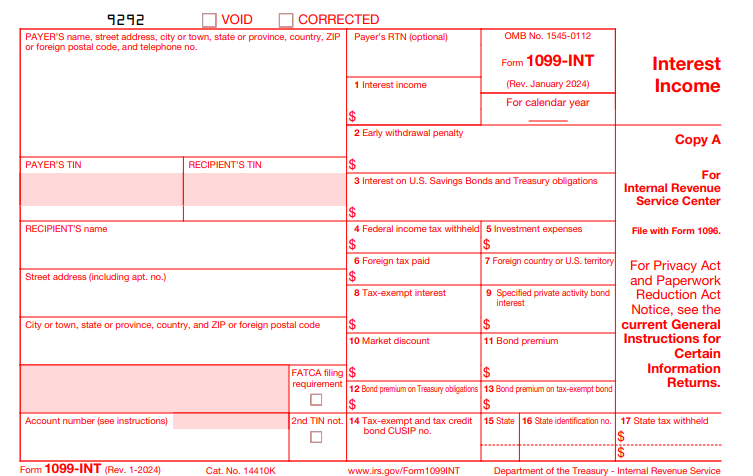
IRS Form 1099-INT – Interest Income – Interest income from savings accounts, CDs, bonds, and other investments is a common earner for many Americans, but properly reporting it to the IRS is crucial to avoid penalties or audits. IRS Form 1099-INT, also known as the Interest Income form, is the key document for tracking and disclosing this income. Whether you’re a saver dipping into high-yield accounts or an investor holding Treasury bonds, understanding Form 1099-INT ensures compliance and maximizes your tax strategy.

In this comprehensive guide, we’ll break down everything you need to know about Form 1099-INT for the 2024 tax year (filed in 2025), including who receives it, what it reports, filing deadlines, and how to integrate it into your tax return. We’ll draw from official IRS resources and trusted tax experts to keep you informed with the latest updates as of December 2025.

IRS Form 1099-INT - Interest Income
IRS Form 1099-INT – Interest Income


What Is IRS Form 1099-INT?

Form 1099-INT is an information return used by payers—such as banks, credit unions, brokerage firms, and government entities—to report interest payments of $10 or more made to recipients during the tax year. It’s part of the IRS’s broader 1099 series, designed to ensure all taxable interest is accounted for and helps the agency cross-check against your Form 1040.

The form captures various types of interest, from everyday bank earnings to specialized income like tax-exempt municipal bond interest. Payers must issue it regardless of whether the interest is taxable, as long as the threshold is met. For 2024, the form was revised in January 2024, with no major structural changes from prior years, but filers should note ongoing emphases on electronic filing and FATCA reporting for foreign accounts.

Who Must File Form 1099-INT?

Not everyone issues a 1099-INT—only those making reportable payments in the course of a trade or business, including federal agencies, nonprofits, and nominees acting on behalf of others. Key triggers include:

  • Paying $10 or more in interest reportable in Boxes 1, 3, or 8.
  • Withholding and paying foreign tax on interest.
  • Applying backup withholding (typically 24%) due to missing taxpayer ID numbers (TINs), regardless of the payment amount.

Exemptions apply to payments to corporations, tax-exempt organizations, IRAs, HSAs, foreign entities under certain rules, and interest from non-U.S. sources paid outside the U.S. If you’re a payer, e-filing is mandatory if you issue 10 or more information returns in 2024.

Who Receives Form 1099-INT?

Taxpayers receive a 1099-INT if they earned at least $10 in qualifying interest from a single payer. Common recipients include:

  • Individuals with savings or checking accounts.
  • Bondholders earning interest on corporate, municipal, or Treasury securities.
  • Those receiving refunds with interest from the IRS or states.

Even if you don’t receive the form (e.g., for amounts under $10), you’re still required to report the income if known. Banks and institutions must send copies by January 31, 2025, for 2024 earnings.

Key Boxes on Form 1099-INT: What Each One Means

Form 1099-INT has 17 boxes, but not all apply to every situation. Here’s a breakdown of the most common ones for 2024, based on IRS instructions:

Box Description Example Tax Treatment
1: Interest Income Taxable interest of $10 or more (e.g., from bank accounts, CDs, corporate bonds). Includes trade/business interest of $600+. $150 from a high-yield savings account. Taxed as ordinary income; report on Form 1040, Line 2b.
2: Early Withdrawal Penalty Forfeited interest/principal from early CD withdrawals. $20 penalty on a 6-month CD cashed early. Deductible on Schedule 1 (Form 1040) as an adjustment to income.
3: Interest on U.S. Savings Bonds and Treasury Obligations Interest from U.S. government securities (not in Box 1). $50 from Series EE bonds. Taxable; may qualify for education exclusion via Form 8815.
4: Federal Income Tax Withheld Backup withholding (24%) applied. $36 withheld on $150 interest. Credits against your tax liability on Form 1040.
6: Foreign Tax Paid Foreign taxes withheld on interest (report in USD). $10 Canadian tax on bond interest. Claim foreign tax credit on Form 1116.
8: Tax-Exempt Interest Nontaxable interest of $10+ (e.g., municipal bonds). $200 from city bonds. Not taxed but reported for AMT/calculation purposes.
9: Specified Private Activity Bond Interest Interest from private activity bonds (subset of Box 8). $30 from qualified school bonds. May trigger Alternative Minimum Tax (AMT).

For a full list, including bond premiums (Boxes 11–13) and state info (15–17), consult the IRS form PDF. Note: Original Issue Discount (OID) is reported on Form 1099-OID, not 1099-INT, unless it’s qualified stated interest.

Filing Deadlines for Form 1099-INT in 2025

Timely filing avoids penalties up to $310 per return (or more for intentional disregard). For tax year 2024:

  • Furnish to Recipients: January 31, 2025 (or March 15 for REMIC/WHFIT interests).
  • File with IRS (Paper): February 28, 2025 (or March 31 if 10 or fewer forms).
  • File with IRS (Electronic): March 31, 2025 (or April 30 if 10 or fewer).

Extensions are available via Form 8809, but only for good cause. Corrections? File amended forms promptly with the IRS and notify recipients. E-filing through services like TaxBandits streamlines this, with recipient delivery options starting at $0.80 per form.

How to Report Form 1099-INT on Your 2024 Tax Return

Don’t attach the form to your return—summarize the data instead. Here’s a step-by-step:

  1. Enter Taxable Interest (Box 1): On Form 1040, Schedule 1, Line 2b (or directly on 1040, Line 2b). If total interest > $1,500, attach Schedule B listing all payers.
  2. Tax-Exempt Interest (Box 8): Report on Form 1040, Line 2a for informational purposes—it affects calculations like Social Security taxation or AMT.
  3. Withheld Taxes (Box 4): Add to Form 1040’s federal payments section for credits.
  4. Penalties (Box 2): Deduct on Schedule 1, Line 24.
  5. Special Cases: For U.S. bond interest (Box 3), use Form 8815 if qualifying for education exclusions. Nominees subtract their share on Schedule B and issue 1099-INT to true owners.

Tax software like TurboTax automates this, pulling data directly from uploaded PDFs. Interest is taxed at your ordinary rate (up to 37% in 2024), but tax-exempt types avoid federal (though not always state) taxes.

IRS Form 1099-INT Download and Printable

Download and Print: IRS Form 1099-INT

Common Mistakes When Handling Form 1099-INT—and How to Avoid Them

Even seasoned filers slip up. Watch for these pitfalls:

  • Underreporting Small Amounts: Report all interest, even under $10—no form needed, but accuracy matters.
  • Forgetting Schedule B: Required over $1,500; list every source to match IRS records.
  • Ignoring Tax-Exempt Reporting: Box 8 isn’t taxed but must be disclosed to prevent AMT surprises.
  • Mishandling Withholdings: Claim Box 4 credits, or risk overpaying taxes.
  • Nominee Errors: If holding for others, report and distribute properly.

Pro Tip: Review all 1099s by mid-February 2025 and consult a tax pro for complex investments.

Frequently Asked Questions (FAQs) About IRS Form 1099-INT

Do I need to file taxes if my only income is from interest under $10?

No form is issued, but report it if your total income meets filing thresholds (e.g., $14,600 for single filers under 65 in 2024).

Is municipal bond interest always tax-exempt?

Yes federally (Box 8), but check state rules—some states tax out-of-state bonds.

What if I don’t receive my 1099-INT by January 31?

Contact the payer; the IRS gets a copy, so report based on your records to avoid mismatches.

Can I e-file my personal taxes with 1099-INT data?

Yes—import PDFs into software for seamless Schedule B generation.

For more, visit IRS.gov or tools like H&R Block’s tax dictionary.

Final Thoughts: Stay Compliant and Optimize Your Interest Earnings

Form 1099-INT is more than paperwork—it’s your ticket to accurate tax filing and potential deductions like early withdrawal penalties or education exclusions. With deadlines approaching in early 2025, gather your forms now, use e-filing for efficiency, and consider high-yield options that maximize after-tax returns.

For personalized advice, consult a CPA or use trusted software. Questions? The IRS’s updated instructions are your best resource. File confidently, and here’s to growing your nest egg in 2025!


IRS Form 1099-H – Health Coverage Tax Credit (HCTC) Advance Payments

IRS Form 1099-H - Health Coverage Tax Credit (HCTC) Advance Payments

IRS Form 1099-H – Health Coverage Tax Credit (HCTC) Advance Payments – In the world of tax forms, IRS Form 1099-H stands out as a specialized document tied to health insurance affordability programs. While the Health Coverage Tax Credit (HCTC) program itself expired on December 31, 2021, Form 1099-H remains relevant for reporting any lingering advance payments from prior years or potential future revivals. If you’re a former eligible recipient—such as those affected by trade adjustment assistance—or a health insurance provider, understanding this form is crucial for accurate tax compliance. This guide breaks down everything you need to know about Form 1099-H, including its purpose, eligibility, filing details, and tax implications for 2025.

Whether you’re searching for “IRS Form 1099-H filing deadlines” or “HCTC advance payments 2025,” this article provides clear, actionable insights based on official IRS guidance.

IRS Form 1099-H - Health Coverage Tax Credit (HCTC) Advance Payments
IRS Form 1099-H – Health Coverage Tax Credit (HCTC) Advance Payments


What Is the Health Coverage Tax Credit (HCTC)?

The HCTC was a refundable tax credit designed to help certain displaced workers and retirees afford qualified health insurance premiums. It covered up to 72.5% of monthly premiums for eligible individuals and their families, with advance payments sent directly to insurers to reduce out-of-pocket costs.

Historical Eligibility for HCTC

Before its expiration, the program targeted:

  • Trade Adjustment Assistance (TAA) recipients: Workers certified for assistance due to foreign trade impacts.
  • Alternative TAA (ATAA) and Reemployment TAA (RTAA) participants: Those opting for wage subsidies or relocation aid.
  • Pension Benefit Guaranty Corporation (PBGC) payees: Retirees receiving pension benefits from the PBGC.
  • Qualifying family members: Spouses and dependents covered under the same plan.

Eligibility was determined monthly, and participants had to enroll in qualified health plans, such as COBRA continuation coverage or individual market policies. Although the program ended in 2021, similar relief is now available through the Affordable Care Act’s Premium Tax Credit (PTC), which helps low- to moderate-income individuals via Marketplace plans.

For 2025 tax filers, if you received HCTC advance payments in prior years, Form 1099-H ensures proper reconciliation on your return.

What Is IRS Form 1099-H?

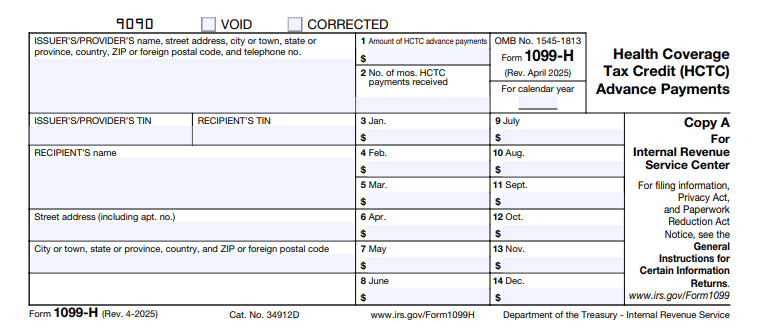
Form 1099-H, titled “Health Coverage Tax Credit (HCTC) Advance Payments,” reports the total advance payments made by the U.S. Department of the Treasury to health insurers on behalf of eligible recipients. These payments represent prepaid portions of the HCTC and are not considered taxable income to the recipient—they’re simply an advance on the tax credit you’ll claim (or reconcile) when filing your taxes.

The form is filed by health insurance providers who received these funds, but in practice, the IRS’s HCTC Program handles most filings unless the provider opts in to do so independently. For tax year 2025, the form and its instructions remain unchanged from prior years, ensuring continuity for any required reporting.

Who Receives Form 1099-H?

Primarily, Form 1099-H is furnished to:

  • Eligible HCTC recipients: Individuals or families who had advance payments applied to their premiums before the program’s end.
  • Health insurance providers: As filers, they (or the IRS) send Copy B to recipients by January 31, 2026, for tax year 2025.

If you’re a former TAA or PBGC recipient reviewing old records, expect this form only if advance payments were processed. Post-2021, new issuances are unlikely due to the expiration. Note: Tax software like TurboTax or TaxAct may prompt for this form if detected in your records.

How to Read and Complete Form 1099-H

Form 1099-H is straightforward, with key boxes detailing payment history. Here’s a breakdown based on the 2025 instructions:

Box Description Example for 2025
1 Total Amount of HCTC Advance Payments Sum of all monthly advances (e.g., $5,200 if 72.5% of $600/month premiums for 12 months). Cannot exceed 72.5% of total premiums.
2 Number of Months HCTC Payments Received Total months covered (max 12, e.g., 8 if coverage started mid-year).
3–14 Monthly Advance Payments Amount per month (e.g., Box 3 for January: $433). Payments may be received early but must align with coverage months.
  • Recipient’s TIN: Your Social Security Number (SSN), ITIN, or ATIN (truncatable on statements to you, but full on IRS copies).
  • Filer’s Info: The insurer’s details.

To complete if filing independently: Download from IRS.gov/Form1099H, enter data accurately, and follow General Instructions for Certain Information Returns.

Filing Requirements and Deadlines for 2025

Health insurance providers must file Form 1099-H if they received HCTC advances, but the IRS HCTC Program defaults to handling this to avoid penalties. If electing to file yourself, notify the program at [email protected].

Key 2025 Deadlines

  • To Recipients: January 31, 2026 (Copy B or substitute statement).
  • To IRS:
    • Paper: February 28, 2026.
    • Electronic: March 31, 2026 (required if filing 10+ forms).

Penalties apply for late or incorrect filing (up to $310 per form), but waivers are available for reasonable cause. Electronic filing via IRS FIRE system is recommended for efficiency.

IRS Form 1099-H Download and Printable

Download and Print: IRS Form 1099-H

How Does Form 1099-H Affect Your Taxes?

Form 1099-H doesn’t create new tax liability—advance payments are reconciled against the HCTC you claim on your return using Form 8885.

  • If advances match your credit: No adjustment needed; the prepaid amount offsets your tax bill.
  • If you overpaid (credit > advances): Claim the difference as a refundable credit.
  • If underpaid: You may owe the shortfall.

These payments help lower premiums upfront but require reporting to avoid IRS notices. For post-2021 coverage, shift to Form 1095-A for PTC reconciliation. Consult a tax professional if your situation involves expired ITINs or truncated TINs on statements.

Frequently Asked Questions (FAQs) About IRS Form 1099-H and HCTC

Is the HCTC still available in 2025?

No, it expired on December 31, 2021. Explore PTC eligibility through HealthCare.gov instead.

Do I need to report Form 1099-H on my 2025 tax return?

Yes, if received—attach it with Form 8885 to claim or reconcile the credit.

What if I didn’t receive a Form 1099-H but think I qualify?

Contact the IRS HCTC Program or your insurer; the IRS may have filed on your behalf.

Can penalties be waived for late 1099-H filing?

Yes, if due to reasonable cause (e.g., program handling errors).

Final Thoughts: Navigating HCTC Legacy in 2025

Though the HCTC program has sunset, IRS Form 1099-H ensures transparency for past advance payments, protecting recipients from unexpected tax surprises. For current health coverage needs, the PTC offers broader support—check eligibility at IRS.gov/ACA. Always use trusted tools like IRS Free File for 2025 returns, and keep records handy.

If this guide helped, share it or bookmark for tax season. For personalized advice, visit IRS.gov or consult a certified tax advisor. Stay compliant and covered!

Last updated: December 2025. Information based on IRS publications for tax year 2025.


IRS Form 1099-G – Certain Government Payments

IRS Form 1099-G - Certain Government Payments

IRS Form 1099-G – Certain Government Payments – If you’ve received unemployment benefits, a state tax refund, or other government payments in 2025, you’re likely familiar with IRS Form 1099-G. This essential tax document reports certain government payments that may be taxable income. Understanding Form 1099-G is crucial for accurate tax filing and avoiding IRS penalties. In this comprehensive guide, we’ll break down everything you need to know about Form 1099-G for the 2025 tax year, including who gets it, what it reports, filing requirements, and tax implications.

Whether you’re a taxpayer wondering “what is IRS Form 1099-G” or a government agency learning “how to file Form 1099-G,” this article has you covered. Let’s dive in.

IRS Form 1099-G - Certain Government Payments
IRS Form 1099-G – Certain Government Payments


What Is IRS Form 1099-G?

IRS Form 1099-G, titled “Certain Government Payments,” is an information return used to report specific payments made by federal, state, or local governments. It’s part of the broader 1099 series of forms designed to track non-wage income that must be reported to the IRS.

Governments issue Form 1099-G to individuals or entities who receive qualifying payments totaling $10 or more (or $600 in some cases). This form helps the IRS ensure that taxable government benefits are included in your income tax return. Unlike W-2 forms for employee wages, 1099-G focuses on one-time or periodic government disbursements.

Key Purposes of Form 1099-G

  • Tracks Taxable Income: Reports amounts that may need to be added to your adjusted gross income (AGI).
  • Ensures Compliance: Helps governments fulfill IRS reporting obligations.
  • Aids Taxpayers: Provides the exact figures needed for Schedule 1 (Form 1040) or other tax forms.

As of 2025, recent IRS guidance in Revenue Ruling 2025-4 clarifies the tax treatment of state paid family and medical leave programs, requiring separate 1099-G forms for contributory programs like California’s Family Temporary Disability Insurance. Additionally, payments for lead service line replacements are exempt from reporting, per Announcement 2024-10.

Who Must File Form 1099-G?

Only units of federal, state, or local governments are required to file Form 1099-G. This includes agencies handling unemployment offices, tax refund processing, or agricultural subsidies. Private entities do not file this form—it’s exclusively for government payers.

The responsible party is typically the officer or employee controlling the payments, or a designated representative. If backup withholding (24% federal tax) applies due to missing or incorrect taxpayer ID numbers, a 1099-G must be issued regardless of the payment amount.

Who Receives Form 1099-G?

Taxpayers receive it if they got:

  • Unemployment Compensation: Including Railroad Retirement Board benefits or state paid family leave from contributory programs ($10+).
  • State/Local Tax Refunds: Refunds, credits, or offsets of $10+, but only if you itemized deductions in the prior year (otherwise, no copy to recipient, but still filed with IRS).
  • Reemployment Trade Adjustment Assistance (RTAA): $600+ for trade-impacted workers.
  • Taxable Grants: $600+ for energy conservation, tribal programs, or other subsidized projects (scholarships excluded).
  • Agricultural Payments: USDA subsidies, including market facilitation ($600+).
  • Commodity Credit Corporation (CCC) Loan Repayments: Market gain on loans.

If you’re a nominee receiving payments for another, report to the actual owner.

What Does Form 1099-G Report? A Breakdown of the Boxes

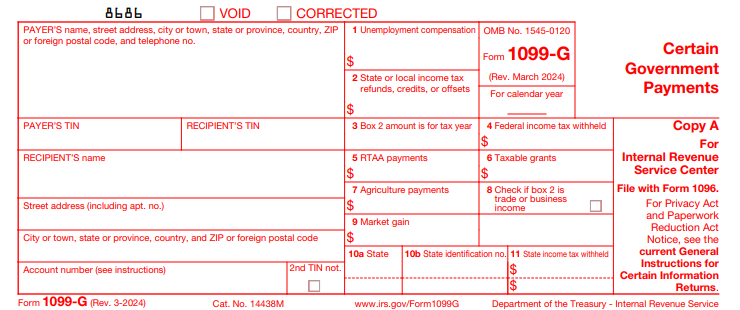
Form 1099-G has several boxes detailing the payment type and amounts. Here’s a quick overview for the 2025 revision:

Box Description Reporting Threshold
1 Unemployment compensation (total before withholding) $10+
2 State/local income tax refunds, credits, or offsets $10+
3 Tax year for Box 2 amount (e.g., “2024”) N/A (if prior year)
4 Federal income tax withheld (backup or voluntary) N/A
5 RTAA payments $600+
6 Taxable grants (e.g., energy subsidies) $600+
7 Agriculture payments (USDA subsidies) $600+
8 Checkbox: Trade/business income tax refund N/A
9 Market gain on CCC loan N/A
10a-11 State info (withholding, ID; optional for IRS) N/A

Interest on refunds under $600 can be noted on Copy B, but use Form 1099-INT for $600+. Always enter amounts before withholding, and use “YYYY” format for dates.

How to Get Your Form 1099-G

  • From Government Agencies: Expect it by January 31, 2026, for 2025 payments (mailed or electronic if consented).
  • If Missing: Contact the issuing agency (e.g., state unemployment office) immediately—don’t wait until tax deadline.
  • Online Access: Many states offer portals for downloading; check your state’s revenue department website.

Electronic delivery requires your consent and must follow IRS rules, including website posting through October 15, 2026.

Tax Implications: How to Report Form 1099-G on Your Return

Form 1099-G income is generally taxable, but not always fully. Here’s how to handle it on your 2025 Form 1040:

  • Unemployment (Box 1): Report on Schedule 1, line 7. Fully taxable unless offset by qualified adjustments.
  • Tax Refunds (Box 2): Taxable only if you itemized deductions in the prior year and got a tax benefit. Use the IRS “State and Local Tax Refund Worksheet” in Pub. 525. Not taxable if you took the standard deduction.
  • RTAA/Grants/Ag Payments (Boxes 5-7): Report on Schedule 1, line 8 (other income). May qualify for exclusions or credits—consult Pub. 525.
  • Withholding (Box 4): Credits against your tax liability on Form 1040, line 25b.

Failing to report can trigger IRS notices or audits. Use tax software like TurboTax, which imports 1099-G data seamlessly.

Filing Deadlines and Requirements for Governments

Government filers must adhere to strict timelines for the 2025 tax year:

  • Furnish to Recipients: January 31, 2026.
  • File with IRS: Paper by February 28, 2026; electronic by March 31, 2026.

Electronic filing is mandatory if submitting 10+ information returns (all 1099 types combined). Use the FIRE System or IRIS Taxpayer Portal. Request waivers via Form 8508 for hardships.

Penalties apply for late filing: $60 per return (up to $1,296,000 max), escalating for intentional disregard.

IRS Form 1099-G Download and Printable

Download and Print: IRS Form 1099-G

Common Mistakes to Avoid with Form 1099-G

  • Forgetting Thresholds: Don’t skip $10+ unemployment or refunds.
  • Incorrect Tax Year: Use Box 3 for prior-year refunds.
  • No Recipient Copy for Non-Itemizers: Still file with IRS.
  • Backup Withholding Oversights: Always report 24% withheld.

FAQs About IRS Form 1099-G

When will I receive my 2025 Form 1099-G?

By January 31, 2026, from the government agency.

Is unemployment on 1099-G taxable?

Yes, fully taxable as income.

Do I need to file a 1099-G for small payments?

Only if $10+ for unemployment/refunds or $600+ for others.

What if my state tax refund isn’t taxable?

Calculate via the IRS worksheet; it may reduce your tax bill if overreported.

How do I correct a 1099-G error?

File Form 1096 with marked “CORRECTED” and resubmit.

Final Thoughts: Stay Compliant with Form 1099-G in 2025

IRS Form 1099-G ensures transparency for government payments, but staying on top of deadlines and reporting rules is key to smooth tax season. With updates like expanded family leave guidance, 2025 brings nuanced changes—bookmark IRS.gov for the latest.

For personalized advice, consult a tax professional or use IRS Free File. Ready to file? Download the 2025 Form 1099-G PDF from IRS.gov today.

Sources: Official IRS publications as of March 2025.


IRS Form 1099-DIV – Dividends and Distributions

IRS Form 1099-DIV - Dividends and Distributions

IRS Form 1099-DIV – Dividends and Distributions – Dividends and distributions from investments are a key source of passive income for many Americans, but they come with important tax obligations. If you’re an investor receiving payouts from stocks, mutual funds, or real estate investment trusts (REITs), understanding IRS Form 1099-DIV is essential. This form reports dividends and distributions to both you and the IRS, ensuring accurate tax reporting.

In 2025, as tax season approaches for the 2024 tax year, staying compliant with Form 1099-DIV requirements can help you avoid penalties and maximize deductions. This guide breaks down everything you need to know about Form 1099-DIV dividends and distributions, from filing rules to box-by-box explanations. Whether you’re a payer issuing the form or a recipient using it for your return, we’ve got you covered with insights from official IRS sources.

IRS Form 1099-DIV - Dividends and Distributions
IRS Form 1099-DIV – Dividends and Distributions


What Is IRS Form 1099-DIV?

IRS Form 1099-DIV, officially titled “Dividends and Distributions,” is an information return used by financial institutions to report certain payments to the IRS and taxpayers. Payers—such as banks, brokerage firms, mutual funds, and corporations—must issue this form when they distribute dividends, capital gains, or other payouts exceeding specific thresholds.

The primary purpose of Form 1099-DIV is to track taxable income from investments. It helps the IRS verify that individuals and entities report these earnings correctly on their tax returns, like Form 1040. For tax year 2024 (filed in 2025), the form remains in continuous use, meaning updates are made as needed without annual revisions.

Common types of payments reported include:

  • Ordinary dividends from stocks or funds.
  • Qualified dividends eligible for lower tax rates.
  • Capital gain distributions from mutual funds.
  • Exempt-interest dividends from municipal bonds.
  • Liquidation distributions from corporate wind-downs.

If you’re unsure if a payment qualifies as a dividend, err on the side of reporting it—better safe than audited.

Who Must File Form 1099-DIV?

Not everyone dealing with investments needs to file Form 1099-DIV, but payers have clear responsibilities. You must file if you paid any of the following to a person during the tax year:

  • At least $10 in dividends (including capital gain or exempt-interest dividends) or other distributions in money or property.
  • Any foreign tax withheld on dividends or distributions.
  • Backup withholding on dividends (federal income tax withheld due to missing TIN).
  • $600 or more in liquidation distributions.

Exceptions: When You Don’t Need to File

Certain payments are exempt to avoid duplicate reporting:

  • Taxable dividends from life insurance contracts or employee stock ownership plans (use Form 1099-R instead).
  • Substitute payments in lieu of dividends (report on Form 1099-MISC).
  • Payments to corporations, tax-exempt organizations, IRAs, HSAs, government entities, or registered dealers.

If a distribution might be a dividend but you’re uncertain by the filing deadline, report the full amount as ordinary dividends to stay compliant.

Key Deadlines for Form 1099-DIV in 2025

Timing is critical for 1099-DIV tax reporting. For the 2024 tax year, key dates include:

Action Deadline Notes
Furnish to Recipients January 31, 2025 Send Copy B to individuals by this date.
File with IRS February 28, 2025 (paper) or March 31, 2025 (electronic) Extensions available via Form 8809 (up to 30 days).
State Reporting (if required) Varies by state Check state tax agency for specifics.

Missing these can trigger penalties starting at $60 per form, escalating to $630 for intentional disregard. Always use certified mail for paper filings.

IRS Form 1099-DIV Download and Printable

Download and Print: IRS Form 1099-DIV

Breaking Down the Boxes on Form 1099-DIV

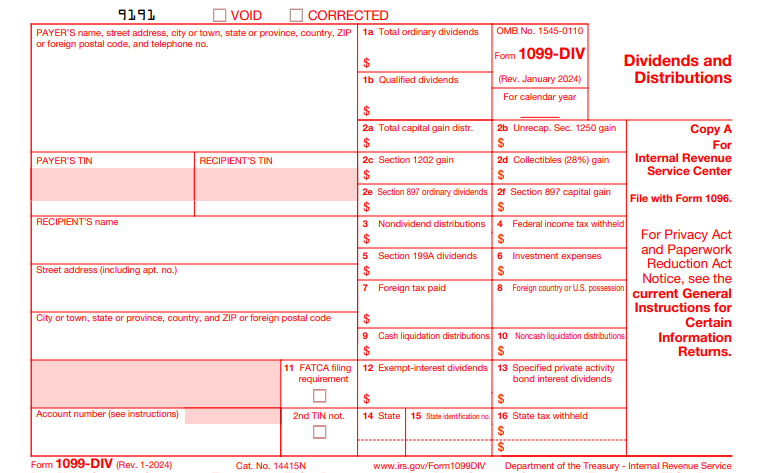
Form 1099-DIV features 16 boxes, each detailing a specific type of distribution or withholding. Understanding these ensures accurate dividends and distributions reporting. Here’s a box-by-box guide based on the latest instructions:

  • Box 1a: Total Ordinary Dividends – The bulk of reportable dividends, including money market fund payouts, short-term capital gains from mutual funds, and reinvested amounts. S corporations report only from accumulated earnings.
  • Box 1b: Qualified Dividends – Portion of Box 1a eligible for preferential capital gains rates (0%, 15%, or 20%). Must meet holding period rules (e.g., 61+ days for common stock).
  • Box 2a: Total Capital Gain Distributions – Long-term capital gains passed through from funds or trusts.
  • Box 2b: Unrecaptured Section 1250 Gain – Gain from depreciable real estate, taxed at up to 25%.
  • Box 2c: Section 1202 Gain – Exclusion-eligible gain from qualified small business stock (up to 100% exclusion).
  • Box 2d: Collectibles (28%) Gain – Gains from collectibles like art or coins, taxed at 28%.
  • Box 2e: Section 897 Ordinary Dividends – Gain from U.S. real property interests (for non-U.S. persons via RICs/REITs).
  • Box 2f: Section 897 Capital Gain – Similar to 2e but for capital gains on U.S. real property.
  • Box 3: Nondividend Distributions – Return of capital, reducing your stock basis (not taxed until basis hits zero).
  • Box 4: Federal Income Tax Withheld – Backup withholding amount (24% rate in 2024).
  • Box 5: Section 199A Dividends – Qualified business income from REITs or funds, eligible for 20% deduction.
  • Box 6: Investment Expenses – Allocable expenses from non-publicly traded funds (deductible on Schedule A).
  • Box 7: Foreign Tax Paid – Taxes withheld by foreign governments (claim as credit on Form 1116).
  • Box 8: Foreign Country or U.S. Possession – Identifies the source country for Box 7 amounts.
  • Box 9: Cash Liquidation Distributions – Cash from corporate liquidations (taxed as capital gains if exceeding basis).
  • Box 10: Noncash Liquidation Distributions – Fair market value of property from liquidations.
  • Box 11: FATCA Filing Requirement – Checked for Foreign Account Tax Compliance Act reporting.
  • Box 12: Exempt-Interest Dividends – Tax-free interest from municipal bonds (still reportable for AMT).
  • Box 13: Specified Private Activity Bond Interest Dividends – Portion of Box 12 subject to alternative minimum tax.
  • Boxes 14–16: State Information – State-specific withholdings and payer details (optional federally).

Include an account number if you have multiple accounts per recipient for easier IRS matching.

Electronic Filing Requirements for 1099-DIV

Starting with returns due in 2025 (for 2024), the IRS mandates electronic filing if you submit 10 or more information returns (including all 1099 types) in aggregate. This threshold dropped from 250 in prior years under the Taxpayer First Act.

Benefits of e-filing:

  • Faster processing and fewer errors.
  • Free File Information Returns (FIRE) system at IRS.gov.
  • Required for large-volume filers; waivers rare.

If under 10, paper filing is allowed via Form 1096 transmittal.

Backup Withholding and Foreign Tax on Form 1099-DIV

Backup withholding kicks in at 24% if a recipient doesn’t provide a valid TIN (via W-9) or is subject to IRS notices. Report it in Box 4 and remit to the IRS quarterly.

For international investors, Box 7 captures foreign taxes paid, which recipients can claim as a credit. Box 11 flags FATCA compliance for U.S. accounts held by foreign financial institutions.

Common Mistakes with Form 1099-DIV and How to Correct Them

Even seasoned filers slip up. Top pitfalls:

  • Forgetting to report reinvested dividends (they’re taxable!).
  • Misclassifying qualified vs. ordinary dividends, leading to overpayment.
  • Late filing without requesting an extension.

To correct: File an amended return marked “Corrected” with the original and updated info. Use the same deadlines as originals.

How to Use Form 1099-DIV on Your Tax Return

Recipients: Transfer Box 1a ordinary dividends to Schedule B (if over $1,500) and Form 1040, line 3b. Qualified dividends (Box 1b) go to the Qualified Dividends and Capital Gain Tax Worksheet for lower rates. Capital gains (Box 2a) flow to Schedule D.

Payers: Download the form PDF from IRS.gov and use tax software for bulk filing.

Frequently Asked Questions (FAQs) About IRS Form 1099-DIV

1. When will I receive my 1099-DIV in 2025?

By January 31, 2025, for 2024 activity.

2. Do I need a 1099-DIV for Roth IRA distributions?

No—Roth distributions are generally non-reportable on 1099-DIV.

3. What if I didn’t receive a 1099-DIV but earned dividends?

Contact your broker; you’re still required to report the income.

4. Are there penalties for not filing Form 1099-DIV?

Yes, up to $630 per form for intentional failures.

5. How has Form 1099-DIV changed for 2025?

No major form changes, but e-filing is now required for 10+ returns.

For the latest updates, visit IRS.gov/forms-pubs/about-form-1099-div. Consult a tax professional for personalized advice—investing wisely starts with compliant reporting.

This article is for informational purposes only and not tax advice. Always refer to official IRS guidance.


IRS Form 1099-C – Cancellation of Debt

IRS Form 1099-C - Cancellation of Debt

IRS Form 1099-C – Cancellation of Debt – In today’s economy, debt relief can feel like a lifeline—whether it’s forgiving a mortgage shortfall after foreclosure or settling credit card balances through negotiation. But there’s a catch: the IRS often views canceled debt as taxable income. Enter IRS Form 1099-C, Cancellation of Debt, a document that reports these events and could significantly impact your tax bill. If you’re dealing with debt forgiveness in 2025, knowing how this form works is crucial to avoid surprises come tax time.

This comprehensive guide breaks down everything you need to know about Form 1099-C, from issuance triggers to reporting requirements and key exclusions. We’ll draw on official IRS guidance to ensure you’re armed with accurate, up-to-date information for the 2025 tax year.

IRS Form 1099-C - Cancellation of Debt
IRS Form 1099-C – Cancellation of Debt


What Is IRS Form 1099-C?

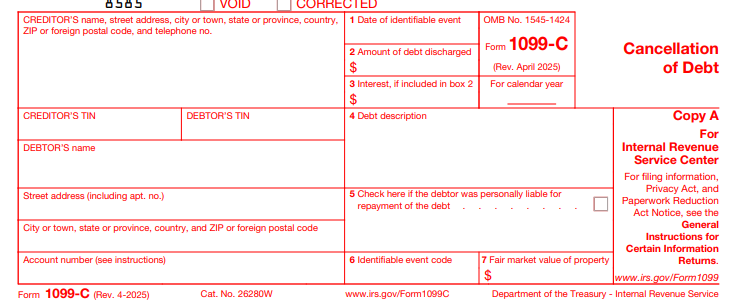
IRS Form 1099-C is an information return used by creditors to report the cancellation, forgiveness, or discharge of a debt of $600 or more. It’s not a bill or a penalty—it’s simply a notification to both you (the debtor) and the IRS that a portion of your debt has been erased.

Key Details on the Form

  • Box 1: The amount of canceled debt.
  • Box 2: The date of identifiable event (e.g., when the cancellation occurred).
  • Box 3: Interest included in the canceled amount.
  • Box 4: Description of the debt (e.g., nonrecourse vs. recourse).

Creditors, such as banks or financial institutions, must file this form if an “identifiable event” happens, like a foreclosure or the expiration of the statute of limitations on collection. For 2025, the threshold remains $600, with no changes to filing requirements.

When Is Form 1099-C Issued?

Lenders aren’t required to send a 1099-C for every small write-off. It’s triggered only when:

  • The canceled debt totals $600 or more.
  • You’re dealing with an “applicable financial entity” (e.g., banks, credit unions).
  • An identifiable event occurs, such as:
    • Bankruptcy filing.
    • Foreclosure or repossession.
    • Cancellation due to insolvency.
    • Expiration of the collection statute (typically 3-6 years).

Expect to receive your form by January 31 of the year following the cancellation—for instance, debt forgiven in 2025 means a form by January 31, 2026. If you don’t get one but suspect debt was canceled, contact your creditor; the IRS still expects you to report it.

Tax Implications of Cancellation of Debt in 2025

Here’s the big one: The IRS treats most canceled debt as ordinary income, just like wages or interest. Why? Because forgiveness means you received economic benefit without paying for it.

How It Affects Your Taxes

  • Taxable Amount: Add the canceled debt to your gross income, potentially pushing you into a higher bracket.
  • Example: If $10,000 of credit card debt is forgiven in 2025, you could owe taxes on that full amount at your marginal rate (e.g., 22% federal = $2,200 owed, plus state taxes).
  • Secured vs. Unsecured Debt:
    • Unsecured (e.g., credit cards): Straight income.
    • Secured (e.g., mortgage): Treated as a sale of the property. For recourse loans, calculate gain/loss based on fair market value (FMV); for nonrecourse, the full debt is the amount realized.

In 2025, with inflation-adjusted brackets, this could sting more for middle-income filers. Always consult a tax pro for personalized math.

IRS Form 1099-C Download and Printable

Download and Print: IRS Form 1099-C

Exceptions and Exclusions: When Canceled Debt Isn’t Taxable

Not all forgiveness triggers a tax hit. The IRS offers several exclusions for Form 1099-C in 2025, but you must qualify and often file Form 982 to claim them.

Exclusion Type Details Eligibility Window (2025)
Bankruptcy (Title 11) Debt discharged in bankruptcy isn’t income. Any time; no expiration.
Insolvency Exclude up to the amount you’re insolvent (liabilities > assets). Use IRS worksheet in Pub. 4681. Applies if calculated at cancellation date.
Qualified Principal Residence Mortgage forgiveness on your main home. Discharged before Jan. 1, 2026, or under agreement before then.
Student Loans Forgiveness for public service, teaching, or certain programs. Discharges from Jan. 1, 2021, to Dec. 31, 2025, are tax-free federally.
Farm/Real Property Business Debt Qualified farm or business real estate loans. Ongoing exclusion.
Gifts/Inheritances Debt canceled as a gift. No tax if truly a gift.

Pro Tip: Exclusions may require reducing your basis in assets or other tax attributes—track this carefully to avoid future audits.

How to Report Form 1099-C on Your 2025 Tax Return

Even if you qualify for an exclusion, report the income and subtract it via Form 982.

Step-by-Step Reporting

  1. Gather Forms: Use your 1099-C and any supporting docs (e.g., insolvency worksheet).
  2. Nonbusiness Debt: Report on Schedule 1 (Form 1040), line 8c as “other income.” Attach Form 982 for exclusions.
  3. Business Debt: Use Schedule C or F.
  4. If Incorrect: Dispute with the creditor before filing; the IRS won’t accept “they were wrong” without evidence.
  5. E-Filing: Tools like TurboTax handle 1099-C imports seamlessly.

File by April 15, 2026 (or October extension). Missing it? Penalties start at $50 per form, plus interest.

Common Scenarios Involving Form 1099-C

  • Home Foreclosure: If your lender forgives the shortfall, expect a 1099-C. But the principal residence exclusion could save you through 2025.
  • Debt Settlement: Negotiating a lump-sum payoff often triggers this—factor taxes into your settlement math.
  • Student Loan Forgiveness: Biden-era programs remain tax-free for 2025 discharges.

FAQs About IRS Form 1099-C and Cancellation of Debt

Do I have to pay taxes on all canceled debt in 2025?

No—check exclusions like insolvency or student loans. But report everything anyway.

What if I never receive a 1099-C?

You’re still responsible for reporting; contact your lender.

Can I deduct canceled debt taxes?

No, but exclusions prevent inclusion in income.

Is there a 2025 update to Form 1099-C rules?

No major changes; student and mortgage relief windows close soon (end of 2025/2026).

Final Thoughts: Navigate Cancellation of Debt Wisely in 2025

Receiving an IRS Form 1099-C doesn’t have to derail your finances—it’s a signal to review your tax strategy. With exclusions available for student loans and home debt through 2025, many can offset the income hit. Stay proactive: Track your debts, consult a CPA, and download Pub. 4681 from IRS.gov for worksheets.

Debt relief is progress, but taxes are part of the equation. For personalized advice, visit IRS.gov or a trusted tax advisor. Have questions? Drop them in the comments below!

Last updated: December 2025. Always verify with official IRS sources for your situation.


IRS Form 1023-EZ – Streamlined Application for Recognition of Exemption Under Section 501(c)(3) of the Internal Revenue Code

IRS Form 1023-EZ - Streamlined Application for Recognition of Exemption Under Section 501(c)(3) of the Internal Revenue Code

IRS Form 1023-EZ – Streamlined Application for Recognition of Exemption Under Section 501(c)(3) of the Internal Revenue Code – Starting a nonprofit organization is an exciting step toward making a positive impact, but navigating the IRS bureaucracy can feel overwhelming. If your group is small-scale with modest finances, the IRS Form 1023-EZ offers a fast-track to 501(c)(3) tax-exempt status. This streamlined application simplifies the process, slashing paperwork and wait times compared to the full Form 1023. In this comprehensive guide, we’ll cover everything from eligibility to filing tips, updated for 2025 changes. Whether you’re launching a local charity or community initiative, understanding IRS Form 1023-EZ can save you time, money, and headaches.

IRS Form 1023-EZ - Streamlined Application for Recognition of Exemption Under Section 501(c)(3) of the Internal Revenue Code
IRS Form 1023-EZ – Streamlined Application for Recognition of Exemption Under Section 501(c)(3) of the Internal Revenue Code


What Is IRS Form 1023-EZ?

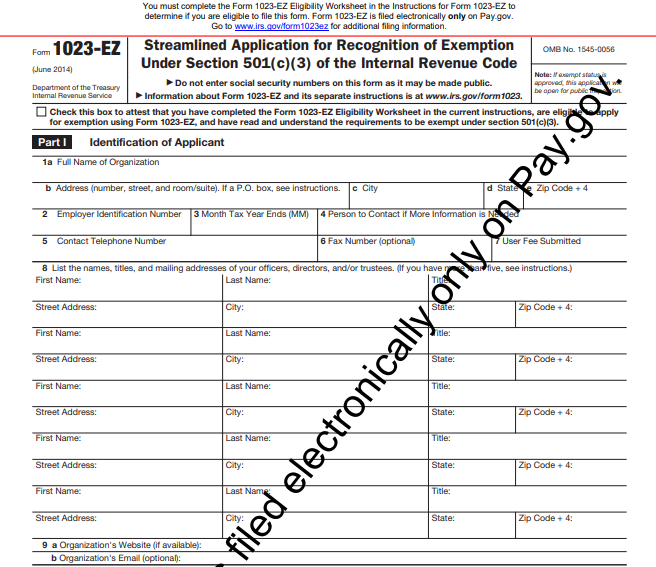
IRS Form 1023-EZ, officially titled the “Streamlined Application for Recognition of Exemption Under Section 501(c)(3) of the Internal Revenue Code,” is a shortened version of the traditional Form 1023. Introduced in 2014 to ease the burden on small nonprofits, it allows eligible organizations to self-certify their compliance with 501(c)(3) requirements without submitting extensive narratives or financial projections.

The form’s purpose is straightforward: to obtain IRS recognition of your organization’s tax-exempt status under Section 501(c)(3). This exemption means your nonprofit won’t pay federal income tax on mission-related income and can receive tax-deductible donations from supporters. It’s ideal for grassroots groups, but remember—it’s not automatic. The IRS reviews submissions and can request more info if needed.

Key benefits include:

  • Shorter form: Just three pages versus the 12+ pages of Form 1023.
  • Lower cost: $275 user fee (versus $600 for the full form).
  • Faster approval: 80% of applications processed within 22 days.

Who Is Eligible for IRS Form 1023-EZ in 2025?

Not every nonprofit qualifies for this shortcut. Eligibility hinges on size, structure, and activities—determined via the Form 1023-EZ Eligibility Worksheet in the instructions. Answer “Yes” to any question? You’re ineligible and must file the full Form 1023.

Core Financial Thresholds

To qualify, your organization must meet both:

  • Projected annual gross receipts of $50,000 or less for each of the next three years (and actual receipts under $50,000 in the past three years if applicable).
  • Total assets of $250,000 or less at filing.

Structural and Activity Restrictions

Beyond finances, exclusions include:

  • Certain organization types: Churches, schools, hospitals, supporting organizations, private operating foundations, donor-advised funds, and more.
  • Business structures: LLCs, for-profits, or successors to suspended entities.
  • International elements: Formed outside the U.S. or with a foreign mailing address.
  • Prior issues: Previously revoked status (except automatic revocations for non-filing, with reinstatement rules).
  • Complex activities: Involvement in partnerships sharing losses, carbon credit trading, HMOs, ACOs, credit counseling, or non-publicly traded investments.

The 2025 Eligibility Worksheet adds questions on annual gross receipts, total assets, and public charity classification to ensure accurate self-assessment. For reinstated organizations, Question 29 now requires applying for the same foundation classification as before revocation.

Key 2025 Updates to IRS Form 1023-EZ

The IRS revised Form 1023-EZ in early 2025 to better support small charities while maintaining the $275 fee. These tweaks, effective January 2025, stem from recommendations by the IRS National Taxpayer Advocate.

Major changes:

  • New mission description box: Part III now includes a 250-character field for your organization’s mission or key activities, helping the IRS quickly grasp your exempt purposes.
  • Added self-certification questions: Directly on the form for gross receipts, assets, and public charity status—mirroring the worksheet for transparency.
  • Reinstatement clarification: Stricter rules for automatically revoked groups to prevent mismatches in classification.

These updates make the form more user-friendly without altering core eligibility. Download the latest PDF instructions from IRS.gov for full details.

Step-by-Step Guide: How to File IRS Form 1023-EZ

Filing is 100% electronic via Pay.gov—no paper accepted. Expect 1-2 hours to complete if prepared. Here’s the breakdown:

Step 1: Confirm Eligibility and Gather Documents

  • Finish the Eligibility Worksheet.
  • Obtain an EIN (free at IRS.gov/EIN).
  • Prepare organizing documents (articles of incorporation with 501(c)(3)-compliant purpose and dissolution clauses) and bylaws.

Step 2: Register on Pay.gov

  • Create an account at Pay.gov.
  • Search for “Form 1023-EZ” and start the application.

Step 3: Complete the Form

The form has six parts—keep responses concise:

  • Part I: Identification: Name, address, EIN, officers (up to 5).
  • Part II: Structure: Entity type (corp, association, trust), formation details, purpose/dissolution clauses.
  • Part III: Activities (Updated in 2025): Mission description, NTEE code, exempt purposes, yes/no on lobbying, private inurement, foreign grants, etc.
  • Part IV: Classification: Public charity or private foundation (use 5-year support tests if needed).
  • Part V: Reinstatement: For revoked orgs only.
  • Part VI: Signature: Electronic by an authorized principal.

Step 4: Pay and Submit

  • Pay the $275 fee via Pay.gov.
  • Submit and print a copy for records. Track status at IRS.gov/teos.

Processing Time: Most approvals in under a month, but full reviews can take 8-12 weeks. Expedited requests aren’t available for 1023-EZ.

IRS Form 1023-EZ Download and Printable

Download and Print: IRS Form 1023-EZ

Common Mistakes to Avoid When Filing Form 1023-EZ

Even with its simplicity, errors can delay approval or lead to denial. Top pitfalls:

  • Ineligibility oversights: Skipping the worksheet and filing anyway—results in rejection.
  • Non-charitable mission: Activities that seem private-benefit focused (e.g., benefiting insiders).
  • Incomplete docs: Forgetting compliant articles or bylaws.
  • Underestimating thresholds: Projecting growth that pushes over $50k receipts.
  • Missing disclosures: Not flagging potential unrelated business income or foreign activities.

Consult a tax pro for complex cases to sidestep these.

Form 1023 vs. 1023-EZ: When to Choose Each in 2025

Stuck between forms? Use 1023-EZ for simple, small orgs under the thresholds—it’s quicker and cheaper. Opt for the full Form 1023 if:

  • You’re larger (over $50k receipts/assets).
  • Complex structure (e.g., schools, hospitals).
  • Need detailed IRS feedback for grants/funding.
Feature Form 1023-EZ Form 1023
Length 3 pages 12+ pages + attachments
Fee $275 $600
Eligibility Small/simple orgs All 501(c)(3) applicants
Processing 22 days (80%) 3-6 months average
Best For Startups under $50k Established/complex nonprofits

FAQs About IRS Form 1023-EZ

Q: Can I file Form 1023-EZ retroactively?
A: Exemption starts from your formation date if approved, but file within 27 months for retro benefits.

Q: What if my application is denied?
A: You can refile with Form 1023 or appeal—common for eligibility errors.

Q: Do I need a lawyer?
A: Not always, but recommended for first-timers to ensure compliance.

Final Thoughts: Unlock Your Nonprofit’s Potential with Form 1023-EZ

IRS Form 1023-EZ democratizes tax exemption for small do-gooders, letting you focus on impact over paperwork. With 2025’s user-friendly updates, now’s the perfect time to apply. Head to Pay.gov, double-check eligibility, and get exempt—your mission awaits. For the latest, visit IRS.gov/charities-non-profits.

This article is for informational purposes; consult a tax advisor for personalized advice.


IRS Form 1120-S – U.S. Income Tax Return for an S Corporation

IRS Form 1120-S - U.S. Income Tax Return for an S Corporation

IRS Form 1120-S – U.S. Income Tax Return for an S Corporation – As an S corporation owner, navigating U.S. federal income tax requirements is essential for maintaining compliance and maximizing pass-through benefits. IRS Form 1120-S, the U.S. Income Tax Return for an S Corporation, is the key document for reporting your business’s income, deductions, credits, and other items. Filed annually, it ensures that profits and losses flow directly to shareholders’ personal tax returns, avoiding double taxation at the corporate level.

In this comprehensive guide, we’ll cover everything you need to know about Form 1120-S for tax year 2025—from eligibility and deadlines to filing tips and recent updates. Whether you’re a first-time filer or refreshing your knowledge, this resource is designed to help you file accurately and on time. Let’s dive in.

IRS Form 1120-S - U.S. Income Tax Return for an S Corporation
IRS Form 1120-S – U.S. Income Tax Return for an S Corporation


What Is IRS Form 1120-S?

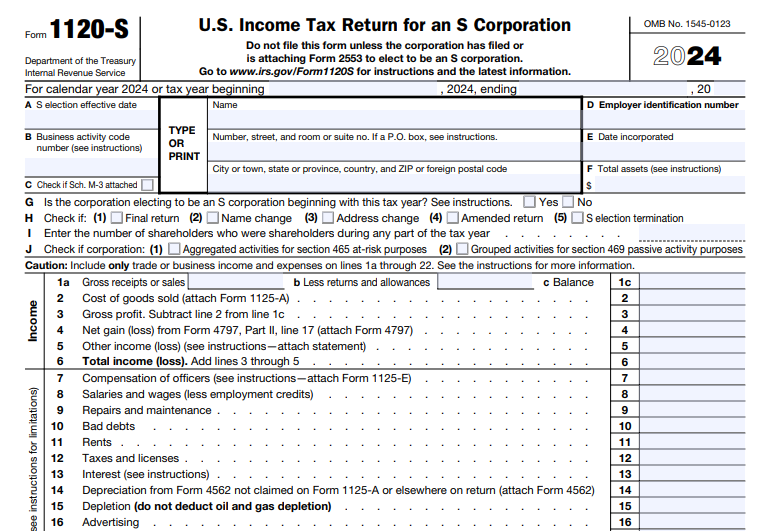
IRS Form 1120-S is the official tax return used by domestic S corporations to report their financial activities for the tax year. Unlike C corporations, which pay taxes at the entity level, S corps are pass-through entities. This means the form doesn’t calculate a corporate tax liability; instead, it aggregates income, gains, losses, deductions, and credits on Schedule K, which are then allocated to shareholders via individual Schedule K-1 forms.

The form covers:

  • Ordinary business income or loss from trade or business activities.
  • Rental real estate income (via Form 8825).
  • Portfolio income like interest and dividends.
  • Capital gains and losses (via Schedule D).
  • Deductions such as salaries, depreciation, and interest.
  • Credits for items like low-income housing or research expenses.

For tax year 2025, the form remains structurally similar to prior years, but includes enhanced reporting for digital assets and new elections for certain deductions.

Who Must File Form 1120-S?

Not every business files Form 1120-S—it’s specifically for entities that have elected S corporation status under Subchapter S of the Internal Revenue Code. To qualify:

  • The entity must be a domestic corporation or eligible entity (e.g., LLC) with no more than 100 shareholders.
  • All shareholders must be U.S. citizens, residents, certain trusts, or estates (no partnerships or corporations as owners).
  • Only one class of stock is allowed.

You must file if:

  • Your S election (via Form 2553) is in effect and accepted by the IRS.
  • The corporation was engaged in a trade or business during the year.
  • Gross receipts were $250,000 or more, or total assets exceeded $250,000 (even if no income).

Exemptions apply to dormant entities with no activity. If your S status terminates (e.g., due to excess passive income over three years), revert to Form 1120 for C corp filing.

Due Dates and Extensions for Form 1120-S in 2025

Timing is critical to avoid penalties. For calendar-year S corporations (January 1–December 31, 2025), the due date is March 15, 2026. If the 15th falls on a weekend or holiday, it’s the next business day (e.g., March 16, 2026).

Tax Year End Due Date Without Extension Extended Due Date (Form 7004)
December 31, 2025 (Calendar) March 15, 2026 September 15, 2026
Fiscal Year Ending June 30, 2025 September 15, 2025 December 15, 2025
Fiscal Year Ending September 30, 2025 December 15, 2025 March 15, 2026
  • Extensions: File Form 7004 by the original due date for an automatic six-month extension. No reason needed, but it doesn’t extend payment deadlines—pay any estimated tax owed to avoid penalties.
  • Dissolved Corporations: File by the 15th day of the third month after dissolution.
  • Short Years: Adjust based on the tax year length.

Always check IRS Publication 509 for the full 2026 tax calendar.

How to File Form 1120-S: Electronic vs. Paper Options

The IRS strongly encourages electronic filing (e-file) for faster processing and fewer errors. Mandatory e-filing applies if:

  • Your S corp filed 10 or more returns (e.g., Forms 940, 941) in the prior year.
  • Total assets are $10 million or more at year-end.

Paper filing is allowed otherwise, but mail to:

  • Without payment: Department of the Treasury, Internal Revenue Service, Ogden, UT 84201-0013.
  • With payment: Internal Revenue Service, P.O. Box 409101, Ogden, UT 84409.

Payments over $25,000 must be electronic via EFTPS. Use tax software like TurboTax Business or hire a CPA for complex returns.

Required Schedules and Forms for Form 1120-S

Form 1120-S requires several attachments, depending on your activities. Attach them in numerical order, and complete every line—use “See Attached” only for detailed statements.

Schedule/Form When Required Purpose
Schedule K Always Aggregates pass-through items for shareholders.
Schedule K-1 One per shareholder Reports each shareholder’s pro rata share (furnish by due date).
Schedule B Always Business activity and ownership info.
Schedule L If assets ≥$250K Balance sheet per books.
Schedule M-1 If Schedule L required Book-to-tax income reconciliation.
Schedule M-2 Always Accumulated adjustments account analysis.
Schedule M-3 Assets ≥$10M Detailed book-to-tax reconciliation.
Schedule D & Form 8949 Capital transactions Gains/losses from asset sales.
Form 4797 Business property sales Ordinary gains/losses.
Form 8825 Rental real estate Income and expenses.
Form 1125-A Inventory sold Cost of goods sold.
Form 3800 Business credits General credits like R&D or energy.
Schedules K-2/K-3 International activity Foreign tax items (exceptions expanded for 2025).

For full list, see the 2025 instructions.

Step-by-Step Guide to Completing Form 1120-S

Filling out Form 1120-S involves gathering financials from your books. Use accrual or cash method consistently.

  1. Header Info: Enter name, EIN, address, business code (from NAICS), and total assets (from Schedule L).
  2. Income Section (Lines 1–6): Report gross receipts (Line 1a), less returns (1b) and COGS (2 via Form 1125-A), plus other business income (5).
  3. Deductions (Lines 7–20): Detail officer compensation (7), salaries (8), repairs (9), rents (11), taxes (12), interest (13, limited by §163(j)), depreciation (14 via Form 4562), and other (19).
  4. Ordinary Income (Line 22): Total income minus deductions.
  5. Taxes and Credits (Lines 23–28): Compute built-in gains tax (23b), credits (24), and balance due/refund.
  6. Schedules: Complete K for aggregates, K-1s for allocations, and others as needed.

Pro tip: Use IRS worksheets for complex items like QBI deductions (Form 8995).

IRS Form 1120-S Download and Printable

Download and Print: IRS Form 1120-S

Common Mistakes to Avoid When Filing Form 1120-S

  • Incomplete K-1s: Forgetting to issue or delaying shareholder statements.
  • Misclassifying Income: Mixing rental/portfolio with business income.
  • Balance Sheet Errors: Inconsistent book vs. tax basis on Schedule L.
  • Missing Attachments: Forgetting Form 4562 for depreciation.
  • Digital Asset Oversight: Failing to check the “Yes” box if your S corp handled crypto in 2025.

Double-check with tax software or a professional to catch these.

Penalties for Late or Incorrect Filing of Form 1120-S

Non-compliance can be costly:

  • Late Filing: $290 per month per shareholder (up to 12 months); minimum $525 if over 60 days late for 2026 returns.
  • Late K-1: $340 per form (up to $3,400 max).
  • Underpayment: 0.5% per month on unpaid tax (up to 25%).
  • Estimated Tax Penalty: If underpayment exceeds $1,000 (Form 2220).

Reasonable cause waivers are possible—document everything.

Recent Updates for IRS Form 1120-S in Tax Year 2025

The IRS released draft instructions in 2025 with key changes:

  • Research Expenses (§174): New election to deduct or amortize pre-2025 amounts (code BA on K-1).
  • Farmland Sales (§1062): Separate Schedule A per qualified sale; report via code ZZ.
  • Rural Loan Interest (§139L): 25% exclusion for ag loans post-July 4, 2025 (code ZZ).
  • Digital Assets: Mandatory disclosure if transacted.
  • K-2/K-3 Exceptions: Expanded for low-activity international ops, with deadlines up to August 15, 2026 for extensions.

These align with the Inflation Reduction Act and other reforms—review Rev. Proc. 2025-28 for details.

Resources and Professional Help for Form 1120-S

  • Official IRS Site: Download forms and instructions at IRS.gov/Form1120S.
  • Free File: Use IRS Free File for eligible businesses.
  • Publications: Pub 535 (Business Expenses) and Pub 541 (Partnerships, but useful for pass-throughs).
  • Help: Consult a CPA or enrolled agent, especially for international or credit-heavy returns. Tools like TaxAct or Thomson Reuters can automate filing.

Conclusion: Stay Compliant and Optimize Your S Corp Taxes

Filing IRS Form 1120-S correctly ensures your S corporation’s pass-through status and avoids costly penalties. With the March 15, 2026 deadline approaching for 2025 returns, start gathering documents now. By understanding the form’s requirements and leveraging 2025 updates, you can streamline the process and focus on growing your business.

For personalized advice, always consult a tax professional. Questions? Visit IRS.gov or comment below. Stay tax-smart!


IRS Form 8949 – Sales and Other Dispositions of Capital Assets

IRS Form 8949 - Sales and Other Dispositions of Capital Assets

IRS Form 8949 – Sales and Other Dispositions of Capital Assets – If you’ve sold stocks, real estate, cryptocurrency, or any other capital asset this year, you’re likely staring at a stack of Form 1099-Bs and wondering how to report those transactions on your taxes. Enter IRS Form 8949—the essential tool for detailing sales and other dispositions of capital assets. This form helps the IRS reconcile what brokers report to them with what you declare on your return, ensuring accurate capital gains tax calculations.

In 2025, with evolving rules around digital assets and basis reporting, getting Form 8949 right is more crucial than ever. This guide breaks it down step by step, drawing from official IRS resources. Whether you’re a first-time investor or a seasoned trader, you’ll learn how to file correctly, avoid penalties, and maximize deductions. Let’s dive in.

IRS Form 8949 - Sales and Other Dispositions of Capital Assets
IRS Form 8949 – Sales and Other Dispositions of Capital Assets


What Is IRS Form 8949?

IRS Form 8949, Sales and Other Dispositions of Capital Assets, is a tax form used to report the sale or exchange of capital assets like stocks, bonds, mutual funds, real estate, and digital assets (e.g., Bitcoin or NFTs). It’s not a standalone form—instead, it feeds directly into Schedule D (Form 1040), where your overall capital gains or losses are summarized and taxed.

The primary purpose of Form 8949 is reconciliation. Brokers and other payers send you (and the IRS) Form 1099-B for securities or Form 1099-S for real estate sales. These may include errors in cost basis or other details. Form 8949 lets you adjust those figures to match your records, preventing discrepancies that could trigger audits.

Key facts:

  • Tax Year Applicability: For transactions in 2025, file with your 2025 tax return (due in 2026).
  • Who Reports: Individuals, estates, trusts, partnerships, and corporations with capital transactions.
  • Digital Assets Note: Starting in 2025, crypto sales may appear on new Form 1099-DA, integrating seamlessly with Form 8949.

Without Form 8949, your Schedule D would be incomplete, potentially leading to underreported gains and IRS penalties up to 20% for substantial underpayments.

Who Needs to File IRS Form 8949?

Not every taxpayer touches capital assets, but if you do, Form 8949 is often required. You must file if:

  • You received a Form 1099-B, 1099-DA, or 1099-S reporting a sale or exchange.
  • You sold or disposed of any capital asset, even if no gain or loss occurred (e.g., gifting appreciated property).
  • You’re claiming adjustments to reported proceeds or basis, like wash sales or home sale exclusions.

Exceptions exist (detailed below), but generally, anyone with reportable capital transactions beyond simple summary totals needs this form. For example:

  • Investors: Stock trades via brokerage accounts.
  • Real Estate Owners: Home or rental property sales.
  • Crypto Holders: Dispositions of virtual currency, now explicitly treated as property.

If your only transactions qualify for exceptions, you can skip the full form and report aggregates on Schedule D. Always check IRS Publication 550 (Investment Income and Expenses) for specifics.

Short-Term vs. Long-Term Capital Gains: The Basics

Form 8949 splits transactions into two parts based on holding period, which determines your tax rate:

Transaction Type Holding Period Tax Rate (2025) Form Section
Short-Term 1 year or less Ordinary income rates (10%-37%) Part I
Long-Term More than 1 year 0%, 15%, or 20% (plus 3.8% NIIT for high earners) Part II
  • Holding Period Calculation: Starts the day after acquisition and includes the sale date. Inherited assets are automatically long-term; gifted assets carry the donor’s holding period.
  • Netting Rules: Short-term gains offset short-term losses first; long-term follows suit. Overall net losses can deduct up to $3,000 ($1,500 if married filing separately) against ordinary income.

Pro tip: Track your holding periods meticulously—software like TurboTax can automate this, but manual filers beware of errors.

How to Complete IRS Form 8949: A Step-by-Step Guide

Form 8949 has a straightforward structure: Part I for short-term and Part II for long-term, each with checkboxes (A-L) based on basis reporting and asset type. Use a separate form for each checkbox category if needed. Here’s how to fill the columns.

Step 1: Gather Your Documents

  • Form 1099-B/1099-DA/1099-S from payers.
  • Records of acquisition costs, fees, and adjustments (e.g., stock splits).

Step 2: Check the Appropriate Box

  • Short-Term (Part I): A (basis reported to IRS on 1099-B), B (basis not reported), C (other non-digital), G (basis on 1099-DA), H (basis not on 1099-DA), I (digital not on forms).
  • Long-Term (Part II): D, E, F, J, K, L (mirroring short-term).

Step 3: Fill the Columns

Each row represents one transaction (or aggregate under exceptions).

  • (a) Description of Property: E.g., “100 sh. AAPL” or “0.5 BTC”.
  • (b) Date Acquired: MM/DD/YYYY; use “VARIOUS” for multiple lots or “INHERITED”.
  • (c) Date Sold or Disposed: Trade date for securities; closing date for real estate.
  • (d) Proceeds: Sales price minus commissions (net amount from 1099).
  • (e) Cost or Other Basis: Original cost + fees – depreciation; use fair market value for inherited property.
  • (f) Code(s) from Instructions: For adjustments (see below).
  • (g) Amount of Adjustment: Positive for additions (e.g., wash sale disallowance); negative in parentheses for subtractions.
  • (h) Gain or (Loss): (d) – (e) + (g); losses in parentheses.

Step 4: Total and Transfer

Sum columns (d), (e), (g), and (h) on line 2. Carry to Schedule D (e.g., line 1b for Box A).

Basis Tips: If your broker’s basis is wrong, enter the reported amount in (e) and adjust in (g). For crypto, include transaction fees in basis.

Common Adjustment Codes for Column (f)

Adjustments explain discrepancies. Use codes alphabetically if multiple apply:

  • B: Basis reported incorrectly to IRS.
  • C: Gain from collectibles (28% max rate; not for digital in 2025).
  • E: Subtract nondeductible expenses (e.g., home improvements not qualifying for exclusion).
  • H: Home sale exclusion under Section 121.
  • W: Wash sale (disallowed loss; add to new basis).
  • Z: Qualified Opportunity Fund (QOF) deferral.
  • New for 2025: G/H/I for short-term digital; J/K/L for long-term digital (avoid C/F for crypto).

Worksheets in the instructions help calculate (g) for complex cases like market discount bonds.

IRS Form 8949 Download and Printable

Download and Print: IRS Form 8949

Exceptions to Filing: When You Can Skip the Details

Save time with these shortcuts:

  1. Exception 1: If all transactions have basis reported to IRS, no adjustments, and no collectibles/QOF—report totals directly on Schedule D lines 1a/8a.
  2. Exception 2: Attach a statement mimicking Form 8949 for multiples; use code “M” in (f) and totals on one row.

Corporations and partnerships have similar aggregation rules if over five transactions. E-filers can attach PDFs of statements.

What’s New for IRS Form 8949 in 2025?

The IRS updated Form 8949 to address digital assets and farmland sales:

  • Digital Asset Codes: Dedicated boxes (G-I, J-L) and Form 1099-DA integration; crypto is now “property” with standard holding rules.
  • Farmland Election: If you sold qualifying farmland to a farmer after July 4, 2025, elect installment payments for tax liability via Form 1062 (four equal parts).

No major structural changes, but enhanced guidance on average basis for mutual funds and DRIPs.

Common Mistakes to Avoid When Filing Form 8949

  • Forgetting Adjustments: Always reconcile 1099 basis with your records—unadjusted errors can inflate taxes.
  • Misclassifying Holding Periods: Double-check dates; one day can shift short- to long-term rates.
  • Omitting Digital Transactions: Report all crypto dispositions, even small ones.
  • Aggregation Errors: Don’t lump ineligible transactions under exceptions.
  • Rounding Issues: Use exact amounts; the IRS matches to the penny.

Penalties for inaccuracies? Up to $290 per form for failure to file, plus accuracy-related fines. Use tax software or a CPA for peace of mind.

  • Schedule D (Form 1040): Summarizes Form 8949 totals for your 1040.
  • Form 1099-B: Broker reporting for securities.
  • Form 1099-S: Real estate sales.
  • Publication 550: Full details on investment income.
  • Download forms at IRS.gov/Form8949.

Final Thoughts: Master Your Capital Gains Taxes Today

Filing IRS Form 8949 doesn’t have to be daunting—it’s your gateway to accurate capital gains tax reporting and potential savings through losses. By understanding short-term vs. long-term rules, leveraging exceptions, and staying updated on 2025 changes like digital asset codes, you’ll file confidently.

Ready to tackle your return? Head to IRS.gov for the latest PDFs and instructions. If you’re dealing with complex portfolios, consult a tax professional. Questions on reporting capital asset sales? Drop them in the comments below!

This article is for informational purposes only and not tax advice. Consult the IRS or a qualified advisor for your situation.

Last Updated: December 13, 2025


IRS Form 56 – Notice Concerning Fiduciary Relationship

IRS Form 56 - Notice Concerning Fiduciary Relationship

IRS Form 56 – Notice Concerning Fiduciary Relationship – Navigating tax obligations as a fiduciary can be complex, especially when managing estates, trusts, or bankruptcy proceedings. If you’re an executor, trustee, guardian, or other fiduciary, understanding IRS Form 56—officially known as the Notice Concerning Fiduciary Relationship—is essential. This form alerts the Internal Revenue Service (IRS) to the start or end of your role, ensuring smooth tax administration for the taxpayer you represent.

In this comprehensive guide, we’ll break down everything you need to know about IRS Form 56, including who must file it, when to submit it, step-by-step filing instructions, and tips to avoid common pitfalls. Updated with the latest IRS instructions from December 2024 (reviewed January 2025), this resource helps fiduciaries stay compliant in 2025.

Whether you’re handling a deceased relative’s estate or overseeing a trust, filing Form 56 protects your legal standing and prevents delays in IRS communications. Let’s dive in.

IRS Form 56 - Notice Concerning Fiduciary Relationship
IRS Form 56 – Notice Concerning Fiduciary Relationship


What Is IRS Form 56?

IRS Form 56 is a critical notification tool used to inform the IRS about the creation or termination of a fiduciary relationship under Internal Revenue Code (IRC) Section 6903. It also serves as notice of qualification under Section 6036 for certain receivers or assignees. Essentially, it establishes you—the fiduciary—as the official point of contact for tax matters related to the taxpayer (e.g., an estate, trust, or individual under guardianship).

Key purposes include:

  • Notifying the IRS of your authority: Once filed, the IRS treats you as the taxpayer for filing returns, paying taxes, and receiving notices until the relationship ends.
  • Ensuring transparency: It prevents miscommunications, such as tax notices going to the wrong party, which could lead to missed deadlines or penalties.
  • No address updates here: Form 56 isn’t for changing addresses—use Form 8822 (individuals) or 8822-B (businesses) instead.

Fiduciaries gain full rights and responsibilities akin to the taxpayer, but this isn’t the same as a power of attorney (use Form 2848 for that). The form is voluntary in the sense that it’s not a tax return, but it’s legally required for proper notification under IRC rules.

As of the 2024 revision (effective for 2025 filings), no major structural changes were made, but the IRS emphasizes timely filing to avoid processing suspensions.

Who Needs to File IRS Form 56?

Not every tax professional or representative files Form 56—it’s specifically for fiduciaries with a legal duty to manage another’s tax affairs. Common roles include:

  • Executors or administrators of estates (testate or intestate).
  • Trustees of trusts, including testamentary or inter vivos trusts.
  • Guardians or conservators appointed by a court.
  • Receivers in foreclosure or receivership proceedings.
  • Assignees for the benefit of creditors.
  • Debtors-in-possession or trustees in bankruptcy (though bankruptcy-specific rules may apply).
  • Personal representatives or distributees handling a decedent’s assets.

If multiple fiduciaries exist (e.g., co-executors), each must file a separate Form 56. This applies to scenarios like:

  • A dissolved corporation’s liquidator.
  • An insolvent taxpayer’s trustee.
  • A court-appointed guardian for a minor or incapacitated adult.

Pro Tip: If you’re only an authorized representative (not a fiduciary), skip Form 56 and use Form 2848 to grant limited powers.

When Should You File IRS Form 56?

Timing is crucial—file Form 56 as soon as your fiduciary role begins or ends to keep the IRS informed. Specific deadlines include:

  • Creation of relationship: File immediately upon appointment. For receivers or assignees under Section 6036, submit within 10 days of qualification.
  • Termination: File when your role ends (e.g., estate distribution complete or trust dissolved). A new fiduciary must then file their own Form 56.
  • Ongoing updates: If your authority is limited to specific tax years, note that on the form.

For bankruptcy trustees or debtors-in-possession, Section 6036 notice isn’t always required due to Bankruptcy Code rules. Always check the IRS service center where the taxpayer files returns, or the local Advisory Group Manager for court-appointed roles (see IRS Publication 4235 for contacts).

In 2025, with potential estate tax changes on the horizon, early filing ensures you’re positioned for any audits or refunds.

How to Complete and File IRS Form 56: Step-by-Step Guide

The latest Form 56 (Rev. December 2024) is a straightforward two-page document, but accuracy is key. Download it from IRS.gov. Here’s how to fill it out:

Part I: Identification

  • Line 1: Enter the taxpayer’s full name (e.g., decedent’s name and estate name separately if needed).
  • Line 3: Provide the taxpayer’s SSN/ITIN (individuals) or EIN (entities). For estates, include the decedent’s SSN from their final Form 1040.
  • Line 4: List your address as fiduciary, using the format: street, suite/room, city, state, ZIP (or foreign equivalent).

Section A: Authority

  • Check the box for your role (e.g., 1a for testate estate with will; 1e for trust).
  • Enter dates: Death (Line 2a) or appointment/transfer (Line 2b).
  • Be ready to attach proof (e.g., letters testamentary).

Section B: Nature of Liability and Tax Notices

  • Check boxes for applicable taxes (e.g., income, estate, gift).
  • If limited to certain years/periods, list them on Line 5.

Part II: Revocation or Termination

  • Complete only if ending a prior notice. Include the date of termination and your signature.

Part III: Court and Administrative Proceedings

  • For court-appointed roles (non-bankruptcy), list appointment details.
  • For assignees, attach a schedule of assets and actions taken.

Part IV: Signature

  • Sign under penalty of perjury, including your title and date.

Filing Method: Mail to the IRS center for the taxpayer’s return location (see IRS.gov/filing/where-to-file-forms-beginning-with-the-number-5). E-filing isn’t available—use certified mail for proof. Expect 4-6 weeks for processing.

IRS Form 56 Download and Printabel

Download and Print: IRS Form 56

Required Attachments and Documentation for Form 56

Don’t forget these essentials:

  • Letters testamentary or court certificate for estates (Lines 1a/1b).
  • Schedule of proceedings if multiple court dates (Part III).
  • Asset description and action summary for creditor assignees.

Keep copies of everything— the IRS may request evidence later.

Common Mistakes to Avoid When Filing IRS Form 56

Even experienced fiduciaries slip up. Watch for these:

  • Delaying filing: Late notices can suspend IRS actions, causing missed refunds or escalated penalties.
  • Incomplete identification: Forgetting the decedent’s SSN or using the wrong EIN.
  • Using it for non-fiduciary roles: Don’t file if you’re just a POA holder.
  • Omitting attachments: This can invalidate your notice.
  • Multiple fiduciaries not filing separately: Each needs their own form.

To mitigate, double-check against the IRS instructions and consult a tax pro if unsure.

Penalties for Not Filing IRS Form 56

Failure to file isn’t just an oversight—it has consequences:

  • Suspended processing: The IRS may hold tax matters until notified, delaying resolutions.
  • False information penalties: Up to $500 or more under perjury rules.
  • Legal risks: Undermines your authority, potentially exposing you to beneficiary lawsuits or IRS audits.

Under IRC Section 6109, providing accurate IDs is mandatory; non-compliance could void your fiduciary status with the IRS.

Form 56 doesn’t stand alone. Pair it with:

  • Form 2848: For authorizing representatives (not fiduciaries).
  • Form 706: Estate tax return for decedents.
  • Form 1041: Trust/estate income tax return.
  • Form 56-F: For financial institutions (e.g., banks in receivership).
  • Form 8822/8822-B: Address changes.

FAQs About IRS Form 56

1. Is Form 56 required for all estates?

Yes, for executors or administrators acting on tax matters.

2. How long does it take to process?

Typically 4-6 weeks; track via IRS account if available.

3. Can I e-file Form 56 in 2025?

No—paper filing only.

4. What if the fiduciary relationship terminates mid-year?

File immediately and notify the IRS of the new fiduciary.

5. Where can I get the latest Form 56?

Download from IRS.gov/forms-pubs/about-form-56.

For more, visit IRS.gov/Form56.

Final Thoughts: Stay Compliant with IRS Form 56 in 2025

IRS Form 56 is more than paperwork—it’s your gateway to authoritative tax handling as a fiduciary. By filing promptly and accurately, you safeguard assets, ensure timely IRS interactions, and avoid costly errors. With the 2024 instructions still guiding 2025 filings, now’s the time to review your role.

If managing complex estates or trusts, consider consulting a CPA or estate attorney. For the form and full instructions, head to the IRS website. Questions? Drop them in the comments below—we’re here to help demystify tax forms like IRS Form 56.