Table of Contents
IRS Form 8995-A (Schedule A) – Specified Service Trades or Businesses – If your business involves law, medicine, consulting, or other “specified service trades or businesses” (SSTBs), the Qualified Business Income (QBI) deduction—up to 20% of your pass-through income—can be a game-changer. But SSTBs face strict phase-out rules based on your taxable income, potentially reducing or eliminating the benefit entirely. Schedule A (Form 8995-A) is the IRS worksheet that computes this “applicable percentage” during the phase-in range, ensuring you claim the right amount.
For tax year 2024 (filed in 2025), SSTB phase-outs start at $191,950 (single) or $383,900 (married filing jointly), fully eliminating the deduction above $241,950/$483,900. This SEO-optimized guide covers eligibility, thresholds, line-by-line instructions, and tips to maximize your deduction before it sunsets after 2025. Download the form at IRS.gov/Form8995A.
What Is Schedule A (Form 8995-A) for SSTBs?
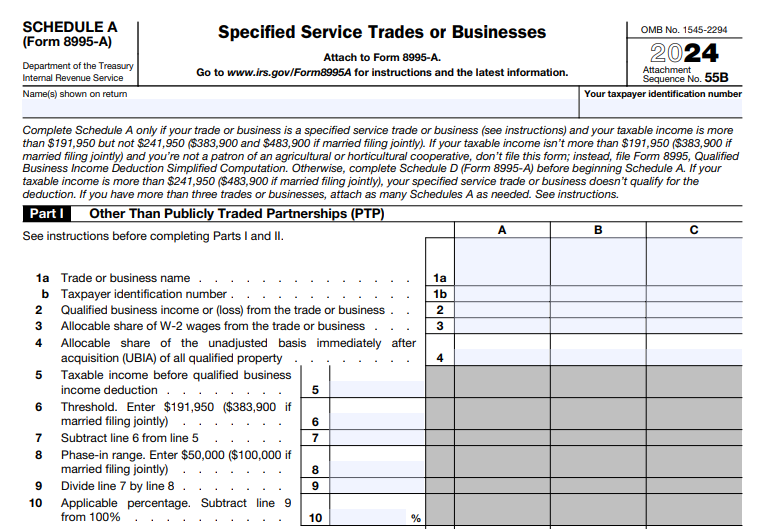
Schedule A (Form 8995-A) calculates the phase-in reduction for QBI from SSTBs when your taxable income (before the QBI deduction) falls in the phase-out range. SSTBs are professional services where the principal asset is the reputation or skill of employees/owners, like health, law, accounting, or performing arts.
- Full Deduction: Below threshold ($191,950 single/$383,900 joint for 2024)—100% applicable percentage.
- Phase-In: In range ($191,951–$241,950 single/$383,901–$483,900 joint)—gradual reduction via applicable percentage.
- No Deduction: Above upper limit—0% for SSTB QBI.
Attach to Form 8995-A (used when income > thresholds or complex scenarios); flows to Part I, line 2. PTP SSTB income also phases out here. No changes for 2025 filings beyond inflation adjustments.
Who Must File Schedule A (Form 8995-A) in 2025?
Complete Schedule A if:
- Your trade/business is an SSTB.
- Taxable income > threshold but ≤ upper limit (phase-in range).
- You have QBI from the SSTB (positive or loss).
Use one per SSTB; aggregate if eligible (but can’t aggregate SSTB with non-SSTB). Below threshold? Skip to Form 8995. Above upper? SSTB QBI = $0.
SSTB Examples Table
| Field | SSTB? | Notes |
|---|---|---|
| Law Firm | Yes | Legal services. |
| Medical Practice | Yes | Health services. |
| Accounting Firm | Yes | Accounting/bookkeeping. |
| Consulting (Management) | Yes | If reputation-based. |
| Retail Store | No | Goods sales. |
| Engineering (Non-Health) | Partial | If <10% gross receipts from SSTB services (de minimis rule). |
De minimis: <10% SSTB services if gross receipts ≤$25M; <5% if >$25M.
2024–2025 QBI SSTB Phase-Out Thresholds
Thresholds adjust annually for inflation. For 2024 (filed 2025):
| Filing Status | Threshold (Full 100%) | Phase-In Range (0–100% Reduction) | Upper Limit (0% Deduction) |
|---|---|---|---|
| Single/Head of Household | $191,950 | $191,951–$241,950 | $241,951+ |
| Married Filing Jointly | $383,900 | $383,901–$483,900 | $483,901+ |
For 2025 (filed 2026): $197,300 single/$394,600 joint (phase-in to $247,300/$494,600). Range width: $50,000 single/$100,000 joint.
IRS Form 8995-A (Schedule A) Download and Printable
Download and Print: IRS Form 8995-A (Schedule A)
When Is Schedule A (Form 8995-A) Due in 2025?
Attach to Form 8995-A with your 2024 Form 1040 by April 15, 2025 (or October 15 extended). No separate deadline—deduction reduces AGI on Schedule 1, line 13.
| Tax Year End | Original Due Date | Extended Due Date |
|---|---|---|
| Dec. 31, 2024 | April 15, 2025 | October 15, 2025 |
How to Complete Schedule A (Form 8995-A): Step-by-Step (2024 Form)
Use the 2024 Schedule A; one per SSTB. Complete Schedule D first if patron reduction applies. Enter on Form 8995-A, line 2 (or Schedule C, line 2 if wage-limited).
Line-by-Line Guide
- Name/TIN: SSTB name and EIN/SSN.
- QBI or (Loss): Net QBI from SSTB (from Part I or K-1 Box 20, Code Z). Losses carry forward but phase separately.
- Qualified PTP Income or (Loss): If PTP SSTB (K-1 Box 20, Code AC).
- Total: Line 2 + 3.
- Taxable Income Before QBI: From Form 8995-A, line 26.
- Threshold: $191,950 single/$383,900 joint.
- Excess: Line 5 – 6 (if negative, 100% applicable; skip to line 11).
- Phase-In Range: $50,000 single/$100,000 joint.
- Ratio: Line 7 ÷ 8 (e.g., 0.50 = 50% phased).
- Applicable %: 1.00 – line 9 (e.g., 0.50 = 50% deductible).
- Adjusted QBI: Line 4 × line 10 (positive only; enter on Form 8995-A, line 2/4 or Schedule C). 12–15: Repeat for up to 3 more SSTBs; total on line 16.
Pro Tip: For losses, applicable % applies when allowed in taxable income. Use software for multi-SSTB calcs.
Recent Changes to Schedule A (Form 8995-A) for 2025 Filings
No structural updates to Schedule A for 2024 (filed 2025)—focus remains on phase-in ratio. Key notes:
- Threshold Inflation: 2024 figures as above; 2025 at $197,300/$394,600 (Rev. Proc. 2024-40).
- No Extension Yet: QBI sunsets post-2025; proposals (e.g., Ways & Means) for 23% rate/permanence pending.
- Negative Dividends Fix: Exclude negatives on Form 8995-A, line 34 (since 2021).
Monitor IRS.gov for 2025 drafts.
Penalties for Errors on Schedule A
- Underclaim: Miss phase-in = 20% accuracy penalty on understated tax.
- Incorrect %: Audit risk high; IRS matches K-1s.
- Late Filing: 5% monthly on tax due (max 25%).
Abate for reasonable cause; amend via 1040-X.
Best Practices for Schedule A Compliance in 2025
- Classify Early: Review if SSTB (Pub. 535); de minimis for hybrid.
- Income Planning: Bunch deductions to stay below threshold.
- Aggregate Non-SSTB: Boost via Schedule B (can’t mix with SSTB).
- Software: TurboTax/H&R Block auto-phases; retain K-1s/worksheets 3+ years.
- Pro Help: CPA for PTPs or multi-entity.
Conclusion: Navigate SSTB Phase-Outs with Schedule A in 2025
IRS Form 8995-A Schedule A ensures fair QBI access for SSTBs in the phase-in range—potentially saving $38,000+ on $383,900 joint income. With thresholds at $383,900 (2024) rising to $394,600 (2025), review now before the April 15, 2025, deadline.
Download at IRS.gov/Form8995A; see Pub. 535. Consult a tax advisor—optimize before sunset.
Last updated: December 2025. Verify IRS sources.