IRS Form 8990 – Limitation on Business Interest Expense Under Section 163(j)

IRS Form 8990 - Limitation on Business Interest Expense Under Section 163(j)

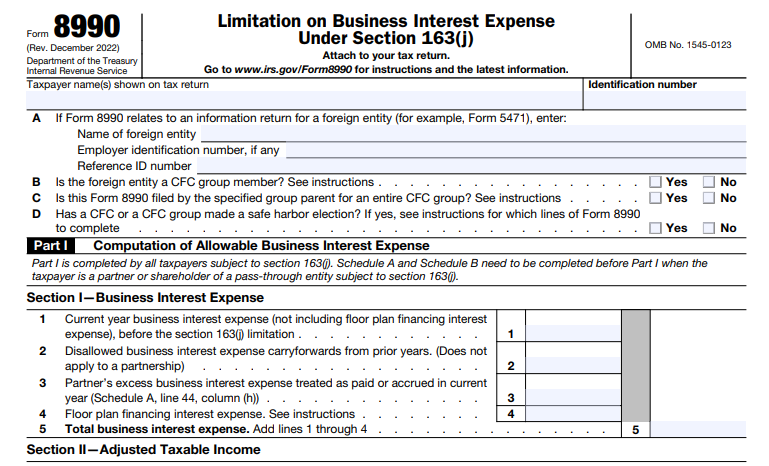
IRS Form 8990 – Limitation on Business Interest Expense Under Section 163(j) – In today’s complex tax landscape, understanding deductions for business interest expenses is crucial for businesses aiming to optimize their tax strategies. IRS Form 8990 plays a pivotal role in this process, helping taxpayers calculate allowable deductions under Internal Revenue Code (IRC) Section 163(j). This provision, introduced by the Tax Cuts and Jobs Act (TCJA) of 2017 and modified by subsequent legislation, limits the amount of business interest expense that can be deducted in a given tax year. Whether you’re a small business owner, a partnership, or a corporation, complying with these rules can significantly impact your bottom line. In this guide, we’ll break down everything you need to know about Form 8990, including who must file, how to calculate limitations, recent 2025 updates, and more—drawing from official IRS sources for accuracy.

IRS Form 8990 - Limitation on Business Interest Expense Under Section 163(j)
IRS Form 8990 – Limitation on Business Interest Expense Under Section 163(j)


What is Section 163(j) and Why Does It Matter?

Section 163(j) imposes a limitation on the deduction for business interest expenses to prevent excessive leveraging and ensure fair taxation. Under this rule, the deductible amount of business interest expense in a taxable year generally cannot exceed the sum of:

  • The taxpayer’s business interest income,
  • 30% of the taxpayer’s adjusted taxable income (ATI), and
  • Floor plan financing interest expense.

Any excess interest expense is disallowed for the current year but can typically be carried forward to future years. This limitation applies broadly to trades or businesses, with exceptions for small businesses and certain electing industries.

The rule matters because it affects cash flow and tax planning. For instance, in years with low income, businesses might face higher disallowed amounts, leading to carryforwards that provide future benefits. Originally capped at 30% of ATI (with add-backs for depreciation and similar items phased out temporarily), recent legislative changes have restored and clarified these computations for 2025 and beyond.

Who Must File IRS Form 8990?

Not every taxpayer needs to file Form 8990. The form is required if you meet any of the following criteria:

  • You have business interest expense for the tax year.
  • You have disallowed business interest expense carried forward from prior years.
  • You’re a partner with excess business interest expense from a partnership.

Pass-through entities like partnerships and S corporations must file if they’re allocating excess taxable income or excess business interest income to owners. Regulated investment companies (RICs) paying section 163(j) interest dividends also file. U.S. shareholders of controlled foreign corporations (CFCs) may need to attach Form 8990 to Form 5471 if the CFC is subject to the limitation.

Exceptions: Who Doesn’t Have to File?

  • Small Business Taxpayers: If your average annual gross receipts for the prior three tax years do not exceed the inflation-adjusted threshold ($31 million for tax years beginning in 2025), you’re exempt—unless you’re a tax shelter or have excess business interest expense from a partnership.
  • Excepted Trades or Businesses: Activities like employee services, electing real property trades, electing farming businesses, or certain regulated utilities are not subject to the limitation.
  • Taxpayers with only excepted businesses or no business interest expense are generally exempt.

If your business mixes excepted and non-excepted activities, you’ll allocate interest expenses based on asset basis to determine applicability.

Key Definitions for Form 8990

To navigate Form 8990 effectively, familiarize yourself with these terms:

  • Business Interest Expense: Interest paid or accrued on indebtedness allocable to a trade or business (excluding investment or personal interest).
  • Adjusted Taxable Income (ATI): Tentative taxable income (computed without the section 163(j) limitation) plus additions like business interest expense, net operating loss (NOL) deductions, and—for tax years beginning after 2024—depreciation, amortization, and depletion. Subtractions include business interest income and certain gains.
  • Floor Plan Financing Interest: Interest on debt used to finance inventory of motor vehicles, boats, or farm machinery (expanded to include trailers and campers for recreational use after 2024).
  • Excess Business Interest Expense: For partnerships, the amount of disallowed interest allocated to partners, which they carry forward.
  • Tentative Taxable Income: Taxable income disregarding the section 163(j) limitation and certain other deductions.

These definitions ensure accurate calculations and compliance.

How to Calculate the Business Interest Expense Limitation

Calculating the limitation involves several steps:

  1. Determine Total Business Interest Expense: Include current year expense plus any carryforwards (Line 1 + Line 2 on Form 8990).
  2. Compute ATI: Start with tentative taxable income, add back items like NOLs and business interest expense, and—for 2025—include depreciation, amortization, and depletion.
  3. Apply the Formula: Limitation = Business interest income + 30% of ATI + Floor plan financing interest.
  4. Deductible Amount: The lesser of total business interest expense or the limitation.
  5. Carryforward: Any excess is carried forward (or allocated in partnerships).

For pass-through entities, the limitation is figured at the entity level, with excesses passed to owners. Use Worksheets A and B in the instructions for allocations.

IRS Form 8990 Download and Printable

Download and Print: IRS Form 8990

Example Calculation Table

Step Description Example Amount
1 Current Business Interest Expense $100,000
2 Prior Year Carryforward $20,000
3 Total Expense (1+2) $120,000
4 Business Interest Income $10,000
5 ATI $300,000
6 30% of ATI $90,000
7 Floor Plan Interest $5,000
8 Limitation (4+6+7) $105,000
9 Deductible Amount (min of 3 or 8) $105,000
10 Carryforward (3-9) $15,000

This simplified example assumes no other adjustments; actual calculations may vary.

Step-by-Step Instructions for Filling Out Form 8990

Form 8990 consists of Part I (Computation), Part II (Partnership Items), Part III (S Corp Items), and Schedules A/B for summaries.

  • Part I, Section I: Enter current expense, carryforwards, and floor plan interest.
  • Section II: Calculate ATI by adding/subtracting specified items from tentative taxable income.
  • Section III: Enter business interest income.
  • Section IV: Compute 30% ATI, total limitation, deductible amount, and carryforward.
  • Schedules A and B: Summarize pass-through items from partnerships/S corps before completing Part I.

Attach election statements for excepted businesses, including your name, TIN, and business description. For CFCs, use Worksheet C for safe-harbor elections.

Recent Updates to Form 8990 and Section 163(j) for 2025

As of 2025, several updates enhance clarity and ease deductions:

  • Gross Receipts Threshold: Increased to $31 million for the small business exemption.
  • ATI Add-Backs: For tax years beginning after 2024, depreciation, amortization, and depletion are added back to ATI, potentially increasing the limitation.
  • One Big Beautiful Bill Act (OBBBA) Changes: Effective for years beginning after December 31, 2025, OBBBA clarifies that business interest expense includes capitalized interest (except under certain sections), restores favorable rules, but adds anti-abuse provisions prohibiting elective interest capitalization to bypass limitations.
  • Form Revisions: The January 2025 instructions reflect these changes, with the form itself revised in December 2025.

Stay updated via IRS Fact Sheet 2025-09 for the latest inflation adjustments.

Common FAQs About IRS Form 8990

  • What if my gross receipts fall below the threshold? The limitation doesn’t apply, and prior carryforwards become fully deductible.
  • How do elections work? Elections for excepted businesses are irrevocable and require attached statements; they mandate alternative depreciation systems (ADS).
  • What about foreign corporations? CFCs are treated like domestic C corps; group elections or safe-harbors can simplify compliance.
  • Can I elect out of higher limits? Yes, for certain CARES Act provisions, but most are historical now.

For more, refer to the IRS Q&A on business interest limitations.

Final Thoughts on Managing Business Interest Deductions

Mastering IRS Form 8990 and Section 163(j) can help businesses maximize deductions while avoiding penalties. With 2025 updates providing more favorable ATI calculations and clarified rules, now is the time to review your interest expenses. However, tax laws are intricate—consult a qualified tax professional or use IRS resources for personalized advice. By staying compliant, you can focus on growing your business rather than navigating tax pitfalls. For the latest forms and instructions, visit the official IRS website.


IRS Form 1128 – Application to Adopt, Change or Retain a Tax Year

IRS Form 1128 - Application to Adopt, Change or Retain a Tax Year

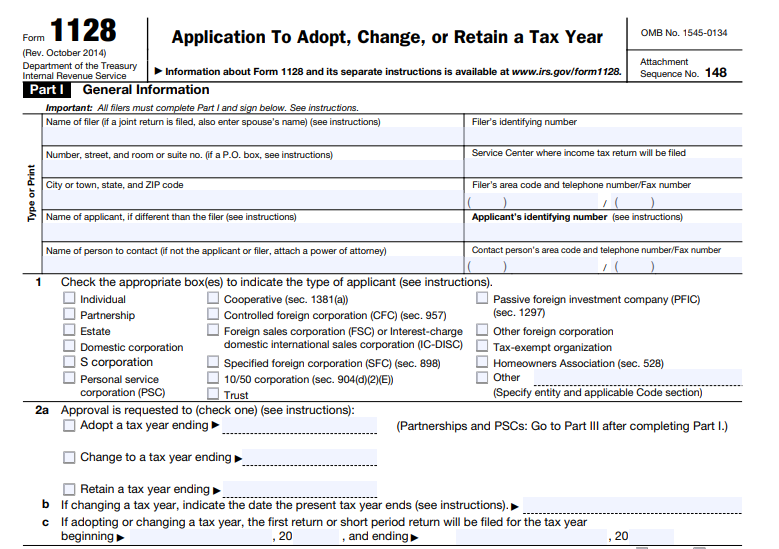
IRS Form 1128 – Application to Adopt, Change or Retain a Tax Year – Businesses, partnerships, S corporations, personal service corporations (PSCs), trusts, and certain tax-exempt organizations often need to align their tax year with operational or financial needs. IRS Form 1128Application to Adopt, Change, or Retain a Tax Year, is the official document required to request IRS approval for such changes under Internal Revenue Code (IRC) Section 442.

As of December 2025, the latest version of Form 1128 remains the October 2014 revision, with instructions from November 2017. No major updates to the form or core procedures have been announced for 2025, though specific revenue procedures govern automatic approvals.

IRS Form 1128 - Application to Adopt, Change or Retain a Tax Year
IRS Form 1128 – Application to Adopt, Change or Retain a Tax Year


What Is IRS Form 1128?

Form 1128 allows taxpayers to request permission to:

  • Adopt a new tax year (e.g., for a newly formed entity).
  • Change an existing tax year (e.g., from fiscal to calendar year).
  • Retain a non-required tax year.

Most entities default to a calendar year (January 1–December 31), but partnerships, S corporations, and PSCs have “required” tax years based on ownership or business purpose. Changing without approval can lead to compliance issues, penalties, or disallowed deductions.

According to the IRS, partnerships, S corporations, PSCs, and trusts “may be required to file Form 1128 to adopt or retain a certain tax year.”

Who Needs to File Form 1128?

Common filers include:

  • Corporations (other than S corps or PSCs) seeking a change.
  • Partnerships not meeting required year rules.
  • S Corporations changing to or retaining a non-permitted year.
  • Personal Service Corporations (PSCs).
  • Trusts and estates.
  • Tax-exempt organizations changing periods after prior changes.
  • Controlled Foreign Corporations (CFCs) or similar entities (filed by controlling shareholders).

Exceptions: New corporations adopting their first tax year generally do not need to file. Sole proprietorships and single-member LLCs typically follow the owner’s calendar year without filing.

Automatic Approval vs. Ruling Request

Many changes qualify for automatic approval under revenue procedures like Rev. Proc. 2006-45 (corporations), Rev. Proc. 2006-46 (partnerships/S corps/PSCs), and Rev. Proc. 2002-39 (natural business year). These require completing Parts I and II of Form 1128.

  • No user fee required for automatic approvals.
  • Common automatic scenarios: Changing to a natural business year (25% gross receipts test) or aligning with majority ownership.

If automatic rules do not apply (e.g., business purpose demonstration needed), complete Part III for a ruling request. This may require a user fee (check current Rev. Proc. for amounts, typically thousands for non-automatic).

Filing Deadlines for 2025

File Form 1128 by the due date (excluding extensions) of the income tax return for the first effective year (the short period or new year).

  • Do not file earlier than the day after the short period ends.
  • Late filings (over 90 days past due) are rarely approved without compelling reasons.

Example: Changing to a calendar year ending December 31, 2025, requires filing by the due date of the 2025 return (e.g., March 15, 2026, for corporations).

IRS Form 1128 Download and Printable

Download and Print: IRS Form 1128

How to File Form 1128 in 2025

  1. Download the Form: Available on IRS.gov (search “Form 1128”).
  2. Complete Relevant Parts:
    • Part I: General information.
    • Part II: Automatic approval (most common).
    • Part III: Ruling request (if needed).
  3. Where to File:
    • Automatic: Mail to the service center where you file returns (Attention: Entity Control).
    • Ruling: IRS National Office (specific address in instructions).
    • Attach a copy to your tax return for the first effective year.
  4. Signature: Required by the taxpayer or authorized representative (attach Form 2848 if needed).
  5. User Fee: None for automatic; pay via pay.gov for rulings.

Common Reasons for Changing Tax Year

  • Aligning with business cycles (e.g., retail fiscal year).
  • Matching parent/subidiary years.
  • Simplifying reporting for partnerships/S corps.
  • Optimizing cash flow or deductions.

Tips for Successful Filing

  • Verify eligibility for automatic approval first—it’s faster and fee-free.
  • Attach required statements (e.g., gross receipts for natural business year).
  • For S corp elections, coordinate with Form 2553.
  • Consult a tax professional for complex cases, as errors can delay approval.

For the most current details, visit IRS.gov/Form1128 or review the instructions PDF. Proper filing ensures compliance and avoids IRS scrutiny.

Sources: IRS.gov (About Form 1128, Instructions for Form 1128 Rev. November 2017), relevant Revenue Procedures. Information accurate as of December 2025.


IRS Form 7217 – Partner’s Report of Property Distributed by a Partnership

IRS Form 7217 - Partner's Report of Property Distributed by a Partnership

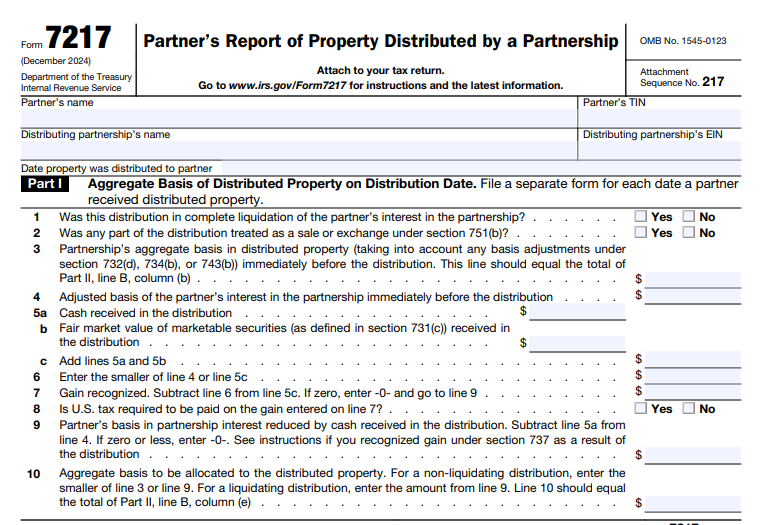
IRS Form 7217 – Partner’s Report of Property Distributed by a Partnership – In the complex world of partnership taxation, staying compliant with IRS requirements is crucial for partners receiving property distributions. IRS Form 7217, officially titled “Partner’s Report of Property Distributed by a Partnership,” plays a key role in reporting the basis of distributed property and any necessary adjustments. Introduced to ensure accurate basis tracking under Internal Revenue Code Section 732, this form helps prevent tax discrepancies and supports proper reporting on individual tax returns. Whether you’re a partner in a business partnership or a tax professional, understanding Form 7217 is essential for navigating distributions effectively. This guide covers everything you need to know, from filing requirements to detailed instructions.

IRS Form 7217 - Partner's Report of Property Distributed by a Partnership
IRS Form 7217 – Partner’s Report of Property Distributed by a Partnership

What Is IRS Form 7217 and Its Purpose?

Form 7217 is a reporting document used by partners who receive property distributions from a partnership. Its primary purpose is to document the basis of the distributed property, including any basis adjustments required under Section 732(a)(2) or (b). This ensures that partners correctly calculate their tax basis in the received assets, which affects future gain or loss recognition when the property is sold or disposed of.

Unlike cash distributions, which are often straightforward, property distributions can involve complex basis allocations. The form applies to both non-liquidating and liquidating distributions but excludes distributions consisting solely of money or marketable securities treated as money under Section 731(c). It also doesn’t cover payments for services under Section 707(a)(1) or disguised sales under Section 707(a)(2)(B). By filing this form, partners provide a clear record that aligns with the partnership’s Schedule K-1 (Form 1065) reporting.

For tax years beginning in 2024 or later, use the December 2024 revision of Form 7217. This recent update reflects the IRS’s ongoing efforts to streamline partnership reporting amid evolving tax laws.

Who Must File Form 7217?

Any partner receiving a distribution of property from a partnership must file Form 7217 if the distribution is subject to Section 732. This includes individuals, corporations, or other entities acting as partners. A separate form is required for each distribution date during the tax year, even if multiple distributions are part of the same transaction.

Exceptions include:

  • Distributions of only cash or marketable securities treated as cash.
  • Transactions treated as payments for services or disguised sales.

If you’re unsure whether a distribution qualifies, review your Schedule K-1 (Form 1065), particularly Box 19, Code C, which details distributed property. Partnerships provide this information to assist with your filing.

When and How to File Form 7217

Form 7217 must be attached to your annual tax return for the tax year in which the property distribution occurred. The due date aligns with your tax return deadline, including any extensions. For example, individual partners typically file by April 15 (or the next business day), while extensions can push this to October 15.

To file:

  1. Complete the form using information from your Schedule K-1.
  2. Attach it to your Form 1040 (for individuals), Form 1120 (for corporations), or other applicable return.
  3. If electronic filing, ensure the form is included as a PDF attachment if required by your software.

No separate mailing is needed; it’s submitted with your return. Always keep records of calculations, as the IRS may request them during audits.

IRS Form 7217 Download and Printable

Download and Print: IRS Form 7217

Breaking Down Form 7217: Parts and Line-by-Line Instructions

Form 7217 is divided into two main parts: Part I for aggregate basis calculations and Part II for allocating basis to individual properties.

Part I: Aggregate Basis of Distributed Property

  • Line 1: Indicate if the distribution is a complete liquidation of your partnership interest.
  • Line 2: Check if any part is treated as a sale under Section 751(b). If yes, attach a statement with calculations.
  • Line 3: Enter the partnership’s aggregate basis in the distributed property (excluding cash).
  • Line 4: Your adjusted basis in the partnership before the distribution.
  • Lines 5a and 5b: Money and marketable securities received.
  • Line 8: Check if you paid U.S. tax on any gain from excess money distributions.
  • Line 9 and 10: Calculate the basis to allocate, adjusting for distribution type.

Part II: Allocation of Basis

This section details each property:

  • Column (a): Description of the property.
  • Column (b): Partnership’s basis before distribution.
  • Columns (c)(i)-(iv): Indicators for special adjustments (e.g., Sections 732(d), 734(b), 743(b)).
  • Column (d): Fair market value (FMV).
  • Column (e): Your basis after Section 732 application.

Use as many pages as needed for multiple properties.

Basis Adjustments Under Section 732 Explained

Section 732 governs how basis is determined in distributed property. For non-liquidating distributions, your basis is generally the partnership’s basis, but limited under 732(a)(2) if it exceeds your remaining outside basis. In liquidating distributions, the aggregate basis equals your outside basis minus money received, allocated per 732(c).

Allocation rules prioritize matching partnership basis, then unrealized appreciation, and finally FMV proportions. Special adjustments (e.g., 732(d) for elective basis shifts) must be noted.

Real-World Examples of Form 7217 in Action

To illustrate, consider a non-liquidating distribution: A partner with a $10,000 outside basis receives $4,000 cash and property worth $8,000 (partnership basis). The property basis is capped at $6,000.

In a liquidating scenario: A partner receives cash and multiple assets; basis is allocated first to basis-matching items, then appreciation, ensuring accurate tax treatment.

Potential Penalties and Important Reminders

While specific penalties for Form 7217 aren’t detailed, failure to report accurately can lead to general underpayment penalties or audit adjustments. Always attach required statements, like for Section 751(b), and consult a tax advisor for complex cases.

Key definitions include “outside basis” (your partnership interest basis) and “deemed distributions” under Section 752(b).

Conclusion: Stay Compliant with Form 7217

Mastering IRS Form 7217 ensures proper handling of partnership property distributions, minimizing tax surprises. By accurately reporting basis adjustments, partners maintain compliance and optimize their tax positions. For the latest updates, check IRS.gov, as legislation may introduce changes. If you’re dealing with distributions in 2025 or beyond, review your Schedule K-1 promptly and file on time. Consult a qualified tax professional for personalized advice.


IRS Form 8959 – Additional Medicare Tax

IRS Form 8959 - Additional Medicare Tax

IRS Form 8959 – Additional Medicare Tax – The Additional Medicare Tax is a 0.9% surcharge on certain earned income for higher earners, introduced in 2013 as part of the Affordable Care Act. Taxpayers use IRS Form 8959 to calculate and report this tax on wages, self-employment income, and railroad retirement (RRTA) compensation that exceed specific thresholds based on filing status.

This guide covers what the Additional Medicare Tax is, who owes it, 2025 thresholds, how to complete Form 8959, and key filing tips—all based on official IRS sources for the 2025 tax year.

IRS Form 8959 - Additional Medicare Tax
IRS Form 8959 – Additional Medicare Tax


What Is the Additional Medicare Tax?

The standard Medicare tax rate is 1.45% for employees (matched by employers) and 2.9% for self-employed individuals, with no income limit. The Additional Medicare Tax adds 0.9% on Medicare wages, RRTA compensation, and self-employment income above threshold amounts.

  • It applies only to the amount exceeding the threshold—not your entire income.
  • Employers withhold this 0.9% on wages over $200,000 (regardless of filing status), but you calculate the exact liability on your tax return using Form 8959.
  • Self-employed individuals pay it directly via their return.
  • This tax funds Medicare and certain ACA provisions.

Thresholds are not indexed for inflation and remain fixed since 2013.

2025 Additional Medicare Tax Thresholds

The 0.9% tax kicks in when applicable income exceeds these amounts:

Filing Status Threshold Amount
Married Filing Jointly $250,000
Married Filing Separately $125,000
Single $200,000
Head of Household $200,000
Qualifying Surviving Spouse $200,000

If you have both wages and self-employment income, subtract wages from the threshold when calculating the tax on self-employment income (but do not treat self-employment losses as reducing wages).

Who Must File Form 8959?

You must file Form 8959 if:

  • Your Medicare wages, RRTA compensation, or self-employment income exceed your filing status threshold.
  • Your employer withheld Additional Medicare Tax (even if you ultimately don’t owe it—you may get a refund).
  • You have unreported tips or other adjustments requiring calculation.

Attach Form 8959 to your Form 1040, 1040-SR, 1040-NR, or 1040-SS.

IRS Form 8959 Download and Printable

Download and Print: IRS Form 8959

How to Complete Form 8959 (2025)

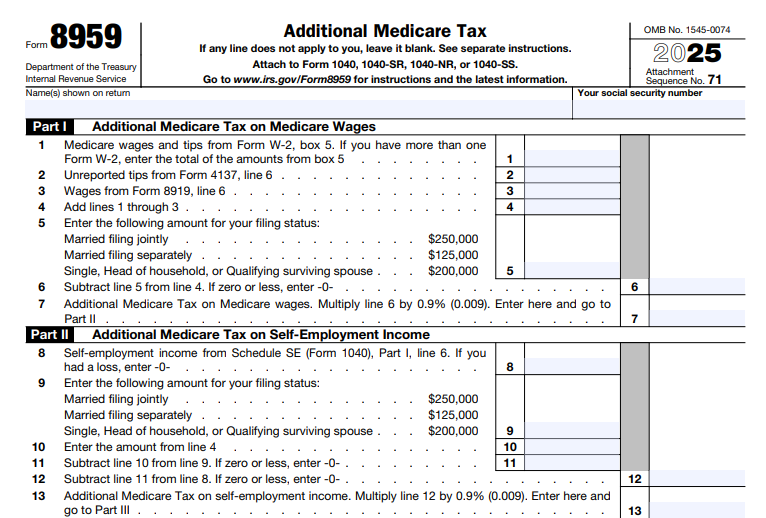
Form 8959 has five parts:

  1. Part I: Additional Medicare Tax on Medicare Wages
    Report wages from Form W-2 (Box 5). Subtract the threshold and multiply excess by 0.9%.
  2. Part II: Additional Medicare Tax on Self-Employment Income
    Use net earnings from Schedule SE. Apply the reduced threshold if you have wages.
  3. Part III: Additional Medicare Tax on RRTA Compensation
    For railroad workers.
  4. Part IV: Total Additional Medicare Tax
    Sum amounts from Parts I–III.
  5. Part V: Withholding Reconciliation
    Report withheld amounts from W-2 (Box 6) and compare to liability.

The total owed (or overwithheld) flows to Schedule 2 (Form 1040), line 11.

Examples of Additional Medicare Tax Calculation

  • Single filer with $225,000 in wages: Tax on $25,000 excess ($225,000 – $200,000) × 0.9% = $225 owed.
  • Married filing jointly, one spouse with $230,000 wages, other with $10,000: Combined $240,000 < $250,000 threshold → No tax owed (but employer may have withheld on wages over $200,000—claim refund on Form 8959).
  • Self-employed single filer with $150,000 net earnings + $100,000 wages: Wages reduce self-employment threshold to $100,000 ($200,000 – $100,000). Tax on $50,000 excess self-employment income × 0.9%.

Employer Withholding and Your Responsibilities

Employers must withhold 0.9% on wages over $200,000 per employee (no employer match). If withholding is insufficient (e.g., multiple jobs or self-employment), make estimated payments or adjust Form W-4.

Overwithholding? Claim credit on your return via Form 8959.

Tips to Avoid Surprises

  • Use the IRS Withholding Estimator tool.
  • Self-employed? Factor this into quarterly estimated taxes.
  • Download the latest Form 8959 and instructions from IRS.gov/Form8959.

For personalized advice, consult a tax professional or refer to IRS Publication 505 (Tax Withholding and Estimated Tax) and Topic No. 560.

This information is based on IRS publications as of December 2025. Always check IRS.gov for the most current forms and guidance.


IRS Form 8621 – Information Return by a Shareholder of a Passive Foreign Investment Company or Qualified Electing Fund

IRS Form 8621 - Information Return by a Shareholder of a Passive Foreign Investment Company or Qualified Electing Fund

IRS Form 8621 – Information Return by a Shareholder of a Passive Foreign Investment Company or Qualified Electing Fund – In today’s global economy, many U.S. taxpayers hold investments in foreign entities, such as mutual funds or corporations. However, these can trigger specific IRS reporting requirements, particularly if they qualify as Passive Foreign Investment Companies (PFICs) or Qualified Electing Funds (QEFs). IRS Form 8621, titled “Information Return by a Shareholder of a Passive Foreign Investment Company or Qualified Electing Fund,” is a critical tool for complying with these rules. This form ensures that income from such investments is properly reported and taxed, helping avoid hefty penalties. Whether you’re an expat, investor, or tax professional, understanding Form 8621 is essential for 2025 tax filings.

This guide covers everything you need to know about IRS Form 8621, including who must file, step-by-step instructions, available elections, and recent updates for tax year 2025. We’ll draw from official IRS sources to provide accurate, up-to-date information.

IRS Form 8621 - Information Return by a Shareholder of a Passive Foreign Investment Company or Qualified Electing Fund
IRS Form 8621 – Information Return by a Shareholder of a Passive Foreign Investment Company or Qualified Electing Fund


What Is IRS Form 8621?

IRS Form 8621 is an information return used by U.S. persons who are direct or indirect shareholders in a PFIC. It reports certain distributions, gains from stock dispositions, and other events related to these foreign investments. The form also handles reporting for QEFs, which are PFICs where shareholders elect to include their pro-rata share of earnings annually.

The primary purpose of Form 8621 is to track and tax passive income from foreign sources under sections 1291, 1293, and 1296 of the Internal Revenue Code. Without proper filing, shareholders may face deferred tax interest charges or unfavorable tax treatment on distributions and gains. A separate form is required for each PFIC, and it must be attached to your federal income tax return (e.g., Form 1040) or filed separately if no return is due.

Who Needs to File IRS Form 8621?

Not every U.S. taxpayer with foreign investments must file Form 8621. Filing is required if you are a U.S. person (including citizens, residents, corporations, partnerships, trusts, or estates) and a direct or indirect shareholder of a PFIC under these scenarios:

  • You receive certain direct or indirect distributions from a PFIC.
  • You recognize a gain on a direct or indirect disposition of PFIC stock.
  • You need to report information for a QEF or a section 1296 mark-to-market election.
  • You are making an election reportable in Part II of the form.
  • You must file an annual report under section 1298(f).

Indirect shareholders include those holding PFIC stock through pass-through entities like partnerships, S corporations, estates, or trusts. Exceptions apply if the stock is held through tax-exempt organizations, certain retirement plans, or if you’re not the first U.S. person in the ownership chain (unless you recognize income under section 1291).

For Part I (annual summary), filing is generally excused if the PFIC stock value is $25,000 or less ($50,000 for joint filers) at year-end, or $5,000 or less for indirect holdings, provided no excess distributions or gains occur.

Understanding PFICs and QEFs

What Is a Passive Foreign Investment Company (PFIC)?

A PFIC is a foreign corporation that meets either the income test (at least 75% of gross income is passive, like dividends or interest) or the asset test (at least 50% of assets produce passive income or are held for that purpose). Common examples include foreign mutual funds, ETFs, and holding companies. The IRS uses look-through rules for subsidiaries and fair market value for publicly traded stocks.

Exceptions exist for Controlled Foreign Corporations (CFCs) under subpart F rules via section 1297(d).

What Is a Qualified Electing Fund (QEF)?

A QEF is a PFIC for which the shareholder elects (via Election A on Form 8621) to include their pro-rata share of the fund’s ordinary earnings and net capital gains annually. This election avoids the default section 1291 excess distribution regime, which imposes deferred taxes and interest. To make a QEF election, you need annual information from the PFIC or intermediary.

Filing Requirements and Deadlines for IRS Form 8621

File Form 8621 with your federal tax return by the due date, including extensions. For calendar-year taxpayers, this is typically April 15, 2026, for tax year 2025, or October 15, 2026, with an extension. If no tax return is required, mail it directly to the IRS center in Ogden, UT.

Use a consistent Reference ID number (alphanumeric, up to 50 characters) to identify the PFIC across years. Elections must generally be made by the return’s due date, though some can be retroactive with IRS consent or via Form 8621-A for late filings.

IRS Form 8621 Download and Printable

Download and Print: IRS Form 8621

How to Complete IRS Form 8621: Step-by-Step Guide

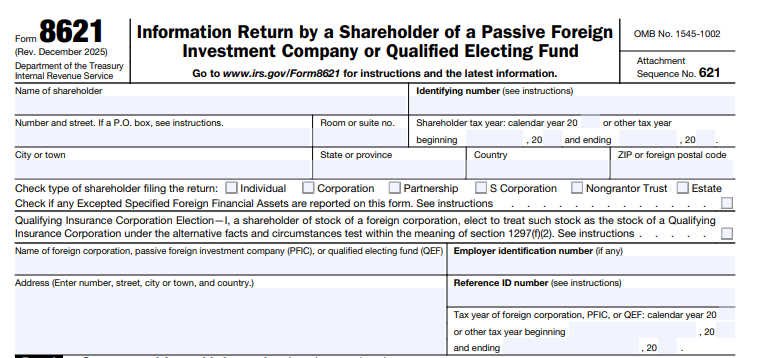
Form 8621 consists of a header and six parts. Here’s an overview based on the 2025 revision:

Provide your name, address, identifying number (SSN or EIN), shareholder type (e.g., individual, corporation), and details about the foreign corporation (name, address, EIN if any, Reference ID, tax year).

Part I: Summary of Annual Information

Report share classes, acquisition dates, number and value of shares at year-end, and types/amounts of PFIC income (e.g., section 1291 excess distributions, section 1293 QEF inclusions).

Part II: Elections

Check boxes and provide statements for elections like treating the PFIC as a QEF (A), extending tax payment (B), mark-to-market (C), deemed sales/dividends (D-H).

Part III: Income From a QEF

Calculate pro-rata ordinary earnings and net capital gains, subtracting section 951 inclusions. If electing to defer tax (Election B), compute deferred amounts and interest.

Part IV: Gain or (Loss) From Mark-to-Market Election

Report fair market value vs. adjusted basis for unrealized and realized gains/losses on marketable PFIC stock.

Part V: Distributions From and Dispositions of Stock of a Section 1291 Fund

Calculate excess distributions and disposition gains, allocating them over the holding period to determine deferred tax and interest. New for 2025: Enter a three-letter currency code and convert foreign amounts to USD.

Part VI: Status of Prior Year Section 1294 Elections and Termination

Track outstanding deferred tax elections and report terminations due to distributions or status changes.

Always consult the official instructions for detailed calculations and attachments.

Elections Available on IRS Form 8621

Form 8621 offers several elections to manage PFIC taxation:

  • Election A (QEF): Include annual earnings to avoid excess distribution rules.
  • Election B: Defer tax on undistributed QEF earnings (with interest).
  • Election C (Mark-to-Market): Annually adjust for market value changes on marketable stock.
  • Elections D-H: Deemed sales or dividends for specific scenarios like unpedigreed QEFs or former PFICs.

Additionally, a Qualifying Insurance Corporation (QIC) election under section 1297(f)(2) allows limited reporting for certain insurance entities.

Penalties for Not Filing IRS Form 8621

Failure to file can trigger penalties under sections 6001, 6011, 6012(a), and 6109. While no specific monetary penalty is tied directly to Form 8621, non-filing keeps the statute of limitations open indefinitely for the entire return. Fraudulent filings may lead to criminal charges. Late elections can be addressed via Form 8621-A, but with potential interest.

Recent Changes to IRS Form 8621 for Tax Year 2025

The 2025 revision includes minor updates, such as requiring a three-letter currency code in Part V and converting foreign excess distributions to USD. The IRS also plans to update Publication 54 to clarify that foreign mutual funds or ETFs may qualify as PFICs, increasing awareness for expats. Proposed changes to reporting thresholds are under consideration but not yet implemented. Always check IRS.gov for the latest developments.

Frequently Asked Questions (FAQs) About IRS Form 8621

Do I need to file Form 8621 if my PFIC investment is small?

No, if the value is below the thresholds in Part I and no triggering events occur.

Can I make a late QEF election?

Yes, via Form 8621-A with IRS consent, potentially incurring interest.

What if my PFIC is also a CFC?

Section 1297(d) may provide relief from PFIC rules if subpart F applies.

How does Form 8621 affect my taxes?

It can lead to ordinary income treatment, deferred taxes, and interest on excess distributions.

For more FAQs, refer to the official IRS instructions.

Conclusion

Navigating IRS Form 8621 is crucial for U.S. shareholders of PFICs and QEFs to ensure compliance and optimize tax outcomes. By understanding the form’s requirements, elections, and updates for 2025, you can avoid pitfalls like penalties and unfavorable taxation. Consult a tax professional for personalized advice, and download the latest form and instructions from IRS.gov. Stay informed to make the most of your foreign investments while meeting U.S. tax obligations.


IRS Form 2439 – Notice to Shareholder of Undistributed Long-Term Capital Gains

IRS Form 2439 - Notice to Shareholder of Undistributed Long-Term Capital Gains

IRS Form 2439 – Notice to Shareholder of Undistributed Long-Term Capital Gains – If you’re an investor in mutual funds, exchange-traded funds (ETFs), or real estate investment trusts (REITs), you might receive IRS Form 2439 — the Notice to Shareholder of Undistributed Long-Term Capital Gains. This form reports long-term capital gains that a regulated investment company (RIC) or REIT retained rather than distributed, along with taxes paid on your behalf. Understanding Form 2439 is essential for accurate tax reporting and claiming potential credits.

IRS Form 2439 - Notice to Shareholder of Undistributed Long-Term Capital Gains
IRS Form 2439 – Notice to Shareholder of Undistributed Long-Term Capital Gains


What Is IRS Form 2439?

Form 2439 notifies shareholders of undistributed long-term capital gains from a RIC (such as mutual funds or ETFs) or REIT. These entities typically distribute at least 90% of income to avoid corporate taxes, but they may retain long-term capital gains, pay corporate tax, and designate them as undistributed under IRC Sections 852(b)(3)(D) or 857(b)(3)(C).

The IRS treats these gains as if distributed to you, making them taxable even without cash receipt. The company issues Form 2439 to report your share and taxes paid, allowing a credit to avoid double taxation.

Key points from official IRS sources:

  • RICs and REITs must provide Copies B and C to shareholders by 60 days after their tax year-end.
  • Attach Copy A to the company’s Form 1120-RIC or Form 1120-REIT.

This retention is uncommon, as most funds distribute gains via Form 1099-DIV.

Why Do Funds Retain Capital Gains?

Funds retain gains to:

  • Reinvest for growth.
  • Manage tax efficiency.
  • Meet specific regulatory or strategic goals.

Shareholders still report the gains as long-term capital gains but claim a credit for taxes paid by the fund.

IRS Form 2439 Download and Printable

Download and Print: IRS Form 2439

Key Boxes on Form 2439

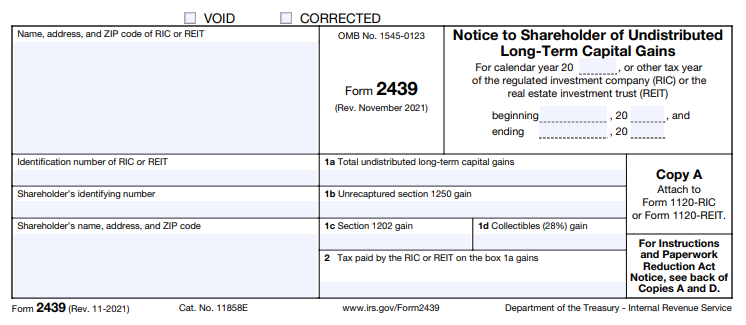
The latest revision (November 2021, still current as of 2025 per IRS.gov) includes:

  • Box 1a: Total undistributed long-term capital gains allocated to you. Report this as long-term gain on your tax return.
  • Box 1b: Unrecaptured Section 1250 gain (from depreciable real property), taxed at up to 25%.
  • Box 1c: Section 1202 gain (qualified small business stock), potentially eligible for exclusion.
  • Box 1d: Collectibles gain (28% rate gain).
  • Box 2: Tax paid by the RIC or REIT on Box 1a gains. Claim this as a credit or refund.

How to Report Form 2439 on Your Tax Return

For individual taxpayers (Form 1040 or 1040-SR):

  1. Report the Gains:
    • Enter Box 1a on Schedule D (Form 1040), Line 11 (long-term capital gains).
    • Use Form 8949 if needed for adjustments.
    • Apply Boxes 1b, 1c, and 1d to relevant worksheets in Schedule D instructions:
      • Box 1b → Unrecaptured Section 1250 Gain Worksheet.
      • Box 1d → 28% Rate Gain Worksheet.
      • Box 1c → Check for Section 1202 exclusion.
  2. Claim the Tax Credit:
    • Report Box 2 on Schedule 3 (Form 1040), Line 13a (or equivalent) as “Credit for tax paid on undistributed capital gains.”
    • Attach Copy B of Form 2439 to your return.
  3. Adjust Your Basis:
    • Increase your cost basis in the shares by (Box 1a minus Box 2). This reduces future capital gains when you sell.

For estates, trusts, or exempt organizations, refer to specific instructions in Schedule D (Form 1041) or Form 990-T.

Tax-deferred accounts (e.g., IRAs) generally do not receive Form 2439, as gains are not currently taxable. If received, the trustee handles it.

Common Questions About Form 2439

  • When will I receive it? Typically early in the year following the fund’s tax year (e.g., by March for calendar-year funds).
  • What if I don’t receive one but think I should? Contact the fund company for a copy.
  • Is this the same as Form 1099-DIV? No—1099-DIV reports distributed gains; 2439 reports undistributed ones.
  • Do I owe taxes immediately? Yes, report in the tax year including the fund’s year-end.

Important Reminders for 2025 Tax Filing

As of December 2025, use the latest Schedule D instructions (2025 version) for precise line references. Capital gains tax rates remain preferential (0%, 15%, or 20% depending on income), with additional rates for special categories like unrecaptured Section 1250 (25%) or collectibles (28%).

Always consult a tax professional for your situation, especially with multiple forms or complex investments. For the most current form and instructions, visit IRS.gov.

By properly reporting Form 2439, you ensure compliance and optimize your tax outcome on investment gains. Stay informed to avoid surprises during tax season!


IRS Form 8867 – Paid Preparer’s Due Diligence Checklist

IRS Form 8867 - Paid Preparer's Due Diligence Checklist

IRS Form 8867 – Paid Preparer’s Due Diligence Checklist – In the world of tax preparation, accuracy and compliance are paramount. For paid tax preparers handling returns that claim specific credits or filing statuses, IRS Form 8867 plays a crucial role. This form, officially titled the Paid Preparer’s Due Diligence Checklist, ensures that preparers exercise proper care when determining eligibility for benefits like the Earned Income Credit (EIC), Child Tax Credit (CTC) including the Additional Child Tax Credit (ACTC) and Credit for Other Dependents (ODC), American Opportunity Tax Credit (AOTC), and Head of Household (HOH) filing status. Updated in November 2024, it helps prevent errors and protects both taxpayers and preparers from potential audits or penalties.

Whether you’re a seasoned tax professional or a business owner navigating tax services, understanding Form 8867 can streamline your processes and enhance compliance. In this guide, we’ll break down everything you need to know about IRS Form 8867, including its purpose, completion requirements, and key resources.

IRS Form 8867 - Paid Preparer's Due Diligence Checklist
IRS Form 8867 – Paid Preparer’s Due Diligence Checklist


What Is IRS Form 8867 and Why Does It Matter?

IRS Form 8867 is a mandatory checklist for paid tax return preparers who assist clients in claiming certain tax benefits. Its primary purpose is to document that the preparer has met due diligence requirements under Treasury Regulations, specifically sections 6695(g) and 1.6695-2. By completing this form, preparers certify that they’ve interviewed the taxpayer, reviewed necessary documents, and accurately determined eligibility and credit amounts.

Failing to adhere to these standards can lead to significant penalties—up to $635 per failure (adjusted for inflation, potentially reaching $2,540 for all benefits in 2025). This form not only safeguards against IRS scrutiny but also promotes ethical tax preparation practices, reducing the risk of fraudulent claims.

Key benefits covered by Form 8867 include:

  • Earned Income Credit (EIC): A refundable credit for low- to moderate-income workers.
  • Child Tax Credit (CTC), Additional Child Tax Credit (ACTC), and Credit for Other Dependents (ODC): Credits for qualifying children and dependents.
  • American Opportunity Tax Credit (AOTC): An education credit for qualified tuition expenses.
  • Head of Household (HOH) Filing Status: A status that may lower tax liability for eligible unmarried taxpayers.

Preparers must file Form 8867 with the tax return (or amended return) when any of these are claimed. For electronic filings, it’s submitted digitally; otherwise, it’s attached to the paper return.

Who Must Complete and File IRS Form 8867?

Any paid tax return preparer who determines eligibility for the EIC, CTC/ACTC/ODC, AOTC, or HOH status must complete Form 8867. This includes both signing and nonsigning preparers. If multiple preparers are involved (e.g., one handles EIC and another AOTC), each may need to submit a separate form—up to four for e-filed returns.

Nonsigning preparers provide the completed form to the signing preparer, who then files it. The form must be based on current-year information, though certain elections (like prior-year earned income for EIC/ACTC, if applicable) require dual-year computations.

Record retention is essential: Keep copies of Form 8867, worksheets, taxpayer documents, and notes for three years from the return’s due date or filing date.

IRS Form 8867 Download and Printable

Download and Print: IRS Form 8867

Step-by-Step Guide to Completing IRS Form 8867

Form 8867 is divided into six parts, each focusing on due diligence and specific questions for the claimed benefits. Preparers answer with “Yes,” “No,” or “N/A” and must certify compliance in Part VI.

Part I: General Due Diligence Requirements

This section (Lines 1–8) applies to all claims:

  • Confirm use of current-year info and completion of required worksheets (e.g., from Form 1040 instructions or Schedule 8812).
  • Ensure no incorrect or inconsistent information was ignored, and make reasonable inquiries (documented contemporaneously).
  • List documents relied upon, like school records for child residency or receipts for business expenses.
  • Inform taxpayers about potential audits and attach Form 8862 if prior credits were denied.
  • Review Schedule C for self-employed taxpayers.

Part II: Questions for EIC

  • 9a: Eligibility for qualifying children or childless EIC.
  • 9b: Child residency verification.
  • 9c: Explanation of tiebreaker rules for multiple claimants.

Part III: Questions for CTC/ACTC/ODC

  • 10: Dependent status and U.S. residency/citizenship.
  • 11: Residency rules and custodial parent releases.
  • 12: Rules for divorced/separated parents, including Form 8332.

Part IV: Questions for AOTC

  • 13: Substantiation of expenses via Form 1098-T and receipts.

Part V: Questions for HOH

  • 14: Unmarried status and home maintenance costs for a qualifying person.

Part VI: Certification

Certify that all information is true and complete.

Use IRS worksheets or equivalents for computations, and document all inquiries.

Penalties for Non-Compliance with Due Diligence

The IRS imposes a $635 penalty (inflation-adjusted) for each failure to meet due diligence standards per credit or status claimed. This can add up quickly if multiple benefits are involved. Proper documentation and training are key to avoidance.

Essential Resources for Tax Preparers

The IRS offers a toolkit for due diligence compliance:

  • Form 8867 PDF and Instructions.
  • Due Diligence Training (eligible for CE credits).
  • Supporting Forms like 886-H-EIC, 886-H-DEP, and 14815 for documentation.
  • Videos and guides on knowledge and recordkeeping.

Visit the IRS EITC Central for more.

Final Thoughts on IRS Form 8867

Mastering IRS Form 8867 is essential for paid preparers to ensure accurate tax filings and avoid penalties. By following due diligence protocols, you not only comply with regulations but also build trust with clients. Stay updated via IRS.gov for any 2025 changes, and consider IRS training to enhance your expertise.

For the latest forms and instructions, always refer to official IRS sources. If you’re a preparer, integrating these practices can optimize your workflow and improve client satisfaction.
 

IRS Form 8615 – Tax for Certain Children Who Have Unearned Income

IRS Form 8615 - Tax for Certain Children Who Have Unearned Income

IRS Form 8615 – Tax for Certain Children Who Have Unearned Income – IRS Form 8615, officially titled “Tax for Certain Children Who Have Unearned Income,” is used to calculate the kiddie tax. This tax rule prevents parents from shifting investment income to their children to benefit from lower tax rates. Commonly known as the kiddie tax, it applies higher parental tax rates to a portion of a child’s unearned income exceeding certain thresholds.

Understanding Form 8615 is essential for parents with children who receive investment income, such as interest, dividends, or capital gains. For the 2025 tax year, key thresholds have been adjusted for inflation, and failing to file when required can lead to penalties.

IRS Form 8615 - Tax for Certain Children Who Have Unearned Income
IRS Form 8615 – Tax for Certain Children Who Have Unearned Income


What Is the Kiddie Tax?

The kiddie tax taxes a child’s net unearned income above a specified amount at the parent’s marginal tax rate, rather than the child’s usually lower rate. This rule, introduced in the Tax Reform Act of 1986, closes a loophole where families transferred assets to children for tax advantages.

Unearned income includes:

  • Taxable interest
  • Ordinary dividends and capital gain distributions
  • Capital gains
  • Rents, royalties
  • Taxable social security benefits, pensions, annuities
  • Income from trusts or estates

Earned income (wages, salaries, self-employment) is not subject to the kiddie tax and is taxed at the child’s rate.

IRS Form 8615 Download and Printable

Download and Print: IRS Form 8615

Who Must File Form 8615 in 2025?

A child must file Form 8615 (attached to their Form 1040 or 1040-NR) if all of the following apply (per IRS Instructions for Form 8615 and Topic No. 553):

  • The child has unearned income over $2,700.
  • The child is required to file a tax return.
  • The child meets age requirements:
    • Under age 18 at the end of 2025, or
    • Age 18 at the end of 2025 and did not have earned income providing more than half of their support, or
    • A full-time student aged 19–23 at the end of 2025 and did not have earned income providing more than half of their support.
  • At least one parent is alive at the end of the year.
  • The child does not file a joint return.

Even if net unearned income is $2,700 or less, Form 8615 may need to be attached (with no tax due) if unearned income exceeds certain amounts.

2025 Kiddie Tax Thresholds and How It’s Calculated

For 2025 (as confirmed in IRS Revenue Procedure 2024-40 and draft instructions):

  • The first $1,350 of net unearned income is tax-free (covered by the child’s standard deduction).
  • The next $1,350 is taxed at the child’s tax rate (typically 0%–12% for most).
  • Any net unearned income over $2,700 is taxed at the parent’s marginal federal income tax rate.

Example: A 16-year-old child has $5,000 in unearned income (dividends and interest) and no earned income.

  • $1,350: Tax-free
  • $1,350: Taxed at child’s rate (e.g., 10% = $135 tax)
  • $2,300 ($5,000 – $2,700): Taxed at parent’s rate (e.g., 24% = $552 tax)
  • Total kiddie tax: Approximately $687 (plus any child’s rate tax)

Form 8615 computes this by:

  1. Calculating the child’s net unearned income.
  2. Figuring a tentative tax using the parent’s rate on excess amounts.
  3. Combining with tax on the child’s other income.

Children with kiddie tax may also owe the 3.8% Net Investment Income Tax (NIIT) if thresholds are met (use Form 8960).

Alternative: Parent’s Election (Form 8814)

If the child’s gross income is only from interest/dividends (including capital gains distributions), less than $13,500 (10x the base amount), and meets other rules, parents can report it on their return using Form 8814. This simplifies filing but may increase the parent’s tax.

Tips to Minimize or Avoid the Kiddie Tax

  • Keep child’s unearned income under $2,700.
  • Invest in tax-free municipal bonds or growth stocks (low dividends).
  • Use 529 plans or Roth IRAs (for earned income) where growth is tax-deferred.
  • Consider UGMA/UTMA accounts carefully.

Where to Find Official Resources

  • Download Form 8615 and instructions: IRS.gov/Form8615
  • Kiddie tax overview: IRS Topic No. 553
  • Publication 929 (Tax Rules for Children and Dependents) for detailed examples.

Always consult a tax professional for your specific situation, as rules can be complex with multiple children or special circumstances.

This article is for informational purposes only and based on IRS guidelines as of December 2025. Tax laws may change.


IRS Form 8833 – Treaty-Based Return Position Disclosure Under Section 6114 or 7701(b)

IRS Form 8833 - Treaty-Based Return Position Disclosure Under Section 6114 or 7701(b)

IRS Form 8833 – Treaty-Based Return Position Disclosure Under Section 6114 or 7701(b) – IRS Form 8833, titled Treaty-Based Return Position Disclosure Under Section 6114 or 7701(b), is a critical tax form for taxpayers who claim benefits under a U.S. income tax treaty that overrides or modifies provisions of the Internal Revenue Code (IRC). Filing this form ensures compliance with disclosure requirements and helps avoid penalties while preventing double taxation on international income.

As of December 2025, the current version of Form 8833 is the December 2022 revision, available on the official IRS website. No major updates to the form or its requirements have been announced for 2024 or 2025.

IRS Form 8833 - Treaty-Based Return Position Disclosure Under Section 6114 or 7701(b)
IRS Form 8833 – Treaty-Based Return Position Disclosure Under Section 6114 or 7701(b)


What Is IRS Form 8833?

Taxpayers use Form 8833 to disclose a “treaty-based return position”—a position where a U.S. tax treaty reduces or eliminates U.S. tax liability that would otherwise apply under domestic law. This disclosure is required under IRC Section 6114 for most taxpayers and under Treasury Regulations Section 301.7701(b)-7 for dual-resident taxpayers.

The form notifies the IRS that you rely on specific treaty provisions, providing transparency and allowing the IRS to review the claimed benefits.

Who Must File Form 8833?

You must file Form 8833 if you take a treaty-based position that reduces your U.S. tax liability, such as:

  • Claiming a treaty exemption or reduced rate on fixed or determinable annual or periodical (FDAP) income (e.g., dividends, interest, royalties) when it overrides IRC rules.
  • Resourcing income (e.g., treating U.S.-source income as foreign-source under a treaty for foreign tax credit purposes).
  • Claiming treaty benefits as a dual-resident taxpayer (e.g., a U.S. green card holder treated as a resident of another country under a treaty tie-breaker rule).
  • Receiving over $100,000 in reportable income and determining residency under a treaty rather than U.S. domestic rules.

Dual-resident taxpayers often file Form 8833 with Form 1040-NR to claim nonresident status.

A separate Form 8833 is required for each distinct treaty-based position.

IRS Form 8833 Download and Printable

Download and Print: IRS Form 8833

When Is Form 8833 Not Required?

The IRS provides several exceptions where disclosure is not needed, including:

  • Treaty-reduced withholding on FDAP income properly reported on Form 1042-S (if the beneficial owner is an individual or government entity and certain conditions are met).
  • Positions disclosed by a pass-through entity (e.g., partnership or trust) on its return.
  • Total affected income or payments of $10,000 or less in the tax year.
  • Certain standard treaty benefits that do not override substantive IRC provisions (e.g., many portfolio interest or pension exemptions).

Always review the latest Form 8833 instructions for the full list of exceptions.

How to File Form 8833

  1. Download the Form — Obtain the latest PDF from IRS.gov/Form8833.
  2. Complete Key Lines:
    • Identify the treaty country and specific article(s).
    • List the IRC section(s) overridden or modified.
    • Provide a detailed explanation of the position, including facts, income amounts, and how the treaty applies.
  3. Attach to Your Return — File Form 8833 with your U.S. tax return (e.g., Form 1040, 1040-NR, or 1120-F) by the due date, including extensions.
  4. Multiple Positions — Submit a separate form for each.

If you are not otherwise required to file a return, submit Form 8833 standalone to the appropriate IRS service center.

Common Examples of Treaty Positions Requiring Form 8833

  • Resourcing U.S.-Source Income → A U.S. expat performs services in the U.S. but claims under a treaty (e.g., U.S.-UK treaty) that the income is foreign-source to avoid U.S. taxation.
  • Dual-Resident Tie-Breaker → A green card holder living abroad claims treaty residency in the foreign country, filing as a nonresident alien.
  • Reduced Rates on Income → Claiming a lower withholding rate on royalties or dividends that exceeds standard treaty benefits not covered by exceptions.

Penalties for Non-Compliance

Failure to file Form 8833 when required can result in a $1,000 penalty per failure for individuals (or $10,000 for C corporations), even if no tax is underpaid. The penalty applies per position and per year. However, the IRS may waive it for reasonable cause.

Why File Form 8833? Benefits of Proper Disclosure

Filing Form 8833 allows you to legitimately claim treaty benefits, potentially saving thousands in taxes by avoiding double taxation. It ensures IRS compliance and protects against audits or disallowed claims.

For the most accurate application, consult the specific U.S. tax treaty with your country (available on IRS.gov) and consider professional tax advice, especially for complex dual-residency or high-value income scenarios.

Sources: Information based on official IRS resources, including Form 8833 (Rev. December 2022), instructions, and related publications (e.g., Publication 901, U.S. Tax Treaties). Always verify the latest details at IRS.gov.


IRS Form 13909 – Tax-Exempt Organization Complaint (Referral)

IRS Form 13909 - Tax-Exempt Organization Complaint (Referral)

IRS Form 13909 – Tax-Exempt Organization Complaint (Referral) – In the world of non-profits and charities, maintaining tax-exempt status requires strict adherence to federal tax laws. If you suspect an organization is violating these rules—such as engaging in prohibited political activities, private inurement, or other abuses—you can report it to the Internal Revenue Service (IRS). IRS Form 13909, also known as the Tax-Exempt Organization Complaint (Referral) Form, is the official tool for submitting such referrals. This article explains what the form is, when to use it, how to complete and submit it, and what to expect afterward, based on the latest IRS guidelines.

Whether you’re a concerned citizen, donor, or former employee, knowing how to file a tax-exempt organization complaint can help ensure accountability. We’ll cover everything from the basics to tips for effective reporting, optimizing your understanding of this important process.

IRS Form 13909 - Tax-Exempt Organization Complaint (Referral)
IRS Form 13909 – Tax-Exempt Organization Complaint (Referral)


What Is IRS Form 13909?

IRS Form 13909 is a voluntary referral form designed to report potential violations of federal tax laws by tax-exempt organizations. These include 501(c)(3) charities, religious groups, social welfare organizations under 501(c)(4), and other entities exempt from federal income tax. The form helps the IRS’s Tax Exempt and Government Entities (TEGE) division investigate whether an organization’s activities comply with tax-exempt requirements.

The purpose of the form is straightforward: it allows individuals to provide information that could trigger an IRS review or audit. Common issues reported include misuse of funds, excessive compensation to insiders, or failure to operate for exempt purposes. Note that this form is specifically for tax law violations—not general grievances like poor service or ethical concerns unrelated to taxes.

As of 2025, there have been no major structural changes to the form, but the IRS emphasizes providing detailed, factual information to aid investigations. The form remains a key part of the IRS’s oversight of over 1.8 million tax-exempt entities in the U.S.

When Should You Use Form 13909?

You should consider filing IRS Form 13909 if you have evidence or reasonable suspicion that a tax-exempt organization is not following federal tax rules. Examples of reportable issues include:

  • Private Benefit or Inurement: When organization assets benefit private individuals, like excessive salaries or personal use of funds.
  • Political Campaign Intervention: Tax-exempt groups (especially 501(c)(3)s) cannot endorse candidates or engage in substantial lobbying.
  • Unrelated Business Income: Earning income from activities not related to the exempt purpose without proper reporting.
  • Failure to File Required Returns: Such as not submitting Form 990 annually.
  • Fraud or Abuse: Misrepresentation of charitable status or embezzlement.

This form can be used for any organization claiming tax-exempt status, including churches (though special rules under IRC Section 7611 apply, limiting inquiries—see IRS Publication 1828 for details). If your concern involves state-level issues, like charitable solicitation laws, consider reporting to your state attorney general or charity regulator in addition to the IRS.

Remember, anonymous submissions are allowed, but providing your contact information enables the IRS to follow up if needed. If you’re worried about retaliation, you can check a box on the form to express this concern.

How to Complete IRS Form 13909

Filling out Form 13909 is relatively simple, but accuracy and detail are crucial for the IRS to act on your referral. The form is divided into three main sections: Referred Organization Information, Details of Alleged Violation, and Submitter Information.

Step 1: Gather Required Information

Before starting, collect:

  • The organization’s name, address, and Employer Identification Number (EIN). If you don’t have the EIN, include the state nonprofit registration number.
  • Specific details about the violation: Who was involved? What happened? Where and when? How did you learn about it? Include dates, dollar amounts, and names of other parties if known.
  • Supporting documents like emails, financial statements, or news articles.

Step 2: Fill Out the Sections

  • Fields 1-7 (Organization Details): Enter the organization’s full name, address (including any prior names or addresses), date of referral, and EIN.
  • Fields 8-12 (Violation Details): Provide names and titles of involved individuals, dates, amounts, and a clear description of the activities. Use additional sheets if space is limited.
  • Fields 13-20 (Your Information): Include your name, occupation, address, phone number. For anonymity, enter “Anonymous” in the name field and check the retaliation concern box if applicable.

The IRS estimates it takes about 46 minutes total to complete and submit the form, including recordkeeping and preparation, per the Paperwork Reduction Act.

IRS Form 13909 Download and Printable

Download and Print: IRS Form 13909

Tips for Effective Completion

  • Be factual and objective—avoid speculation.
  • Attach evidence to strengthen your complaint.
  • If reporting a church, reference Publication 1828 for procedural notes.
  • For reward claims related to underpayments of tax, use Form 211 instead.

How to Submit Your Complaint

Once completed, you can submit Form 13909 in one of two ways:

  • Email: Send to [email protected]. Note that emails are not encrypted, so avoid including sensitive personal data beyond what’s necessary.
  • Mail: Address to TEGE Referrals Group, 1100 Commerce Street, MC 4910 DAL, Dallas, TX 75242.

You can also submit the same information in a letter format without using the form, as long as you include all relevant details and attachments. If you have additional information later, resubmit with a copy of your original referral.

For broader oversight, copy your state tax agency or charity regulator—they handle complementary aspects of non-profit compliance.

What Happens After You Submit?

Upon receipt, the IRS will send an acknowledgment letter to non-anonymous submitters (via mail, not email). This confirms they’ve received your referral but doesn’t provide details on next steps.

Your identity remains confidential, and due to tax privacy laws under Internal Revenue Code Section 6103, the IRS cannot share updates on the investigation or outcomes. The TEGE division reviews referrals to decide if further action, like an audit, is warranted. Not all complaints lead to investigations, but your input helps prioritize oversight.

If the IRS finds violations, consequences for the organization could include revocation of tax-exempt status, back taxes, or penalties.

Frequently Asked Questions About IRS Form 13909

Can I file anonymously?

Yes, simply mark yourself as anonymous on the form. However, this means no acknowledgment letter or potential follow-up.

Is there a deadline for filing?

No, but report as soon as possible while details are fresh.

What if my complaint isn’t about taxes?

Form 13909 is for federal tax law violations only. For other issues, contact the Federal Trade Commission, state regulators, or law enforcement.

Can I get a reward?

For cases involving tax underpayments, file Form 211 for whistleblower rewards, but this is separate from Form 13909.

Conclusion: Promoting Transparency in Tax-Exempt Organizations

Filing IRS Form 13909 is a civic duty that supports the integrity of the non-profit sector. By reporting suspected abuses, you help ensure donations are used appropriately and tax benefits are granted fairly. Always rely on official IRS resources for the most accurate guidance, and consider consulting a tax professional if you’re unsure about a situation.

For the latest form and instructions, visit the IRS website directly. If you have evidence of wrongdoing, don’t hesitate—your referral could make a difference.