IRS Form 8867 – Paid Preparer’s Due Diligence Checklist

IRS Form 8867 - Paid Preparer's Due Diligence Checklist

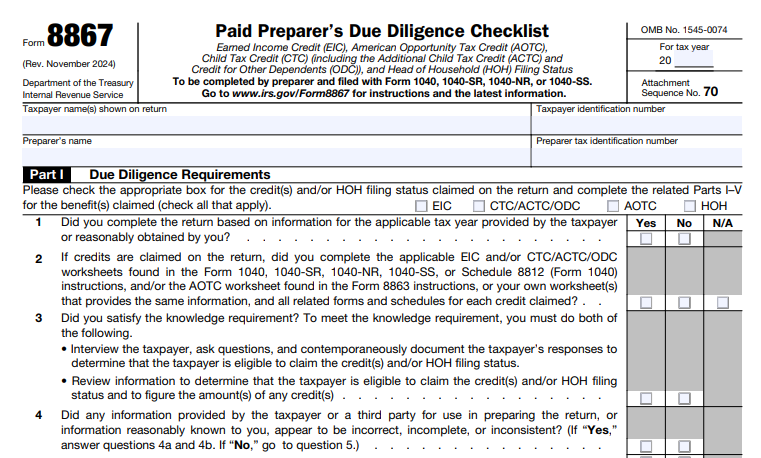
IRS Form 8867 – Paid Preparer’s Due Diligence Checklist – In the world of tax preparation, accuracy and compliance are paramount. For paid tax preparers handling returns that claim specific credits or filing statuses, IRS Form 8867 plays a crucial role. This form, officially titled the Paid Preparer’s Due Diligence Checklist, ensures that preparers exercise proper care when determining eligibility for benefits like the Earned Income Credit (EIC), Child Tax Credit (CTC) including the Additional Child Tax Credit (ACTC) and Credit for Other Dependents (ODC), American Opportunity Tax Credit (AOTC), and Head of Household (HOH) filing status. Updated in November 2024, it helps prevent errors and protects both taxpayers and preparers from potential audits or penalties.

Whether you’re a seasoned tax professional or a business owner navigating tax services, understanding Form 8867 can streamline your processes and enhance compliance. In this guide, we’ll break down everything you need to know about IRS Form 8867, including its purpose, completion requirements, and key resources.
IRS Form 8867 - Paid Preparer's Due Diligence Checklist
IRS Form 8867 – Paid Preparer’s Due Diligence Checklist


What Is IRS Form 8867 and Why Does It Matter?

IRS Form 8867 is a mandatory checklist for paid tax return preparers who assist clients in claiming certain tax benefits. Its primary purpose is to document that the preparer has met due diligence requirements under Treasury Regulations, specifically sections 6695(g) and 1.6695-2. By completing this form, preparers certify that they’ve interviewed the taxpayer, reviewed necessary documents, and accurately determined eligibility and credit amounts.

Failing to adhere to these standards can lead to significant penalties—up to $635 per failure (adjusted for inflation, potentially reaching $2,540 for all benefits in 2025). This form not only safeguards against IRS scrutiny but also promotes ethical tax preparation practices, reducing the risk of fraudulent claims.

Key benefits covered by Form 8867 include:

  • Earned Income Credit (EIC): A refundable credit for low- to moderate-income workers.
  • Child Tax Credit (CTC), Additional Child Tax Credit (ACTC), and Credit for Other Dependents (ODC): Credits for qualifying children and dependents.
  • American Opportunity Tax Credit (AOTC): An education credit for qualified tuition expenses.
  • Head of Household (HOH) Filing Status: A status that may lower tax liability for eligible unmarried taxpayers.

Preparers must file Form 8867 with the tax return (or amended return) when any of these are claimed. For electronic filings, it’s submitted digitally; otherwise, it’s attached to the paper return.

Who Must Complete and File IRS Form 8867?

Any paid tax return preparer who determines eligibility for the EIC, CTC/ACTC/ODC, AOTC, or HOH status must complete Form 8867. This includes both signing and nonsigning preparers. If multiple preparers are involved (e.g., one handles EIC and another AOTC), each may need to submit a separate form—up to four for e-filed returns.

Nonsigning preparers provide the completed form to the signing preparer, who then files it. The form must be based on current-year information, though certain elections (like prior-year earned income for EIC/ACTC, if applicable) require dual-year computations.

Record retention is essential: Keep copies of Form 8867, worksheets, taxpayer documents, and notes for three years from the return’s due date or filing date.

IRS Form 8867 Download and Printable

Download and Print: IRS Form 8867

Step-by-Step Guide to Completing IRS Form 8867

Form 8867 is divided into six parts, each focusing on due diligence and specific questions for the claimed benefits. Preparers answer with “Yes,” “No,” or “N/A” and must certify compliance in Part VI.

Part I: General Due Diligence Requirements

This section (Lines 1–8) applies to all claims:

  • Confirm use of current-year info and completion of required worksheets (e.g., from Form 1040 instructions or Schedule 8812).
  • Ensure no incorrect or inconsistent information was ignored, and make reasonable inquiries (documented contemporaneously).
  • List documents relied upon, like school records for child residency or receipts for business expenses.
  • Inform taxpayers about potential audits and attach Form 8862 if prior credits were denied.
  • Review Schedule C for self-employed taxpayers.

Part II: Questions for EIC

  • 9a: Eligibility for qualifying children or childless EIC.
  • 9b: Child residency verification.
  • 9c: Explanation of tiebreaker rules for multiple claimants.

Part III: Questions for CTC/ACTC/ODC

  • 10: Dependent status and U.S. residency/citizenship.
  • 11: Residency rules and custodial parent releases.
  • 12: Rules for divorced/separated parents, including Form 8332.

Part IV: Questions for AOTC

  • 13: Substantiation of expenses via Form 1098-T and receipts.

Part V: Questions for HOH

  • 14: Unmarried status and home maintenance costs for a qualifying person.

Part VI: Certification

Certify that all information is true and complete.

Use IRS worksheets or equivalents for computations, and document all inquiries.

Penalties for Non-Compliance with Due Diligence

The IRS imposes a $635 penalty (inflation-adjusted) for each failure to meet due diligence standards per credit or status claimed. This can add up quickly if multiple benefits are involved. Proper documentation and training are key to avoidance.

Essential Resources for Tax Preparers

The IRS offers a toolkit for due diligence compliance:

  • Form 8867 PDF and Instructions.
  • Due Diligence Training (eligible for CE credits).
  • Supporting Forms like 886-H-EIC, 886-H-DEP, and 14815 for documentation.
  • Videos and guides on knowledge and recordkeeping.

Visit the IRS EITC Central for more.

Final Thoughts on IRS Form 8867

Mastering IRS Form 8867 is essential for paid preparers to ensure accurate tax filings and avoid penalties. By following due diligence protocols, you not only comply with regulations but also build trust with clients. Stay updated via IRS.gov for any 2025 changes, and consider IRS training to enhance your expertise.

For the latest forms and instructions, always refer to official IRS sources. If you’re a preparer, integrating these practices can optimize your workflow and improve client satisfaction.
 

IRS Form 8615 – Tax for Certain Children Who Have Unearned Income

IRS Form 8615 - Tax for Certain Children Who Have Unearned Income

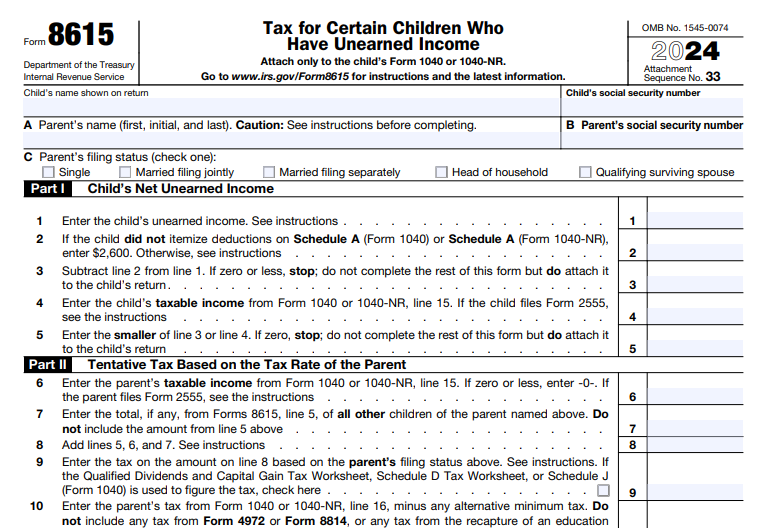
IRS Form 8615 – Tax for Certain Children Who Have Unearned Income – IRS Form 8615, officially titled “Tax for Certain Children Who Have Unearned Income,” is used to calculate the kiddie tax. This tax rule prevents parents from shifting investment income to their children to benefit from lower tax rates. Commonly known as the kiddie tax, it applies higher parental tax rates to a portion of a child’s unearned income exceeding certain thresholds.

Understanding Form 8615 is essential for parents with children who receive investment income, such as interest, dividends, or capital gains. For the 2025 tax year, key thresholds have been adjusted for inflation, and failing to file when required can lead to penalties.

IRS Form 8615 - Tax for Certain Children Who Have Unearned Income
IRS Form 8615 – Tax for Certain Children Who Have Unearned Income


What Is the Kiddie Tax?

The kiddie tax taxes a child’s net unearned income above a specified amount at the parent’s marginal tax rate, rather than the child’s usually lower rate. This rule, introduced in the Tax Reform Act of 1986, closes a loophole where families transferred assets to children for tax advantages.

Unearned income includes:

  • Taxable interest
  • Ordinary dividends and capital gain distributions
  • Capital gains
  • Rents, royalties
  • Taxable social security benefits, pensions, annuities
  • Income from trusts or estates

Earned income (wages, salaries, self-employment) is not subject to the kiddie tax and is taxed at the child’s rate.

IRS Form 8615 Download and Printable

Download and Print: IRS Form 8615

Who Must File Form 8615 in 2025?

A child must file Form 8615 (attached to their Form 1040 or 1040-NR) if all of the following apply (per IRS Instructions for Form 8615 and Topic No. 553):

  • The child has unearned income over $2,700.
  • The child is required to file a tax return.
  • The child meets age requirements:
    • Under age 18 at the end of 2025, or
    • Age 18 at the end of 2025 and did not have earned income providing more than half of their support, or
    • A full-time student aged 19–23 at the end of 2025 and did not have earned income providing more than half of their support.
  • At least one parent is alive at the end of the year.
  • The child does not file a joint return.

Even if net unearned income is $2,700 or less, Form 8615 may need to be attached (with no tax due) if unearned income exceeds certain amounts.

2025 Kiddie Tax Thresholds and How It’s Calculated

For 2025 (as confirmed in IRS Revenue Procedure 2024-40 and draft instructions):

  • The first $1,350 of net unearned income is tax-free (covered by the child’s standard deduction).
  • The next $1,350 is taxed at the child’s tax rate (typically 0%–12% for most).
  • Any net unearned income over $2,700 is taxed at the parent’s marginal federal income tax rate.

Example: A 16-year-old child has $5,000 in unearned income (dividends and interest) and no earned income.

  • $1,350: Tax-free
  • $1,350: Taxed at child’s rate (e.g., 10% = $135 tax)
  • $2,300 ($5,000 – $2,700): Taxed at parent’s rate (e.g., 24% = $552 tax)
  • Total kiddie tax: Approximately $687 (plus any child’s rate tax)

Form 8615 computes this by:

  1. Calculating the child’s net unearned income.
  2. Figuring a tentative tax using the parent’s rate on excess amounts.
  3. Combining with tax on the child’s other income.

Children with kiddie tax may also owe the 3.8% Net Investment Income Tax (NIIT) if thresholds are met (use Form 8960).

Alternative: Parent’s Election (Form 8814)

If the child’s gross income is only from interest/dividends (including capital gains distributions), less than $13,500 (10x the base amount), and meets other rules, parents can report it on their return using Form 8814. This simplifies filing but may increase the parent’s tax.

Tips to Minimize or Avoid the Kiddie Tax

  • Keep child’s unearned income under $2,700.
  • Invest in tax-free municipal bonds or growth stocks (low dividends).
  • Use 529 plans or Roth IRAs (for earned income) where growth is tax-deferred.
  • Consider UGMA/UTMA accounts carefully.

Where to Find Official Resources

  • Download Form 8615 and instructions: IRS.gov/Form8615
  • Kiddie tax overview: IRS Topic No. 553
  • Publication 929 (Tax Rules for Children and Dependents) for detailed examples.

Always consult a tax professional for your specific situation, as rules can be complex with multiple children or special circumstances.

This article is for informational purposes only and based on IRS guidelines as of December 2025. Tax laws may change.


IRS Form 8833 – Treaty-Based Return Position Disclosure Under Section 6114 or 7701(b)

IRS Form 8833 - Treaty-Based Return Position Disclosure Under Section 6114 or 7701(b)

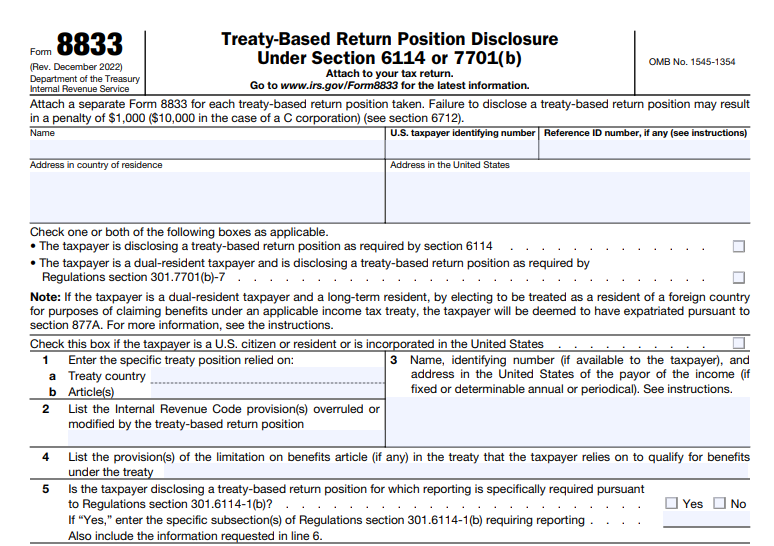
IRS Form 8833 – Treaty-Based Return Position Disclosure Under Section 6114 or 7701(b) – IRS Form 8833, titled Treaty-Based Return Position Disclosure Under Section 6114 or 7701(b), is a critical tax form for taxpayers who claim benefits under a U.S. income tax treaty that overrides or modifies provisions of the Internal Revenue Code (IRC). Filing this form ensures compliance with disclosure requirements and helps avoid penalties while preventing double taxation on international income.

As of December 2025, the current version of Form 8833 is the December 2022 revision, available on the official IRS website. No major updates to the form or its requirements have been announced for 2024 or 2025.

IRS Form 8833 - Treaty-Based Return Position Disclosure Under Section 6114 or 7701(b)
IRS Form 8833 – Treaty-Based Return Position Disclosure Under Section 6114 or 7701(b)


What Is IRS Form 8833?

Taxpayers use Form 8833 to disclose a “treaty-based return position”—a position where a U.S. tax treaty reduces or eliminates U.S. tax liability that would otherwise apply under domestic law. This disclosure is required under IRC Section 6114 for most taxpayers and under Treasury Regulations Section 301.7701(b)-7 for dual-resident taxpayers.

The form notifies the IRS that you rely on specific treaty provisions, providing transparency and allowing the IRS to review the claimed benefits.

Who Must File Form 8833?

You must file Form 8833 if you take a treaty-based position that reduces your U.S. tax liability, such as:

  • Claiming a treaty exemption or reduced rate on fixed or determinable annual or periodical (FDAP) income (e.g., dividends, interest, royalties) when it overrides IRC rules.
  • Resourcing income (e.g., treating U.S.-source income as foreign-source under a treaty for foreign tax credit purposes).
  • Claiming treaty benefits as a dual-resident taxpayer (e.g., a U.S. green card holder treated as a resident of another country under a treaty tie-breaker rule).
  • Receiving over $100,000 in reportable income and determining residency under a treaty rather than U.S. domestic rules.

Dual-resident taxpayers often file Form 8833 with Form 1040-NR to claim nonresident status.

A separate Form 8833 is required for each distinct treaty-based position.

IRS Form 8833 Download and Printable

Download and Print: IRS Form 8833

When Is Form 8833 Not Required?

The IRS provides several exceptions where disclosure is not needed, including:

  • Treaty-reduced withholding on FDAP income properly reported on Form 1042-S (if the beneficial owner is an individual or government entity and certain conditions are met).
  • Positions disclosed by a pass-through entity (e.g., partnership or trust) on its return.
  • Total affected income or payments of $10,000 or less in the tax year.
  • Certain standard treaty benefits that do not override substantive IRC provisions (e.g., many portfolio interest or pension exemptions).

Always review the latest Form 8833 instructions for the full list of exceptions.

How to File Form 8833

  1. Download the Form — Obtain the latest PDF from IRS.gov/Form8833.
  2. Complete Key Lines:
    • Identify the treaty country and specific article(s).
    • List the IRC section(s) overridden or modified.
    • Provide a detailed explanation of the position, including facts, income amounts, and how the treaty applies.
  3. Attach to Your Return — File Form 8833 with your U.S. tax return (e.g., Form 1040, 1040-NR, or 1120-F) by the due date, including extensions.
  4. Multiple Positions — Submit a separate form for each.

If you are not otherwise required to file a return, submit Form 8833 standalone to the appropriate IRS service center.

Common Examples of Treaty Positions Requiring Form 8833

  • Resourcing U.S.-Source Income → A U.S. expat performs services in the U.S. but claims under a treaty (e.g., U.S.-UK treaty) that the income is foreign-source to avoid U.S. taxation.
  • Dual-Resident Tie-Breaker → A green card holder living abroad claims treaty residency in the foreign country, filing as a nonresident alien.
  • Reduced Rates on Income → Claiming a lower withholding rate on royalties or dividends that exceeds standard treaty benefits not covered by exceptions.

Penalties for Non-Compliance

Failure to file Form 8833 when required can result in a $1,000 penalty per failure for individuals (or $10,000 for C corporations), even if no tax is underpaid. The penalty applies per position and per year. However, the IRS may waive it for reasonable cause.

Why File Form 8833? Benefits of Proper Disclosure

Filing Form 8833 allows you to legitimately claim treaty benefits, potentially saving thousands in taxes by avoiding double taxation. It ensures IRS compliance and protects against audits or disallowed claims.

For the most accurate application, consult the specific U.S. tax treaty with your country (available on IRS.gov) and consider professional tax advice, especially for complex dual-residency or high-value income scenarios.

Sources: Information based on official IRS resources, including Form 8833 (Rev. December 2022), instructions, and related publications (e.g., Publication 901, U.S. Tax Treaties). Always verify the latest details at IRS.gov.


IRS Form 13909 – Tax-Exempt Organization Complaint (Referral)

IRS Form 13909 - Tax-Exempt Organization Complaint (Referral)

IRS Form 13909 – Tax-Exempt Organization Complaint (Referral) – In the world of non-profits and charities, maintaining tax-exempt status requires strict adherence to federal tax laws. If you suspect an organization is violating these rules—such as engaging in prohibited political activities, private inurement, or other abuses—you can report it to the Internal Revenue Service (IRS). IRS Form 13909, also known as the Tax-Exempt Organization Complaint (Referral) Form, is the official tool for submitting such referrals. This article explains what the form is, when to use it, how to complete and submit it, and what to expect afterward, based on the latest IRS guidelines.

Whether you’re a concerned citizen, donor, or former employee, knowing how to file a tax-exempt organization complaint can help ensure accountability. We’ll cover everything from the basics to tips for effective reporting, optimizing your understanding of this important process.

IRS Form 13909 - Tax-Exempt Organization Complaint (Referral)
IRS Form 13909 – Tax-Exempt Organization Complaint (Referral)


What Is IRS Form 13909?

IRS Form 13909 is a voluntary referral form designed to report potential violations of federal tax laws by tax-exempt organizations. These include 501(c)(3) charities, religious groups, social welfare organizations under 501(c)(4), and other entities exempt from federal income tax. The form helps the IRS’s Tax Exempt and Government Entities (TEGE) division investigate whether an organization’s activities comply with tax-exempt requirements.

The purpose of the form is straightforward: it allows individuals to provide information that could trigger an IRS review or audit. Common issues reported include misuse of funds, excessive compensation to insiders, or failure to operate for exempt purposes. Note that this form is specifically for tax law violations—not general grievances like poor service or ethical concerns unrelated to taxes.

As of 2025, there have been no major structural changes to the form, but the IRS emphasizes providing detailed, factual information to aid investigations. The form remains a key part of the IRS’s oversight of over 1.8 million tax-exempt entities in the U.S.

When Should You Use Form 13909?

You should consider filing IRS Form 13909 if you have evidence or reasonable suspicion that a tax-exempt organization is not following federal tax rules. Examples of reportable issues include:

  • Private Benefit or Inurement: When organization assets benefit private individuals, like excessive salaries or personal use of funds.
  • Political Campaign Intervention: Tax-exempt groups (especially 501(c)(3)s) cannot endorse candidates or engage in substantial lobbying.
  • Unrelated Business Income: Earning income from activities not related to the exempt purpose without proper reporting.
  • Failure to File Required Returns: Such as not submitting Form 990 annually.
  • Fraud or Abuse: Misrepresentation of charitable status or embezzlement.

This form can be used for any organization claiming tax-exempt status, including churches (though special rules under IRC Section 7611 apply, limiting inquiries—see IRS Publication 1828 for details). If your concern involves state-level issues, like charitable solicitation laws, consider reporting to your state attorney general or charity regulator in addition to the IRS.

Remember, anonymous submissions are allowed, but providing your contact information enables the IRS to follow up if needed. If you’re worried about retaliation, you can check a box on the form to express this concern.

How to Complete IRS Form 13909

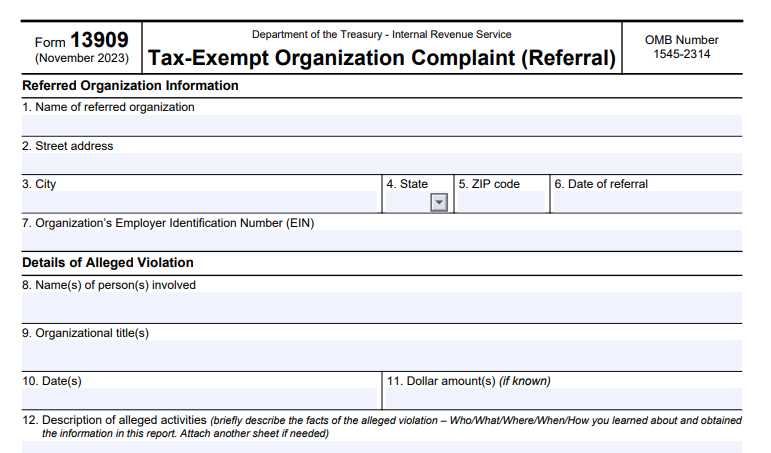
Filling out Form 13909 is relatively simple, but accuracy and detail are crucial for the IRS to act on your referral. The form is divided into three main sections: Referred Organization Information, Details of Alleged Violation, and Submitter Information.

Step 1: Gather Required Information

Before starting, collect:

  • The organization’s name, address, and Employer Identification Number (EIN). If you don’t have the EIN, include the state nonprofit registration number.
  • Specific details about the violation: Who was involved? What happened? Where and when? How did you learn about it? Include dates, dollar amounts, and names of other parties if known.
  • Supporting documents like emails, financial statements, or news articles.

Step 2: Fill Out the Sections

  • Fields 1-7 (Organization Details): Enter the organization’s full name, address (including any prior names or addresses), date of referral, and EIN.
  • Fields 8-12 (Violation Details): Provide names and titles of involved individuals, dates, amounts, and a clear description of the activities. Use additional sheets if space is limited.
  • Fields 13-20 (Your Information): Include your name, occupation, address, phone number. For anonymity, enter “Anonymous” in the name field and check the retaliation concern box if applicable.

The IRS estimates it takes about 46 minutes total to complete and submit the form, including recordkeeping and preparation, per the Paperwork Reduction Act.

IRS Form 13909 Download and Printable

Download and Print: IRS Form 13909

Tips for Effective Completion

  • Be factual and objective—avoid speculation.
  • Attach evidence to strengthen your complaint.
  • If reporting a church, reference Publication 1828 for procedural notes.
  • For reward claims related to underpayments of tax, use Form 211 instead.

How to Submit Your Complaint

Once completed, you can submit Form 13909 in one of two ways:

  • Email: Send to [email protected]. Note that emails are not encrypted, so avoid including sensitive personal data beyond what’s necessary.
  • Mail: Address to TEGE Referrals Group, 1100 Commerce Street, MC 4910 DAL, Dallas, TX 75242.

You can also submit the same information in a letter format without using the form, as long as you include all relevant details and attachments. If you have additional information later, resubmit with a copy of your original referral.

For broader oversight, copy your state tax agency or charity regulator—they handle complementary aspects of non-profit compliance.

What Happens After You Submit?

Upon receipt, the IRS will send an acknowledgment letter to non-anonymous submitters (via mail, not email). This confirms they’ve received your referral but doesn’t provide details on next steps.

Your identity remains confidential, and due to tax privacy laws under Internal Revenue Code Section 6103, the IRS cannot share updates on the investigation or outcomes. The TEGE division reviews referrals to decide if further action, like an audit, is warranted. Not all complaints lead to investigations, but your input helps prioritize oversight.

If the IRS finds violations, consequences for the organization could include revocation of tax-exempt status, back taxes, or penalties.

Frequently Asked Questions About IRS Form 13909

Can I file anonymously?

Yes, simply mark yourself as anonymous on the form. However, this means no acknowledgment letter or potential follow-up.

Is there a deadline for filing?

No, but report as soon as possible while details are fresh.

What if my complaint isn’t about taxes?

Form 13909 is for federal tax law violations only. For other issues, contact the Federal Trade Commission, state regulators, or law enforcement.

Can I get a reward?

For cases involving tax underpayments, file Form 211 for whistleblower rewards, but this is separate from Form 13909.

Conclusion: Promoting Transparency in Tax-Exempt Organizations

Filing IRS Form 13909 is a civic duty that supports the integrity of the non-profit sector. By reporting suspected abuses, you help ensure donations are used appropriately and tax benefits are granted fairly. Always rely on official IRS resources for the most accurate guidance, and consider consulting a tax professional if you’re unsure about a situation.

For the latest form and instructions, visit the IRS website directly. If you have evidence of wrongdoing, don’t hesitate—your referral could make a difference.


IRS Form 1125-A – Cost of Goods Sold

IRS Form 1125-A - Cost of Goods Sold

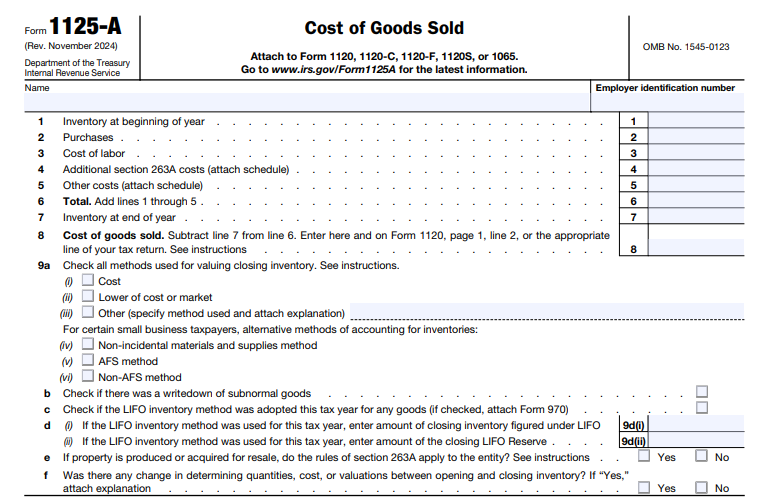
IRS Form 1125-A – Cost of Goods Sold – Understanding IRS Form 1125-ACost of Goods Sold (COGS), is essential for businesses that maintain inventory and deduct production or purchase costs from gross receipts to calculate taxable income. This form ensures accurate reporting of COGS, which directly impacts gross profit and tax liability.

Businesses filing certain corporate or partnership returns must attach Form 1125-A when claiming a COGS deduction. As of the latest revision (November 2024), applicable for tax year 2025 filings, this guide draws from official IRS sources to help you comply correctly.

IRS Form 1125-A - Cost of Goods Sold
IRS Form 1125-A – Cost of Goods Sold


What Is IRS Form 1125-A?

Form 1125-A is a tax document used to calculate and report the cost of goods sold for the tax year. COGS includes direct costs tied to producing or acquiring goods sold by the business, such as materials, labor, and certain overhead.

The IRS requires filers of the following forms to complete and attach Form 1125-A if reporting a COGS deduction:

  • Form 1120 (U.S. Corporation Income Tax Return)
  • Form 1120-C (U.S. Income Tax Return for Cooperative Associations)
  • Form 1120-F (U.S. Income Tax Return of a Foreign Corporation)
  • Form 1120-S (U.S. Income Tax Return for an S Corporation)
  • Form 1065 (U.S. Return of Partnership Income)
  • Form 1065-B (for certain electing large partnerships)

Businesses without inventory (e.g., pure service providers) generally do not need this form. The COGS amount from Line 8 transfers to the main tax return (e.g., Form 1120, Line 2).

Who Must File Form 1125-A?

You must file if your business:

  • Produces, purchases, or sells physical goods
  • Maintains inventory
  • Claims a COGS deduction on an applicable return

Small business taxpayers (generally those with average annual gross receipts of $29 million or less for 2025, adjusted for inflation) may qualify for exceptions from certain rules, like uniform capitalization under Section 263A.

IRS Form 1125-A Download and Printable

Download and Print: IRS Form 1125-A

How to Fill Out Form 1125-A: Step-by-Step

Form 1125-A has two main sections: COGS calculation and inventory valuation methods. Use the latest version from IRS.gov.

Section I: Cost of Goods Sold Calculation

  1. Line 1: Inventory at beginning of year
    Enter the value of inventory from the end of the prior tax year (matches prior year’s Line 7).
  2. Line 2: Purchases
    Enter cost of goods purchased for resale, minus any items withdrawn for personal use.
  3. Line 3: Cost of labor
    Include direct labor costs (not salaries for administrative staff).
  4. Line 4: Additional Section 263A costs
    Add costs required to be capitalized under uniform capitalization rules (attach schedule if applicable). Small businesses may be exempt.
  5. Line 5: Other costs
    Include additional direct costs (e.g., freight-in, overhead allocable to production; attach statement).
  6. Line 6: Total
    Add Lines 1 through 5.
  7. Line 7: Inventory at end of year
    Enter the value of closing inventory.
  8. Line 8: Cost of goods sold
    Subtract Line 7 from Line 6. This is your COGS deduction—carry it to your main return.

Section II: Inventory Valuation Methods (Line 9)

Check applicable boxes for valuation methods:

  • Cost
  • Lower of cost or market
  • LIFO (if used, provide details and attach Form 970 if adopting)
  • Other (explain)

Answer questions about:

  • LIFO adoption or use
  • Section 263A applicability
  • Changes in inventory valuation

Consistency in methods is required; changes need IRS approval.

Key Considerations for 2025

  • Small Business Exceptions — Many small taxpayers avoid full Section 263A capitalization and can treat inventory per their books.
  • Inventory Methods — Common options include FIFO, LIFO, or specific identification. LIFO requires specific elections.
  • Common Mistakes to Avoid — Inconsistent inventory valuation, forgetting to attach schedules for Lines 4 or 5, or mismatching beginning/ending inventory.

Always download the current form and instructions from IRS.gov, as rules can update.

Frequently Asked Questions

Is Form 1125-A required every year?
Yes, if you have inventory and claim COGS on an applicable return.

Where do I get the form?
Directly from the IRS website: Form 1125-A (Rev. November 2024).

Can I e-file with Form 1125-A?
Yes, when attached to an e-filed main return.

For personalized advice, consult a tax professional. Accurate COGS reporting reduces taxable income legally and helps avoid audits.

Sources: IRS.gov (About Form 1125-A, Form 1125-A PDF Rev. November 2024, Instructions for Form 1120 and related forms).


IRS Form 5305-SEP – Simplified Employee Pension – Individual Retirement Accounts Contribution Agreement

IRS Form 5305-SEP - Simplified Employee Pension - Individual Retirement Accounts Contribution Agreement

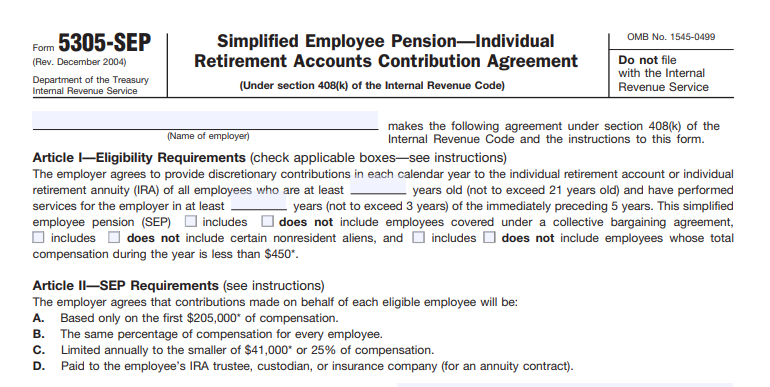
IRS Form 5305-SEP – Simplified Employee Pension – Individual Retirement Accounts Contribution Agreement – In today’s competitive job market, offering robust retirement benefits can be a game-changer for small businesses and self-employed individuals. One popular option is the Simplified Employee Pension (SEP) plan, established using IRS Form 5305-SEP. This form, officially titled “Simplified Employee Pension – Individual Retirement Accounts Contribution Agreement,” provides a straightforward way to set up retirement contributions without the complexities of traditional pension plans. Whether you’re a sole proprietor or a small business owner, understanding Form 5305-SEP can help you attract talent and secure your financial future.

IRS Form 5305-SEP - Simplified Employee Pension - Individual Retirement Accounts Contribution Agreement
IRS Form 5305-SEP – Simplified Employee Pension – Individual Retirement Accounts Contribution Agreement


What Is IRS Form 5305-SEP?

IRS Form 5305-SEP is a model document created by the Internal Revenue Service (IRS) to establish a SEP plan. A SEP is essentially a retirement plan where employers contribute directly to individual retirement accounts (IRAs) for eligible employees, including themselves if self-employed. Unlike more elaborate retirement plans, SEPs have minimal administrative costs and no annual filing requirements like Form 5500.

The form outlines the agreement between the employer and employees, specifying how contributions will be made to traditional IRAs. It’s designed for simplicity: employers can deduct contributions as business expenses, and employees benefit from tax-deferred growth on those funds. Note that this form cannot be used for Roth IRAs or if the employer maintains other qualified plans (except another SEP).

Who Should Use Form 5305-SEP?

Form 5305-SEP is ideal for small businesses, partnerships, corporations, and self-employed individuals looking for an easy retirement plan setup. It’s particularly suitable if:

  • You want flexible contributions that can vary year to year.
  • Your business has fluctuating income.
  • You employ fewer than 25 people, though there’s no size limit.

However, avoid this form if:

  • You use leased employees.
  • You want to allow employee elective deferrals (use Form 5305A-SEP instead).
  • Your plan year isn’t the calendar year.

Eligible employees must be at least 21 years old, have worked for you in at least 3 of the last 5 years, and earn at least $750 in 2025 (up from $750 in 2024). Employers can set less restrictive criteria but not more. Exclusions apply to union employees with bargained retirement benefits or nonresident aliens without U.S. income.

How to Establish a SEP Plan Using Form 5305-SEP

Setting up a SEP is straightforward and can be done retroactively up to your tax filing deadline (including extensions). Here’s the step-by-step process:

  1. Execute a Written Agreement: Complete Form 5305-SEP without modifications. Include your business name, employee participation requirements, and the contribution formula (typically a uniform percentage of compensation).
  2. Inform Employees: Provide each eligible employee with a copy of the completed form, its instructions, and statements about IRA options, amendments, and contribution notifications. Annual contribution notices are due by January 31 of the following year.
  3. Set Up IRAs: Establish a traditional IRA for each eligible employee at a qualified financial institution. Employees manage their investments.

Do not file the form with the IRS; keep it in your records. The agreement is adopted once IRAs are set up and information is distributed.

IRS Form 5305-SEP Download and Printable

Download and Print: IRS Form 5305-SEP

2025 SEP Contribution Limits and Rules

Contributions are employer-only and discretionary—you don’t have to contribute every year, but if you do, they must be uniform for all eligible employees. For 2025:

  • Maximum Contribution: The lesser of 25% of an employee’s compensation or $70,000.
  • Compensation Cap: Contributions are based on the first $350,000 of compensation.
  • Minimum Compensation for Eligibility: $750.

For self-employed individuals, calculate compensation as net earnings minus half your self-employment tax and your own SEP contribution. Contributions are deductible on your business tax return and must be made by your tax filing deadline (including extensions). Employees are immediately 100% vested.

Key 2025 Limits Amount
Max Contribution per Employee $70,000 or 25% of compensation (whichever is less)
Compensation Considered Up to $350,000
Min Compensation for Participation $750

Excess contributions can be withdrawn penalty-free by your tax deadline but may incur taxes if left in the account.

Benefits of Using a SEP Plan

SEPs offer several advantages:

  • Tax Benefits: Employer contributions are tax-deductible, and growth is tax-deferred for employees.
  • Flexibility: No mandatory annual contributions, and easy setup.
  • Low Costs: Minimal paperwork and no setup fees compared to 401(k)s.
  • Employee Attraction: Helps retain talent by providing retirement security.

Withdrawals before age 59½ may face a 10% penalty, and distributions are taxed as ordinary income. Rollovers to other IRAs are allowed.

Common FAQs About Form 5305-SEP

Can I amend the SEP agreement?

Yes, but notify employees within 30 days of changes.

What if I miss the contribution deadline?

Contributions for a year can be made up to your tax return due date, including extensions.

Are SEPs subject to ERISA?

Generally, no annual reporting is required, but certain IRA restrictions may trigger ERISA rules.

How do I handle terminated employees?

If they were eligible during the year, they must receive contributions even if they leave before the deposit.

For the latest updates, always check the IRS website, as limits adjust annually for inflation.

Final Thoughts

IRS Form 5305-SEP simplifies retirement planning for small businesses, offering tax advantages and flexibility. By establishing a SEP, you invest in your employees’ futures while potentially reducing your taxable income. Consult a tax professional to ensure compliance, especially with 2025’s updated limits. Ready to get started? Download the form from the IRS site and take the first step toward a secure retirement strategy.


IRS Form 5305 – Traditional Individual Retirement Trust Account

IRS Form 5305 - Traditional Individual Retirement Trust Account

IRS Form 5305 – Traditional Individual Retirement Trust Account – In today’s financial landscape, planning for retirement is essential, and one of the most popular tools for building a nest egg is the Traditional Individual Retirement Account (IRA). If you’re considering setting up a trust-based Traditional IRA, IRS Form 5305 plays a crucial role. This form provides a model agreement for establishing a tax-advantaged retirement account that can help you save for the future while potentially reducing your current tax burden. In this comprehensive guide, we’ll explore what IRS Form 5305 is, its purpose, eligibility requirements, and how to use it effectively. Whether you’re a first-time saver or looking to optimize your retirement strategy, understanding this form can empower you to make informed decisions.

IRS Form 5305 - Traditional Individual Retirement Trust Account
IRS Form 5305 – Traditional Individual Retirement Trust Account


What Is IRS Form 5305?

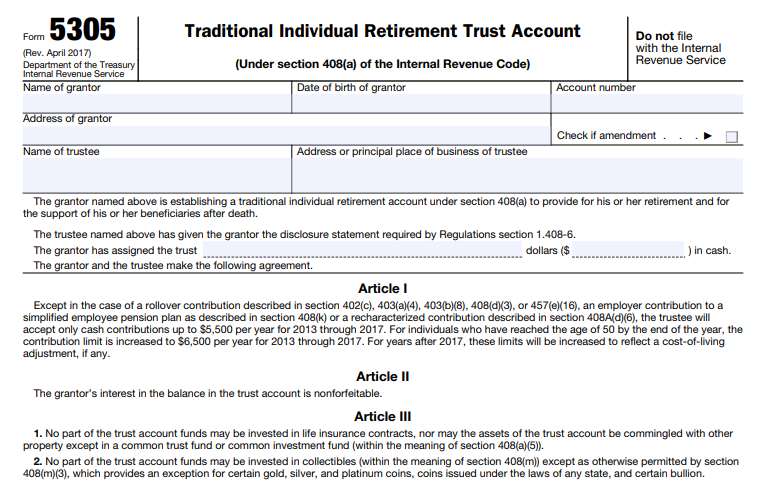
IRS Form 5305, officially titled “Traditional Individual Retirement Trust Account,” is a model trust agreement provided by the Internal Revenue Service (IRS) under Section 408(a) of the Internal Revenue Code. It serves as a template for individuals (known as the grantor) and a trustee—such as a bank or IRS-approved entity—to create a Traditional IRA structured as a trust account. Unlike forms you file with the IRS, Form 5305 is not submitted; instead, it’s executed between you and the trustee and kept with your records.

This form ensures the account meets IRS requirements for tax-deferred growth, making it a foundational document for trust-based IRAs. It’s distinct from Form 5305-A, which is used for custodial accounts, another common setup for Traditional IRAs. The current version of Form 5305 was revised in April 2017, and while contribution limits mentioned in the form are outdated (referencing $5,500 for years 2013–2017), the structure remains valid with adjustments for current limits.

The Purpose and Benefits of a Traditional IRA

A Traditional IRA is a retirement savings account that allows your investments to grow tax-deferred until withdrawal. Contributions are often tax-deductible, lowering your taxable income in the year you contribute, and earnings like interest, dividends, and capital gains aren’t taxed until distributed.

Key benefits include:

  • Tax Deductions: If eligible, contributions reduce your current tax bill, making it ideal for those in higher tax brackets now who expect lower rates in retirement.
  • Investment Flexibility: You can invest in stocks, bonds, mutual funds, and even certain precious metals, as long as they comply with IRS rules (no life insurance or most collectibles).
  • Spousal Contributions: Even non-working spouses can have an IRA funded based on the working spouse’s income.
  • Rollover Options: Easily transfer funds from employer plans like 401(k)s without immediate taxes.

However, withdrawals are taxed as ordinary income, and early distributions (before age 59½) may incur a 10% penalty, with exceptions for first-time home purchases or medical expenses.

Eligibility and Contribution Limits for 2025

To contribute to a Traditional IRA using Form 5305, you must have taxable compensation, such as wages, salaries, or self-employment income. There’s no upper age limit for contributions, thanks to the SECURE Act of 2019, but you need earned income. If you’re covered by an employer retirement plan, your deduction may phase out based on modified adjusted gross income (MAGI)—for 2024, full deductions for singles start phasing out at $77,000 and end at $87,000; for married couples filing jointly, $123,000 to $143,000. These limits typically adjust annually.

For 2025, the contribution limits are:

  • $7,000 for individuals under age 50.
  • $8,000 for those age 50 or older (including a $1,000 catch-up contribution).

Looking ahead to 2026, limits increase to $7,500 (under 50) and $8,500 (50+). Contributions must be in cash and can be made until the tax filing deadline (usually April 15 of the following year).

How to Set Up a Traditional IRA Using Form 5305

Setting up involves selecting a trustee (e.g., a bank or financial institution) and executing the agreement. Here’s a step-by-step guide:

  1. Choose a Trustee: Ensure they’re IRS-approved and provide the required disclosure statement under Regulations section 1.408-6.
  2. Complete the Form: Fill in details like your name, the trustee’s name, and the initial contribution amount. The form outlines the trust in Articles I–VIII.
  3. Fund the Account: Make your initial cash contribution; rollovers don’t count toward annual limits.
  4. Retain Records: Don’t file with the IRS—keep the signed form for your files.
  5. Invest Wisely: Work with your trustee to select investments compliant with IRS rules.

For spousal IRAs, create a separate trust account. Consult a financial advisor to ensure compliance, especially under the Retirement Security Rule for fiduciary standards.

IRS Form 5305 Download and Printable

Download and Print: IRS Form 5305

Key Provisions in IRS Form 5305

The form is divided into articles that govern the account:

  • Article I: Caps annual contributions and specifies they must be cash (excluding rollovers).
  • Article II: Ensures your interest is nonforfeitable.
  • Article III: Prohibits certain investments like life insurance or collectibles, with exceptions for specific metals.
  • Article IV: Details distribution rules, including required minimum distributions (RMDs) starting at age 73 (for those born 1951–1959) or later, based on life expectancy tables.
  • Articles V–VIII: Cover reporting, amendments, and additional provisions compliant with state and federal law.

Only Articles I–VII are IRS-reviewed; custom additions in Article VIII must not conflict.

Traditional IRA vs. Roth IRA: Key Differences

While both offer retirement savings, a Traditional IRA uses pre-tax contributions with taxable withdrawals, ideal if you expect lower taxes in retirement. A Roth IRA involves after-tax contributions but tax-free qualified withdrawals and no RMDs during your lifetime. Roth eligibility phases out at higher incomes (e.g., $150,000–$165,000 MAGI for singles in 2025). Traditional IRAs require RMDs, which can be satisfied across multiple accounts.

Tax Implications and Distribution Rules

Contributions may be deductible, but withdrawals are taxed as income. RMDs prevent indefinite tax deferral, calculated by dividing your account balance by your life expectancy factor. Upon death, beneficiaries inherit per rules: spouses can delay distributions, while others may need to withdraw over 5–10 years or life expectancy.

Frequently Asked Questions About IRS Form 5305

  • Do I need to file Form 5305 with the IRS? No, it’s a model agreement kept privately.
  • Can I use Form 5305 for a Roth IRA? No, it’s specifically for Traditional IRAs; use Form 5305-R for Roth trusts.
  • What if I exceed contribution limits? Excess contributions incur a 6% tax; remove them by your tax deadline to avoid penalties.
  • Is a trust account better than a custodial one? Trusts offer more control for complex estate planning, but custodial accounts (Form 5305-A) are simpler for most.
  • Where can I get help? Refer to IRS Publications 590-A (contributions) and 590-B (distributions), or consult a tax professional.

By leveraging IRS Form 5305, you can establish a solid foundation for your retirement savings. Always verify the latest rules on the IRS website, as tax laws evolve. Start planning today to secure a comfortable tomorrow.


IRS Form 5472 – Information Return of a 25% Foreign-Owned U.S. Corporation or a Foreign Corporation Engaged in a U.S. Trade or Business

IRS Form 5472 - Information Return of a 25% Foreign-Owned U.S. Corporation or a Foreign Corporation Engaged in a U.S. Trade or Business

IRS Form 5472 – Information Return of a 25% Foreign-Owned U.S. Corporation or a Foreign Corporation Engaged in a U.S. Trade or Business – In today’s global economy, many U.S. businesses have foreign ownership or engage in international transactions. If your company falls into this category, understanding IRS Form 5472 is crucial for tax compliance. This information return helps the IRS track reportable transactions between U.S. entities and related foreign parties, preventing tax evasion and ensuring transparency. Failing to file can lead to hefty penalties, so staying informed about Form 5472 filing requirements is essential for foreign-owned U.S. corporations and foreign corporations doing business in the U.S.

This comprehensive guide covers everything you need to know about IRS Form 5472, including who must file, how to submit it, deadlines, and recent updates as of 2025. Whether you’re a tax professional, business owner, or accountant, we’ll break it down step by step using the latest IRS guidelines.

IRS Form 5472 - Information Return of a 25% Foreign-Owned U.S. Corporation or a Foreign Corporation Engaged in a U.S. Trade or Business
IRS Form 5472 – Information Return of a 25% Foreign-Owned U.S. Corporation or a Foreign Corporation Engaged in a U.S. Trade or Business


What Is IRS Form 5472?

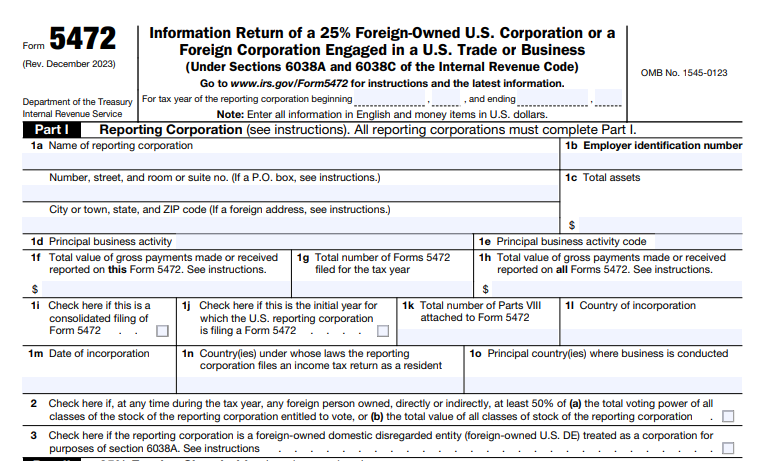
IRS Form 5472, officially titled “Information Return of a 25% Foreign-Owned U.S. Corporation or a Foreign Corporation Engaged in a U.S. Trade or Business,” is an informational tax form. It’s required under Internal Revenue Code sections 6038A and 6038C to report certain transactions between a reporting corporation and its related parties.

The form doesn’t calculate taxes owed but provides the IRS with details on transactions that could impact U.S. tax liability. This includes sales, purchases, loans, rents, and other exchanges of value. For tax years beginning after December 31, 2016, it also applies to foreign-owned disregarded entities (DEs) treated as corporations for this purpose.

Key related forms include:

  • Form 1120 (U.S. Corporation Income Tax Return)
  • Form 1120-F (U.S. Income Tax Return of a Foreign Corporation)
  • Form 5471 (Information Return of U.S. Persons With Respect to Certain Foreign Corporations)
  • Form 7004 (for extensions)

Who Must File IRS Form 5472?

A “reporting corporation” must file Form 5472 if it had any reportable transactions with a foreign or domestic related party during the tax year. Reporting corporations include:

  • 25% Foreign-Owned U.S. Corporations: This covers U.S. corporations (including disregarded entities) with at least one direct or indirect 25% foreign shareholder at any point in the tax year. Ownership is determined using constructive rules under section 318, with modifications like substituting “10%” for “50%” in certain attributions.
  • Foreign Corporations Engaged in U.S. Trade or Business: Any foreign corporation conducting business in the U.S. that has reportable transactions.

For single-member LLCs owned by foreign individuals or entities, Form 5472 is often required if treated as a disregarded entity. A separate form is needed for each related party involved in reportable transactions.

If you’re part of a consolidated group filing a U.S. income tax return, a single consolidated Form 5472 can be submitted with a schedule listing all reporting members.

Exceptions to Filing Form 5472

Not every qualifying corporation needs to file. Exceptions include:

  • No reportable transactions occurred (as defined in Parts IV, V, and VI of the form).
  • A U.S. person controlling the foreign related corporation files Form 5471 with Schedule M detailing the transactions (does not apply to foreign-owned U.S. DEs).
  • The related corporation is a foreign sales corporation filing Form 1120-FSC (does not apply to foreign-owned U.S. DEs).
  • Foreign corporations without a U.S. permanent establishment under a tax treaty that file Form 8833.
  • Foreign corporations with income exempt under section 883 that comply with related reporting.
  • Transactions between non-U.S. persons that don’t generate U.S.-sourced income or deductions (does not apply to foreign-owned U.S. DEs).

These exceptions help streamline compliance for entities with minimal U.S. ties.

What Are Reportable Transactions for Form 5472?

Reportable transactions are the core of Form 5472 filing requirements. They include:

Transaction Type Description Part of Form
Monetary Transactions Sales, purchases, rents, royalties, interest, premiums, loans, etc., where money is the sole consideration. Part IV
Additional Transactions for Foreign-Owned U.S. DEs Contributions, distributions, formations, or dissolutions not covered in Part IV. Part V
Nonmonetary or Less-Than-Full Consideration Exchanges of property or services not fully compensated, including fair market value estimates. Part VI

Transactions with U.S. related parties don’t need specific identification in these parts. Use the accrual method for amounts if your corporation does, and report in U.S. dollars with reasonable exchange rates. Small transactions ($50,000 or less) can be aggregated.

How to File IRS Form 5472

Filing Form 5472 is straightforward but requires attention to detail:

  1. Attach to Your Income Tax Return: Submit as an attachment to Form 1120, 1120-F, or similar by the due date (including extensions).
  2. For Foreign-Owned U.S. DEs: File a pro forma Form 1120 (only name, address, and items B and E completed) with Form 5472 attached. Mail or fax to: IRS, 1973 Rulon White Blvd, M/S 6112 Attn: PIN Unit, Ogden, UT 84201; or fax 855-887-7737. Electronic filing isn’t available for DEs.
  3. Electronic Filing: Follow your main tax return’s e-file instructions if applicable.
  4. Record-Keeping: Maintain detailed records under section 6001 to support all reported transactions.

Use identifying numbers like EIN, SSN, ITIN, or foreign tax IDs, and include reference IDs for consistency across years.

IRS Form 5472 Filing Deadlines

File by the due date of your corporation’s income tax return, including any extensions. For most U.S. corporations, this is the 15th day of the 4th month after the tax year ends (e.g., April 15 for calendar-year filers). Foreign-owned U.S. DEs use the owner’s tax year or calendar year if none.

Extensions are available via Form 7004, but you must file it by the original due date. Mark “Foreign-owned U.S. DE” on the form if applicable.

Penalties for Not Filing Form 5472

Non-compliance can be costly. The IRS imposes a $25,000 penalty for each failure to file Form 5472 on time or accurately, or for not maintaining required records. If the failure continues more than 90 days after IRS notification, an additional $25,000 penalty applies per 30-day period (or fraction thereof), per related party.

Criminal penalties may also apply for fraudulent submissions under sections 7203, 7206, and 7207. Each member of a consolidated group is jointly liable.

IRS Form 5472 Download andPrintable

Download and Print: IRS Form 5472

Recent Changes to IRS Form 5472 in 2025

The instructions for Form 5472 were last revised in December 2024, with a page update on February 11, 2025. Key update: The definition of “foreign person” now explicitly references sections 6013(g) and (h) for joint return elections, aligning with Regulations section 1.6038A-1(f)(1).

No major structural changes were noted, but always check the IRS website for the latest revisions, especially for foreign-owned LLCs.

Tips for Form 5472 Compliance

  • Track Transactions Early: Monitor related-party dealings throughout the year to avoid last-minute scrambles.
  • Use Professional Help: Consult a tax advisor familiar with international tax rules to ensure accuracy.
  • Double-Check Ownership: Apply constructive ownership rules carefully to determine if you’re 25% foreign-owned.
  • Aggregate Small Amounts: For minor transactions, use the “$50,000 or less” category to simplify reporting.

Frequently Asked Questions About IRS Form 5472

Do I need to file if my foreign ownership is exactly 25%?

Yes, if you meet the threshold and have reportable transactions.

Can I file Form 5472 electronically?

It depends on your entity type—yes for most corporations attached to e-filed returns, but no for foreign-owned U.S. DEs.

What if I miss the deadline?

You may qualify for penalty relief under certain conditions, but it’s best to file on time or request an extension.

Is Form 5472 required for foreign-owned single-member LLCs?

Yes, if disregarded for U.S. tax purposes and reportable transactions occur.

Conclusion

Navigating IRS Form 5472 doesn’t have to be overwhelming. By understanding the filing requirements, deadlines, and potential penalties, you can ensure your business stays compliant and avoids unnecessary fines. Always refer to the official IRS instructions for the most current details, and consider professional guidance for complex situations. Staying proactive with Form 5472 helps protect your operations in the U.S. market. For more tax resources, visit the IRS website or consult a certified tax expert.


IRS Form 3468 – Investment Credit

IRS Form 3468 - Investment Credit

IRS Form 3468 – Investment Credit – In today’s evolving tax landscape, businesses and individuals investing in energy-efficient projects, historic building rehabilitations, or advanced manufacturing can significantly reduce their tax liabilities through targeted credits. IRS Form 3468, known as the Investment Credit, serves as the key tool for claiming these incentives. Whether you’re a solar energy installer, a real estate developer preserving historic structures, or a manufacturer expanding clean tech facilities, understanding Form 3468 can unlock substantial savings. This guide breaks down everything you need to know about IRS Form 3468, including eligibility, filing steps, and recent updates influenced by the Inflation Reduction Act (IRA).


IRS Form 3468 - Investment Credit
IRS Form 3468 – Investment Credit


What is IRS Form 3468?

IRS Form 3468 is a federal tax form used to claim the investment tax credit under Internal Revenue Code Section 46. This credit encompasses several sub-credits designed to encourage investments in sustainable energy, historic preservation, and innovative projects. The form allows taxpayers to calculate and report credits based on qualified investments in depreciable property placed in service during the tax year.

Key purposes of Form 3468 include:

  • Promoting energy efficiency and renewable sources.
  • Supporting the rehabilitation of historic buildings.
  • Incentivizing advanced energy and manufacturing projects.

Taxpayers must file a separate Form 3468 for each qualified facility or property, ensuring detailed reporting for accuracy. It’s typically attached to your main tax return, such as Form 1040 for individuals or Form 1120 for corporations, and credits are often carried over to Form 3800 (General Business Credit) for aggregation.

Types of Investment Credits Available on Form 3468

Form 3468 covers a range of credits, each with specific qualifications and rates. Here’s a breakdown of the main categories:

1. Energy Credit (Section 48)

This is one of the most utilized credits, applying to investments in solar, wind, geothermal, fuel cells, and other renewable energy properties. Base rates are 6% (or up to 30% with prevailing wage and apprenticeship compliance), plus bonuses for domestic content (up to 10%) and energy communities (up to 10%).

2. Rehabilitation Credit (Section 47)

Aimed at preserving historic buildings, this credit offers 10-20% on qualified rehabilitation expenditures for certified historic structures or pre-1936 buildings. Transitional rules apply for projects started before 2018.

3. Clean Electricity Investment Credit (Section 48E)

Introduced under the IRA, this tech-neutral credit replaces phasing-out energy credits after 2024. It provides up to 30% (base 6%, multiplied by 5 for wage/apprenticeship compliance) for zero-emission electricity facilities and energy storage, with additional 10% bonuses for domestic content and energy communities. Phaseout begins after 2032 or when U.S. electricity GHG emissions drop to 25% of 2022 levels.

4. Advanced Manufacturing Investment Credit (Section 48D)

Offers 25% on investments in semiconductor or equipment manufacturing facilities, excluding foreign entities of concern.

5. Other Credits

  • Qualifying Advanced Coal Project (Section 48A): Up to 30% for coal tech with CO2 sequestration.
  • Qualifying Gasification Project (Section 48B): Up to 30% for gasification with sequestration.
  • Qualifying Advanced Energy Project (Section 48C): 6-30% for re-equipping facilities for clean energy production.
Credit Type Base Rate Maximum with Bonuses Key Eligibility
Energy Credit 6% 50% Renewable energy properties
Clean Electricity 6% 50% Zero-emission facilities post-2024
Rehabilitation 10-20% N/A Historic buildings
Advanced Manufacturing 25% N/A Semiconductor facilities

Who Is Eligible for the Investment Credit?

Eligibility varies by credit type, but general requirements include:

  • The property must be depreciable or amortizable.
  • It must be placed in service in the U.S. (with exceptions).
  • Taxpayers cannot claim credits if they’ve received certain grants or used tax-exempt financing (basis reductions apply).
  • For increased rates, projects must meet prevailing wage and apprenticeship (PWA) rules, unless under 1 MW or started before January 29, 2023.
  • Businesses, individuals, partnerships, S-corporations, estates, trusts, and cooperatives can claim it. Tax-exempt entities may elect direct payments under Section 6417.

Special considerations: Credits may be recaptured if property is disposed of or fails requirements within 5 years (report on Form 4255).

IRS Form 3468 Download and Printable

Download and Print: IRS Form 3468

How to File IRS Form 3468: Step-by-Step Guide

Filing Form 3468 requires careful documentation. Here’s a streamlined process based on official instructions:

  1. Gather Documentation: Collect basis amounts, placement-in-service dates, certifications (e.g., NPS for rehabilitation, DOE for advanced projects), and pre-filing registration numbers for elective payments or transfers.
  2. Complete Part I (Facility Information): Enter details like IRS registration number, facility type, address, coordinates, and checkboxes for bonuses (e.g., domestic content, low-income).
  3. Fill Relevant Credit Parts (II-VII): Calculate qualified investment basis, apply rates, and add bonuses. For example, in Part VI (Energy Credit), enter basis in specific sections (e.g., solar on Line 3a) and multiply by percentages.
  4. Apply Reductions and Bonuses: Reduce for subsidized financing or tax-exempt bonds. Add PWA multipliers, domestic content (Line 9), energy community (Line 10), and low-income bonuses (Line 11).
  5. Total and Report: Sum credits and transfer to Form 3800. Attach statements for elections, certifications, or PWA compliance.
  6. File with Your Return: Submit electronically or by mail with your annual tax return. For 2023-2024, relief allows aggregated filing for high-volume claimants (attach “CleanEnergyRelief.pdf”); check if extended to 2025.

Common tip: Use tax software like TurboTax for guided entry, or consult a professional for complex projects.

Recent Changes to IRS Form 3468 for 2025

The IRA has transformed Form 3468, emphasizing clean energy:

  • Clean Electricity Credit Expansion: Fully effective post-2024, with elective payment phaseouts (90% for 2024 starts, 85% for 2025) unless exceptions met.
  • Bonus Credits Updates: Domestic content now requires certifications; energy community definitions expanded to include certain MSAs after July 4, 2025.
  • Safe Harbor Removal: For commercial solar, the 5% expenditure safe harbor ended September 2, 2025, requiring detailed tracking.
  • Pre-Filing Mandatory: For payments/transfers, register via IRS.gov.
  • Draft Form Insights: The 2025 draft cautions against dual claims (e.g., no 48C if claiming 45X).

Stay updated via IRS.gov for final 2025 forms.

Common Mistakes to Avoid When Filing Form 3468

  • Failing to file separate forms per property.
  • Overlooking basis reductions for grants or bonds.
  • Missing PWA documentation for higher rates.
  • Not attaching required statements or certifications.
  • Claiming incompatible credits (e.g., production vs. investment).

FAQs About IRS Form 3468 and the Investment Credit

What if I have multiple properties?

File a separate Form 3468 for each, unless qualifying for 2023-2024 aggregation relief.

Can individuals claim this credit?

Yes, for qualifying investments like home solar installations.

How does the IRA affect 2025 filings?

It boosts clean energy incentives but requires stricter compliance for bonuses.

What happens if I miss the deadline?

File an extension with your return, but credits may carry forward.

Where can I download Form 3468?

From IRS.gov/forms.

Conclusion

IRS Form 3468 is a powerful tool for taxpayers investing in America’s future through energy innovation and historic preservation. By leveraging these credits, you can offset costs while contributing to sustainability goals. Always consult a tax advisor for personalized advice, as rules can be complex. For the latest details, visit the IRS website and review your eligibility today to maximize your 2025 tax savings.


IRS Form 941-X – Adjusted Employer’s Quarterly Federal Tax Return or Claim for Refund

IRS Form 941-X - Adjusted Employer's Quarterly Federal Tax Return or Claim for Refund

IRS Form 941-X – Adjusted Employer’s Quarterly Federal Tax Return or Claim for Refund – In the world of payroll taxes, accuracy is paramount. Mistakes on your Employer’s Quarterly Federal Tax Return (Form 941) can lead to overpayments, underpayments, or compliance issues. That’s where IRS Form 941-X comes in. This form, officially titled the Adjusted Employer’s Quarterly Federal Tax Return or Claim for Refund, allows employers to correct errors on previously filed Form 941s. Whether you’re dealing with misreported wages, incorrect tax withholdings, or unclaimed credits, understanding Form 941-X can save your business time and money. In this guide, we’ll cover everything you need to know about Form 941-X, including its purpose, filing process, deadlines, and recent updates as of 2025.

IRS Form 941-X - Adjusted Employer's Quarterly Federal Tax Return or Claim for Refund
IRS Form 941-X – Adjusted Employer’s Quarterly Federal Tax Return or Claim for Refund


What Is IRS Form 941-X and When Should You Use It?

Form 941-X is specifically designed for employers to amend errors discovered on a prior Form 941. Form 941 itself reports quarterly federal income tax withholdings, Social Security taxes, and Medicare taxes for employees. If you spot discrepancies after filing—such as underreported wages, overreported tips, incorrect credits for qualified sick or family leave wages, or issues with the COBRA premium assistance credit—Form 941-X is your tool for correction.

Common scenarios for using Form 941-X include:

  • Correcting taxable Social Security wages or tips (e.g., if an employee’s earnings were miscalculated).
  • Adjusting federal income tax withheld from wages.
  • Claiming or correcting credits like the qualified small business payroll tax credit for increasing research activities.
  • Fixing errors related to Additional Medicare Tax withholding.
  • Reclassifying workers (e.g., from independent contractors to employees under Section 3509 rates).

Important note: You must file a separate Form 941-X for each quarter you’re correcting. Don’t use it for errors in employee counts or federal tax liabilities reported on Schedule B (Form 941)—those require different handling. For territories like American Samoa, Guam, or Puerto Rico, special rules apply, and Spanish-language versions (Form 941-X (sp)) are available.

Adjustment Process vs. Claim for Refund: Which One to Choose?

When filing Form 941-X, you’ll select one of two processes in Part 1:

  • Adjustment Process (Line 1): Use this if you’ve underreported taxes (pay the additional amount owed) or overreported taxes (apply the credit to your current or future Form 941). This is ideal for ongoing corrections and can be interest-free if filed timely.
  • Claim Process (Line 2): This is for overreported taxes where you want a direct refund or abatement. It’s not available for underreported amounts and requires certification that you’ve repaid or reimbursed employees (or obtained their consent) for any overcollected taxes.

In Part 2, certify that you’ve filed (or will file) corrected Forms W-2 and W-2c with the Social Security Administration (SSA). For overreported taxes, provide details on repayments, reimbursements, or employee consents using Lines 4a–4c (for adjustments) or 5a–5d (for claims).

Step-by-Step Guide: How to Fill Out Form 941-X

Filling out Form 941-X involves five parts and requires precise calculations. Always refer to the official instructions for line-by-line details, and use the provided worksheets for credits. Here’s a high-level overview:

  1. Header Information: Enter your Employer Identification Number (EIN), business name, address, the quarter and year you’re correcting, and the date you discovered the error.
  2. Part 1: Select Process: Check Box 1 for adjustment or Box 2 for claim.
  3. Part 2: Certifications: Confirm W-2 filings (Line 3) and handle employee-related certifications for overreported taxes (Lines 4–5).
  4. Part 3: Enter Corrections: This is the core section. Use columns 1–4 for each line:
    • Column 1: Corrected amount.
    • Column 2: Originally reported (or previously corrected) amount.
    • Column 3: Difference (Column 1 minus Column 2).
    • Column 4: Tax correction (apply applicable rates, e.g., 12.4% for Social Security, 2.9% for Medicare).

    Key lines include:

    • Lines 6–7: Wages and federal income tax withheld (correct only for administrative errors or same-calendar-year discoveries).
    • Lines 8–11: Taxable Social Security wages and tips (use 12.4% rate; 6.2% for employer-only corrections).
    • Lines 12–13: Medicare and Additional Medicare Tax (rates: 2.9% and 0.9%, respectively).
    • Lines 16–18d: Credits (e.g., nonrefundable portions for sick/family leave or COBRA; use Worksheets 1–3).
    • Lines 19–22: Additions for reclassified workers (special rates under Section 3509).
    • Lines 23–27: Subtotals and total correction amounts.
    • Lines 28–40: Supporting details for credits, like qualified health plan expenses or wages.
  5. Part 4: Explanations: Check boxes for mixed adjustments (Line 41) or worker reclassifications (Line 42). Provide a detailed explanation on Line 43, including affected lines, error discovery date, amounts, and causes.
  6. Part 5: Sign and Date: Authorize with your signature; paid preparers must include their Preparer Tax Identification Number (PTIN).

Attach any required forms, like a corrected Form 8974 for research credits or Schedule R for aggregate filers. Electronic filing is available through Modernized e-File (MeF) for added convenience.

Deadlines for Filing Form 941-X

Timing is critical to avoid penalties. File Form 941-X as soon as you discover an error.

  • For Underreported Taxes: File by the due date of the Form 941 for the quarter in which the error was discovered to qualify for interest-free adjustments. Pay any owed amount at filing.
  • For Overreported Taxes:
    • Adjustment: File more than 90 days before the period of limitations expires.
    • Claim: File anytime before the limitations period ends (generally 3 years from the Form 941 filing date or 2 years from payment, whichever is later).

For example, for a 2023 Q4 Form 941 filed in January 2024, the limitations period ends around April 15, 2027. Note that credits like the Employee Retention Credit (ERTC) have expired limitations (e.g., April 15, 2025, for most 2021 quarters).

IRS Form 941-X Download and Printable

Download and Print: IRS Form 941-X

Where to File Form 941-X

Electronic filing is encouraged via IRS.gov/EmploymentEfile. For paper filings, mail to the appropriate IRS address based on your state:

  • Cincinnati, OH 45999-0005 for states like CT, DE, FL, IL, etc.
  • Ogden, UT 84201-0005 for others like AK, CA, TX, etc.
  • Special addresses for exempt organizations, governments, or private delivery services (PDS).

Penalties and Common Mistakes to Avoid

Late or incorrect filings can trigger penalties:

  • Failure to Deposit (FTD) Penalties: Apply if underreported taxes are paid late; attach an amended Schedule B.
  • Failure to Pay Penalties: For unpaid balances due.
  • Other Issues: Insufficient explanations on Line 43 can delay processing or deny claims. Always keep records for 4–6 years.

Common mistakes include not certifying employee consents, using the wrong process, or failing to explain corrections fully. Double-check calculations using the form’s worksheets and consult Publication 15 (Circular E) for guidance.

Recent Updates to Form 941-X in 2025

As of July 31, 2025, the latest revision of Form 941-X is from April 2025. Key changes include:

  • Expanded electronic filing options for amended returns (announced July 17, 2024).
  • Replacement of certain forms and instructions for Puerto Rico taxpayers (March 14, 2024).
  • Discontinuation of Form 941-SS and 941-PR after 2023; use Form 941 and 941-X instead.
  • Expired limitations for certain COVID-era credits, but claims for post-2023 sick/family leave wages (for pre-October 2021 leave) are still possible via Form 941-X.

Stay updated by checking IRS.gov for any new announcements.

Final Thoughts on Managing Form 941-X

Navigating IRS Form 941-X doesn’t have to be overwhelming. By understanding when and how to use it, you can ensure compliance, recover overpayments, and avoid costly penalties. If you’re unsure about your specific situation, consult a tax professional or contact the IRS Business and Specialty Tax Line at 800-829-4933. Remember, proactive error correction keeps your business on solid ground with the IRS.

For the most accurate information, always download the latest form and instructions from the official IRS website. If you’ve recently filed a Form 941 and suspect an error, act quickly—timely adjustments can make all the difference.