IRS Form 172 – Net Operating Losses (NOLs) For Individuals, Estates, and Trusts

IRS Form 172 - Net Operating Losses (NOLs) For Individuals, Estates, and Trusts

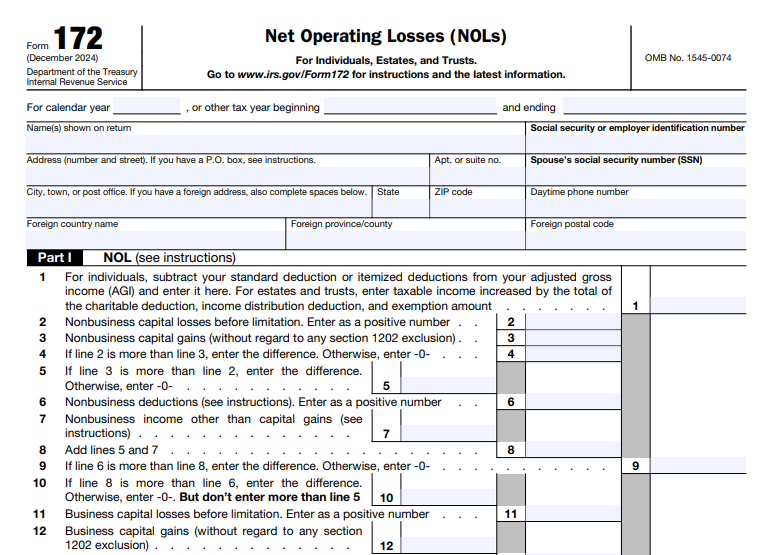
IRS Form 172 – Net Operating Losses (NOLs) For Individuals, Estates, and Trusts – In the complex world of tax planning, net operating losses (NOLs) can provide significant relief for taxpayers facing financial setbacks. If your deductions exceed your income in a given year, you might qualify for an NOL, allowing you to offset taxable income in other years. IRS Form 172 is the key document for calculating and managing these losses for individuals, estates, and trusts. This comprehensive guide breaks down everything you need to know about Form 172, including how to calculate NOLs, carryover rules, and recent updates, to help you optimize your tax strategy.
IRS Form 172 - Net Operating Losses (NOLs) For Individuals, Estates, and Trusts
IRS Form 172 – Net Operating Losses (NOLs) For Individuals, Estates, and Trusts


What Is a Net Operating Loss (NOL)?

A net operating loss occurs when your allowable tax deductions surpass your gross income for the year, typically stemming from business activities, employment, casualty or theft losses from federally declared disasters, moving expenses, or rental properties. NOLs are not just for corporations; individuals, estates, and trusts can also benefit by using them to reduce taxable income in prior or future years.

For example, if you’re a small business owner or freelancer and experience a loss due to high expenses, an NOL can help you recover some of that by applying the loss against profitable years. Importantly, NOLs exclude certain items like capital losses exceeding gains, nonbusiness deductions over nonbusiness income, prior NOL deductions, and qualified business income (QBI) deductions under Section 199A.

Who Needs to Use IRS Form 172?

Form 172 is specifically designed for non-corporate taxpayers—individuals, estates, and trusts—who need to determine the amount of an NOL available for carryback or carryforward. If you’re filing Form 1040 (U.S. Individual Income Tax Return), Form 1040-NR, or Form 1041 (U.S. Income Tax Return for Estates and Trusts), and suspect an NOL, this form is essential.

Partnerships and S corporations don’t file Form 172 directly, but partners and shareholders can use their distributive shares to calculate personal NOLs. Keep detailed records for at least three years after using the NOL or until the carryforward expires, as the IRS may require verification.

Step-by-Step: How to Calculate an NOL Using Form 172

Calculating an NOL involves a structured process outlined in Form 172’s Part I. Here’s a breakdown:

  1. Complete Your Tax Return First: Start by filing your regular tax return for the NOL year. For individuals, subtract your standard or itemized deductions from adjusted gross income (AGI). For estates and trusts, adjust taxable income by adding back charitable deductions, income distribution deductions, and exemptions. A negative result signals a potential NOL.
  2. Figure the NOL Amount: Use Part I of Form 172 to compute the loss. Key lines include:
    • Line 2: Enter nonbusiness capital losses (excluding Section 1202 exclusions for qualified small business stock).
    • Line 6: List nonbusiness deductions, such as IRA contributions, alimony, or itemized deductions (excluding business-related ones like self-employed health insurance).
    • Line 7: Input nonbusiness income, like dividends or interest (excluding wages or business profits).
    • Line 17: Add back Section 1202 exclusions as a positive amount.
    • Lines 19–22: Apply capital loss limitations—nonbusiness capital losses are limited to nonbusiness capital gains, while business losses have broader offsets.
    • Line 23: Exclude any NOL deductions from prior years.

    The final NOL is shown on Line 33 if negative.

  3. Handle Excess Business Losses: If your trade or business deductions exceed income plus a threshold (adjusted annually), use Form 461 to calculate the excess, which is treated as an NOL carryforward. Combine this with your Form 172 results using the provided worksheet.

If you have multiple NOLs, apply them starting with the earliest year.

IRS Form 172 Download and Printable

Download and print: IRS Form 172

NOL Carryback and Carryforward Rules Explained

One of the biggest advantages of NOLs is their flexibility in application:

  • Carryback Rules: For NOLs arising in tax years after 2020, general carrybacks are eliminated, except for farming losses, which can be carried back two years. Farming losses are defined as those from cultivating or raising agricultural commodities, excluding contract work. To claim a carryback, file Form 1045 (Application for Tentative Refund) or an amended return (Form 1040-X or 1041).
  • Waiving Carryback: You can elect to forgo carryback and only carry forward by attaching a statement to your timely filed return (including extensions). This election is irrevocable if made on time.
  • Carryforward Rules: Unused NOLs can be carried forward indefinitely. However, for post-2017 NOLs carried to years after 2020, the deduction is limited to 80% of taxable income (calculated without the NOL, QBI, or Section 250 deductions, minus pre-2018 NOLs). Use Part II of Form 172 to figure the carryover deduction for each year, adjusting for items like capital losses, QBI deductions, and modified taxable income.

For joint returns where filing status changes, allocate the NOL based on each spouse’s contribution.

Recent Changes to NOL Rules for 2025

As of 2025, NOL rules remain largely consistent with post-2020 reforms, with no major alterations specifically targeting NOLs in recent legislation like the One Big Beautiful Bill Act. However, broader tax changes—such as new deductions for seniors ($6,000 additional for those 65+ from 2025–2028) and tip/overtime reporting relief—could indirectly affect income calculations that feed into NOLs. Always check for updates, as itemized deduction limits and bonus depreciation extensions set for 2026 might influence future NOL strategies.

Form 172 isn’t filed separately; it’s used to support your NOL calculations when amending returns or applying for refunds. Attach it to Form 1045 for quick refunds on carrybacks or include the calculations in your amended return. For software users like TaxSlayer or Intuit ProSeries, Form 172 is integrated for e-filing, with availability confirmed for March 2025 prints.

Related forms include:

  • Form 1045 for tentative refunds.
  • Form 461 for excess business losses.
  • Schedule A (Form 1040) for itemized deductions.

Consult IRS Publication 536 for additional guidance, though it’s no longer being revised as of October 2024.

Real-World Examples of Using Form 172

Consider a married couple filing jointly with a $5,000 farming NOL. If they carried it back to a year of separate filings, only the spouse responsible for the loss claims it. In another scenario, a single taxpayer with a $1 million Schedule C loss might have a $738,000 excess business loss after Form 461, treated as an NOL carryforward.

These examples illustrate how Form 172 ensures accurate allocation and maximizes tax benefits.

Maximizing Your Tax Benefits with NOLs

Navigating IRS Form 172 can turn a financial loss into a strategic advantage, reducing your tax burden over multiple years. Whether you’re an individual dealing with business setbacks or managing an estate, understanding NOL calculation and carryover rules is crucial. For personalized advice, consult a tax professional, as rules can vary based on your situation.

Stay updated with IRS resources to ensure compliance and optimization. By leveraging Form 172 effectively, you can enhance your financial recovery and long-term tax planning.
 

IRS Form SS-8 – Determination of Worker Status for Purposes of Federal Employment Taxes and Income Tax Withholding

IRS Form SS-8 - Determination of Worker Status for Purposes of Federal Employment Taxes and Income Tax Withholding

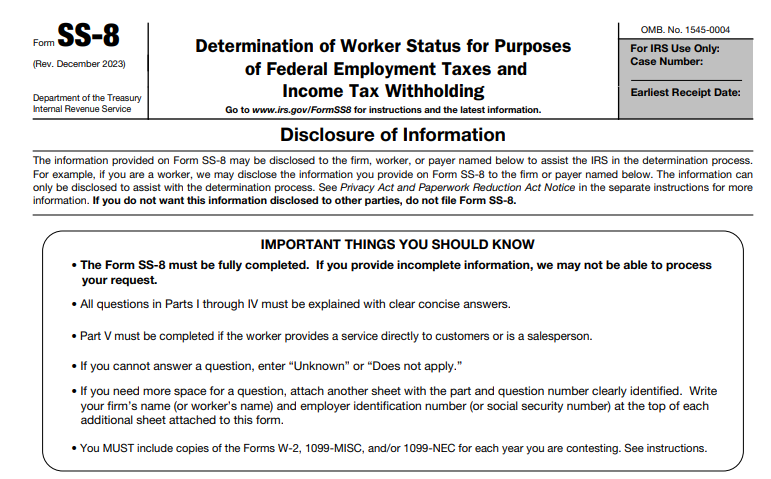
IRS Form SS-8 – Determination of Worker Status for Purposes of Federal Employment Taxes and Income Tax Withholding – In today’s gig economy and evolving workforce, correctly classifying workers as employees or independent contractors is crucial for businesses and individuals alike. Misclassification can lead to significant tax penalties, back taxes, and legal issues. That’s where IRS Form SS-8 comes into play. This form, officially titled “Determination of Worker Status for Purposes of Federal Employment Taxes and Income Tax Withholding,” allows firms and workers to request an official IRS ruling on a worker’s classification. Whether you’re a small business owner hiring freelancers or a worker unsure about your status, understanding Form SS-8 can help ensure compliance with federal tax laws.

In this comprehensive guide, we’ll break down what IRS Form SS-8 is, who should use it, how to file it, and the key factors the IRS considers. We’ll also cover recent updates as of 2025 to keep you informed with the latest IRS guidelines.

IRS Form SS-8 - Determination of Worker Status for Purposes of Federal Employment Taxes and Income Tax Withholding
IRS Form SS-8 – Determination of Worker Status for Purposes of Federal Employment Taxes and Income Tax Withholding


What Is IRS Form SS-8?

IRS Form SS-8 is a request form submitted to the Internal Revenue Service (IRS) to determine whether a worker should be classified as an employee or an independent contractor under common law rules. This classification affects federal employment taxes, such as Social Security, Medicare, and unemployment taxes, as well as income tax withholding requirements.

The form is not for hypothetical scenarios, proposed transactions, or situations involving pending litigation. Instead, it’s designed for actual work relationships where there’s uncertainty about the status. The IRS uses the information provided to issue a determination letter, which can be binding if the facts and circumstances remain unchanged.

Filing Form SS-8 is free, and it helps prevent costly mistakes. For businesses, treating a worker as an independent contractor when they should be an employee can result in owing unpaid taxes plus interest and penalties. For workers, it ensures proper tax treatment and potential eligibility for benefits like unemployment insurance.

Employee vs. Independent Contractor: The Key Factors

The core of worker classification lies in the degree of control and independence. The IRS evaluates this through three main categories: behavioral control, financial control, and the type of relationship. No single factor is decisive; the IRS weighs all elements holistically based on the entire relationship.

Behavioral Control

This examines whether the business has the right to direct and control how the work is performed. Factors include:

  • Instructions on when, where, and how to work (e.g., specific tools or sequences).
  • Training provided by the business, which suggests employee status.

Example: If a company dictates daily schedules and methods, the worker is likely an employee. In contrast, an independent contractor typically chooses their own approach.

Financial Control

This looks at the economic aspects of the job:

  • How the worker is paid (e.g., hourly wage vs. flat fee per project).
  • Reimbursement of expenses and who provides tools/supplies.
  • Opportunity for profit or loss, and whether the worker can work for others.

Example: A worker using their own equipment and bearing unreimbursed expenses leans toward independent contractor status.

Type of Relationship

This considers the ongoing nature of the work:

  • Written contracts describing the relationship.
  • Employee benefits like insurance, pension, or vacation pay.
  • Permanency of the relationship and if the work is key to the business.

Example: Long-term engagements with benefits indicate employee status, while short-term projects without perks suggest an independent contractor.

If these factors leave you uncertain, filing Form SS-8 is the next step. The IRS reviews the specifics of your situation to make a determination.

Who Should File Form SS-8?

Both workers and firms (businesses) can file Form SS-8. It’s particularly useful for:

  • Businesses hiring workers in roles like gig workers, consultants, or freelancers where classification is ambiguous.
  • Workers who believe they’ve been misclassified (e.g., treated as contractors but functioning as employees).
  • Situations involving multiple workers in similar roles, where a class determination might apply.

However, it’s not suitable for state or local government workers under Section 218 agreements (handled by the Social Security Administration) or business-to-business transactions. If you’re a worker filing for multiple firms, submit separate forms for each.

Note: Don’t file if confidentiality is a concern, as the IRS may share information with the other party involved.

How to Complete and Submit Form SS-8

Completing Form SS-8 requires detailed information about the work relationship. The form is divided into parts:

  • Part I: General information, including years of service, tax forms issued (e.g., W-2, 1099-NEC), and any litigation.
  • Part II: Behavioral control questions.
  • Part III: Financial control details.
  • Part IV: Relationship factors and any changes over time.
  • Part V: For service providers or salespersons (e.g., those interacting directly with customers).

Provide clear, concise answers and attach supporting documents like copies of Forms 1099 or W-2, paystubs, contracts, or bank statements. Use “Unknown” or “Does not apply” where appropriate, and add extra sheets if needed.

Sign the form (handwritten or electronic; no stamps) and submit via mail to Internal Revenue Service, Form SS-8 Determinations, P.O. Box 630, Stop 631, Holtsville, NY 11742-0630, or fax to 855-242-4481. There’s no filing fee, and don’t attach it to your tax return.

IRS Form SS-8 Download and Printable

Download and Print: IRS Form SS-8

The IRS Determination Process

Once submitted, the IRS acknowledges receipt and may request additional information, including from the other party via a blank Form SS-8. The review process, which can take at least six months, involves analyzing facts against common law rules.

The IRS issues either a formal determination letter (binding) or an information letter (advisory). There’s no appeal process like in audits, but you can request reconsideration with new facts. Determinations don’t affect Section 530 relief for businesses with a reasonable basis for their classification.

Consequences of Worker Misclassification

Misclassifying an employee as an independent contractor can lead to:

  • Back payment of employment taxes, plus penalties and interest.
  • Loss of deductions for businesses.
  • For workers: Ineligibility for benefits and potential need to file amended returns.

Correct classification ensures proper withholding, tax payments, and compliance, avoiding audits or disputes.

Recent Updates to IRS Form SS-8 in 2025

As of December 2025, the latest revision of Form SS-8 is from December 2023, with instructions updated in January 2024. No major structural changes have been reported in 2025, but the IRS continues to emphasize accurate classification amid gig economy growth. The “About Form SS-8” page was last updated in February 2025, reinforcing its use for federal tax purposes only.

Third-party resources, like those from payroll providers, have been updated in April 2025 to reflect ongoing guidance without new form revisions. Always check the official IRS website for the most current version before filing.

Frequently Asked Questions (FAQs) About IRS Form SS-8

How long does it take to get a determination?

Typically at least six months, so don’t delay filing taxes while waiting.

Can I file Form SS-8 electronically?

No, only mail or fax submissions are accepted.

What if I’m misclassified as an independent contractor?

If determined an employee, you may need to file amended returns and could be eligible for refunds (within statutes of limitations).

Does a determination apply retroactively?

Yes, for open tax years, but it won’t override prior reasonable classifications under Section 530.

Where can I download the latest Form SS-8?

From the IRS website at irs.gov/forms.

Final Thoughts on Worker Classification and Form SS-8

Navigating worker status can be complex, but IRS Form SS-8 provides a clear path to resolution. By understanding the factors and process, you can avoid pitfalls and ensure tax compliance. If in doubt, consult a tax professional or file the form directly. Stay updated with IRS resources to adapt to any future changes in employment tax rules. Proper classification not only saves money but also protects your business or career in the long run.


IRS Form 8379 – Injured Spouse Allocation

IRS Form 8379 - Injured Spouse Allocation

IRS Form 8379 – Injured Spouse Allocation – If you’re married and filing a joint tax return, you might expect a refund based on your combined income and withholdings. However, if your spouse has past-due debts—such as child support, federal student loans, state taxes, or other obligations—the IRS may offset the entire joint refund to pay those debts, even if you aren’t responsible for them. This is where IRS Form 8379, Injured Spouse Allocation, comes in. Filing this form allows the “injured spouse” (the one not liable for the debt) to reclaim their portion of the refund.

As of 2025, the latest instructions for Form 8379 are revised November 2024, applicable for tax years beginning in 2024 and later. This guide explains what injured spouse allocation is, who qualifies, how to file, and key differences from similar relief options, based on official IRS guidelines.

IRS Form 8379 - Injured Spouse Allocation
IRS Form 8379 – Injured Spouse Allocation


What Is IRS Form 8379: Injured Spouse Allocation?

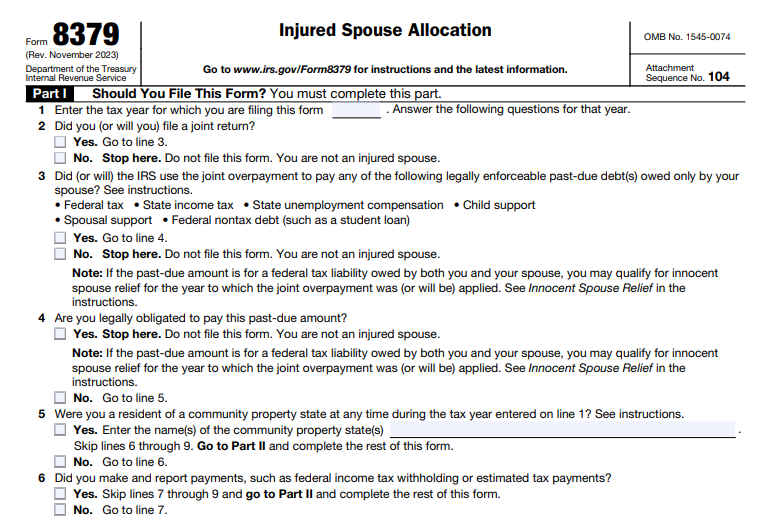
Form 8379 is used when a joint tax overpayment (refund) is applied to a past-due obligation owed solely by one spouse. The injured spouse files it to allocate the joint refund and recover their share.

Common debts that trigger offsets include:

  • Past-due child or spousal support
  • Federal nontax debts (e.g., student loans)
  • State income tax obligations
  • Certain unemployment compensation debts

The IRS administers this through the Treasury Offset Program (TOP). Without Form 8379, the full refund can be seized, leaving the non-liable spouse without their entitled portion.

Note: This relief protects your refund share—it does not forgive or remove the underlying debt owed by your spouse.

Who Qualifies as an Injured Spouse?

You may qualify if:

  • You filed a joint return (Form 1040 or 1040-SR).
  • Your share of the joint refund was (or will be) offset to pay your spouse’s separate past-due debt.
  • You are not legally required to pay that debt.
  • You reported income, withholdings, or refundable credits (e.g., Earned Income Credit) contributing to the overpayment.

Special rules apply in community property states (Arizona, California, Idaho, Louisiana, Nevada, New Mexico, Texas, Washington, Wisconsin). The IRS allocates the refund according to state laws, which often treat income and overpayments as equally shared.

If both spouses owe separate debts, you may still file, but allocation is more complex.

IRS Form 8379 Download and Printable

Download and Print: IRS Form 8379

Injured Spouse vs. Innocent Spouse Relief: Key Differences

People often confuse “injured spouse” with “innocent spouse” relief, but they address different issues:

Aspect Injured Spouse (Form 8379) Innocent Spouse (Form 8857)
Purpose Recover your share of a joint refund offset to spouse’s debt Relieve you from joint tax liability due to spouse’s errors/underreporting
When It Applies Refund seized for spouse’s pre-existing debt (e.g., child support) Understated tax on joint return (e.g., omitted income)
Liability Relief Only affects refund allocation Relieves you from paying additional taxes, interest, penalties
Filing Deadline Generally 3 years from return filing or 2 years from payment Usually 2 years from IRS collection notice

Do not file Form 8379 if seeking innocent spouse relief—use Form 8857 instead.

How to File Form 8379 in 2025

You can file Form 8379 in three ways:

  1. With your original joint return (recommended to prevent offset): Attach it and write “Injured Spouse” in the upper left corner of Form 1040.
  2. With an amended return (Form 1040-X).
  3. Separately (after offset notice or if you learn of potential offset later).

Steps to Complete:

  • Part I: Confirm eligibility.
  • Part II/III: Allocate income, credits, deductions, and withholdings between spouses (as if filing separately).
  • Attach copies of W-2s, 1099s showing withholding (for both spouses).
  • Sign (injured spouse only if filing separately).

Electronic Filing: Yes, you can e-file Form 8379 with your joint return.

Where to Mail (if separate): Send to the IRS Service Center where your original return was filed.

Processing Time (as of 2025):

  • E-filed with joint return: ~11 weeks
  • Paper-filed with joint return: ~14 weeks
  • Filed separately: ~8 weeks

Tips for Successful Filing

  • File early (with your return) to avoid offset delays.
  • Include all required supporting documents to prevent processing delays.
  • In community property states, check the box on the form—IRS will apply state rules.
  • Track status via IRS “Where’s My Refund?” tool or call 800-829-1040.

For the latest form and instructions, visit IRS.gov/Form8379 or IRS.gov/InjuredSpouse.

Frequently Asked Questions

Can I file if we’re divorced?
Yes, if the joint return was for a year when married and the debt is your ex-spouse’s.

What if no offset has occurred yet?
File proactively with your return.

Is there a deadline?
Generally within 3 years of filing the return or 2 years of payment (see IRC Section 6511 for details).

Filing Form 8379 can protect your hard-earned refund. Always consult a tax professional for your specific situation, as rules can vary by state and circumstances.

Sources: IRS.gov (About Form 8379, Instructions for Form 8379 Rev. Nov 2024, Injured Spouse Relief page, last reviewed/updated 2025).


IRS Form 1040 (Schedule 8812) – Credits for Qualifying Children and Other Dependents

IRS Form 1040 (Schedule 8812) - Credits for Qualifying Children and Other Dependents

IRS Form 1040 (Schedule 8812) – Credits for Qualifying Children and Other Dependents – If you’re a parent or guardian filing your taxes, claiming credits for your dependents can significantly reduce your tax bill or even result in a refund. One key form for this is IRS Form 1040 Schedule 8812, officially titled “Credits for Qualifying Children and Other Dependents.” This schedule helps you calculate the Child Tax Credit (CTC), the Credit for Other Dependents (ODC), and the Additional Child Tax Credit (ACTC). In this comprehensive guide, we’ll break down what Schedule 8812 is, who qualifies, how to fill it out, and the latest updates for the 2025 tax year. Whether you’re new to tax filing or looking to maximize your credits, this article will provide the insights you need.

IRS Form 1040 (Schedule 8812) - Credits for Qualifying Children and Other Dependents
IRS Form 1040 (Schedule 8812) – Credits for Qualifying Children and Other Dependents


What Is IRS Schedule 8812?

Schedule 8812 is an attachment to Form 1040, 1040-SR, or 1040-NR. Its primary purpose is to help taxpayers figure out tax credits related to dependents. These credits can lower your federal income tax liability and, in some cases, provide a refund if the credit exceeds what you owe.

The form is divided into several parts:

  • Part I: Calculates the CTC and ODC.
  • Part II-A: Determines the ACTC for all filers.
  • Part II-B: Applies to filers with three or more qualifying children or bona fide residents of Puerto Rico.
  • Part II-C: Finalizes the ACTC amount.

Using this schedule is essential if you have qualifying children under 17 or other dependents, as it ensures you claim the maximum allowable credits.

Eligibility for the Child Tax Credit (CTC)

The CTC is a valuable credit designed to help families with the costs of raising children. To qualify for the CTC in 2025:

  • The child must be your dependent and under age 17 at the end of the tax year.
  • They must meet the IRS’s dependent qualifications (see Steps 1–3 in the Form 1040 instructions).
  • The child needs a valid Social Security Number (SSN) issued before your return’s due date (including extensions).
  • If filing jointly, at least one spouse must have a valid SSN; the other can have an SSN or Individual Taxpayer Identification Number (ITIN).
  • You must check the “Child tax credit” box for the dependent on Form 1040 (row 7) or 1040-NR (row 6).

Note: You can’t claim the CTC if the child was born and died in 2025 without an SSN (though you may attach supporting documents for other purposes). Also, improper claims due to fraud or disregard can lead to penalties, including a ban on claiming the credit for up to 10 years.

Eligibility for the Credit for Other Dependents (ODC)

The ODC is for dependents who don’t qualify for the CTC, such as children 17 or older, elderly parents, or other relatives. Eligibility requirements include:

  • The dependent must be claimed on your return and be a U.S. citizen, national, or resident alien.
  • They need an SSN, ITIN, or Adoption Taxpayer Identification Number (ATIN) issued on or before your return’s due date.
  • Check the “Credit for other dependents” box on Form 1040 (row 7) or 1040-NR (row 6).
  • Adopted children are treated as your own if lawfully placed for adoption and meet residency rules.

You can’t claim the same dependent for both CTC and ODC. If the required taxpayer identification number isn’t issued on time, the credit is disallowed.

Eligibility for the Additional Child Tax Credit (ACTC)

The ACTC is the refundable portion of the CTC, meaning you can get money back even if you owe no tax. To qualify:

  • You must have qualifying children under 17 with a valid SSN.
  • Your CTC must exceed your tax liability after accounting for the ODC.
  • You can’t claim it if filing Form 2555 (Foreign Earned Income).
  • Bona fide residents of Puerto Rico may claim it under special rules, potentially using Form 1040-SS.

The ACTC requires earned income above $2,500 for phase-in, and refunds for claims are delayed until mid-February 2026. Importantly, ACTC refunds don’t count as income for most federal benefit programs like SNAP or Medicaid for at least 12 months.

IRS Form 1040 (Schedule 8812) Download and Printable

Download and Print: IRS Form 1040 (Schedule 8812)

Credit Amounts and Income Phaseouts for 2025

For the 2025 tax year, the credit amounts have been adjusted:

  • CTC: Up to $2,200 per qualifying child.
  • ODC: $500 per qualifying other dependent.
  • ACTC: Up to $1,700 per qualifying child (refundable).

These credits phase out based on your modified adjusted gross income (AGI):

  • Phaseout starts at $400,000 for married filing jointly or $200,000 for other filing statuses.
  • The credit reduces by 5% for every $1,000 (or part thereof) above the threshold.

For example, if your modified AGI is $210,000 (single filer), the phaseout amount is $1,000 (next multiple of $1,000), reducing the credit by $50 (5% of $1,000). The ACTC phases in at 15% of earned income over $2,500.

Credit Type Maximum Amount Refundable? Phaseout Threshold (Single/Other) Phaseout Threshold (Joint)
CTC $2,200 per child Partially (via ACTC) $200,000 $400,000
ODC $500 per dependent No $200,000 $400,000
ACTC $1,700 per child Yes N/A (earned income threshold: $2,500) N/A

How to Fill Out Schedule 8812: A Step-by-Step Guide

Filling out Schedule 8812 involves referencing your Form 1040 and other worksheets. Here’s a high-level overview:

Part I: CTC and ODC

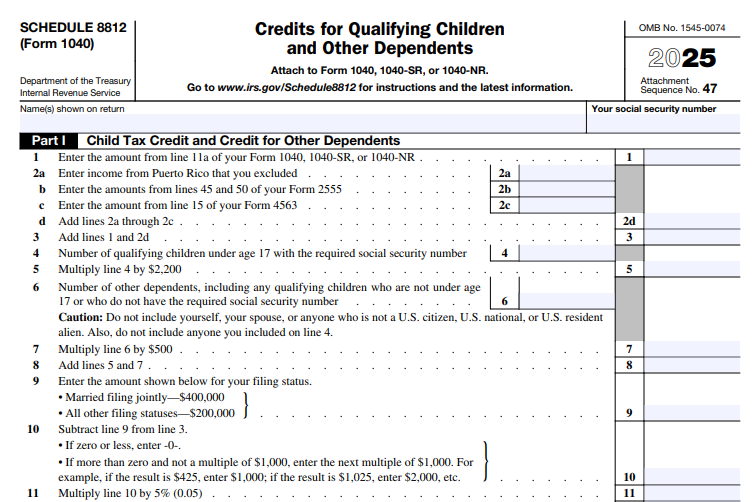
  1. Enter your AGI from Form 1040 (line 11a).
  2. Add excluded income (e.g., from Puerto Rico or foreign sources).
  3. Calculate modified AGI (line 3).
  4. Enter the number of qualifying children under 17 with SSNs (line 4); multiply by $2,200 (line 5).
  5. Enter other dependents (line 6); multiply by $500 (line 7).
  6. Add lines 5 and 7 (line 8).
  7. Subtract phaseout threshold (line 9) from modified AGI and apply 5% reduction (lines 10–11).
  8. Subtract reduction from total credits (line 12).
  9. Use Credit Limit Worksheet A to find your tax liability limit (line 13).
  10. Take the smaller of line 12 or 13 (line 14) – this is your CTC/ODC; enter on Form 1040 line 19.

Part II-A: ACTC for All Filers

  • Subtract line 14 from line 12 (line 16a).
  • Multiply qualifying children by $1,700 (line 16b).
  • Enter earned income (line 18a) and subtract $2,500 if over that amount (line 19); multiply by 15% (line 20).

Part II-B: For 3+ Children or Puerto Rico Residents

  • Add withheld taxes and certain Schedule 2 amounts (lines 21–23).
  • Subtract other credits (line 24) to get line 25.
  • Compare with line 20 and enter the smaller amount on line 27 (your ACTC; Form 1040 line 28).

If you’ve had credits denied in prior years, attach Form 8862. Always complete relevant worksheets like the Earned Income Worksheet or Credit Limit Worksheet A/B.

Key Changes for the 2025 Tax Year

The IRS has made notable updates for 2025:

  • CTC increased to $2,200 per child (from previous years’ amounts).
  • ACTC maximum raised to $1,700.
  • New emphasis on SSN requirements for CTC/ACTC (ITINs insufficient).
  • Introduction of Trump accounts for children born 2024–2029, with potential $1,000 contributions (file Form 4547 if electing).
  • Refunds delayed to mid-February 2026 for ACTC claims.

These changes reflect inflation adjustments and policy tweaks.

Frequently Asked Questions About Schedule 8812

Can I claim the CTC if my child doesn’t have an SSN?

No, a valid SSN is required for CTC and ACTC. However, an ITIN may work for ODC.

What if my income is too high?

The credits phase out gradually. Use the form to calculate your reduced amount.

Do I need to file Schedule 8812 every year?

Only if you’re claiming these credits. Consult a tax professional for personalized advice.

How does this affect my state taxes?

Federal credits like these don’t directly impact state taxes, but check your state’s rules.

Final Thoughts

IRS Schedule 8812 is a powerful tool for reducing your tax burden through dependent-related credits. By understanding eligibility, amounts, and how to complete the form, you can ensure you’re getting every dollar you deserve in 2025. Always use the latest IRS forms and instructions, and consider consulting a tax advisor for complex situations. Filing accurately not only maximizes your refund but also avoids penalties. For more details, visit the official IRS website.


IRS Form 941 (Schedule B) – Report of Tax Liability for Semiweekly Schedule Depositors

IRS Form 941 (Schedule B) - Report of Tax Liability for Semiweekly Schedule Depositors

IRS Form 941 (Schedule B) – Report of Tax Liability for Semiweekly Schedule Depositors – In the world of payroll taxes, staying compliant with IRS requirements is crucial for businesses. One key form that often comes into play for employers with significant tax liabilities is IRS Form 941 Schedule B, also known as the Report of Tax Liability for Semiweekly Schedule Depositors. This schedule helps the IRS ensure that federal employment taxes are deposited on time, preventing penalties and ensuring smooth operations. Whether you’re a business owner, HR professional, or accountant, understanding how to handle Form 941 Schedule B in 2025 can save you time and money. In this guide, we’ll break down everything you need to know, from who must file to step-by-step instructions and common pitfalls.

IRS Form 941 (Schedule B) - Report of Tax Liability for Semiweekly Schedule Depositors
IRS Form 941 (Schedule B) – Report of Tax Liability for Semiweekly Schedule Depositors


What Is IRS Form 941 Schedule B?

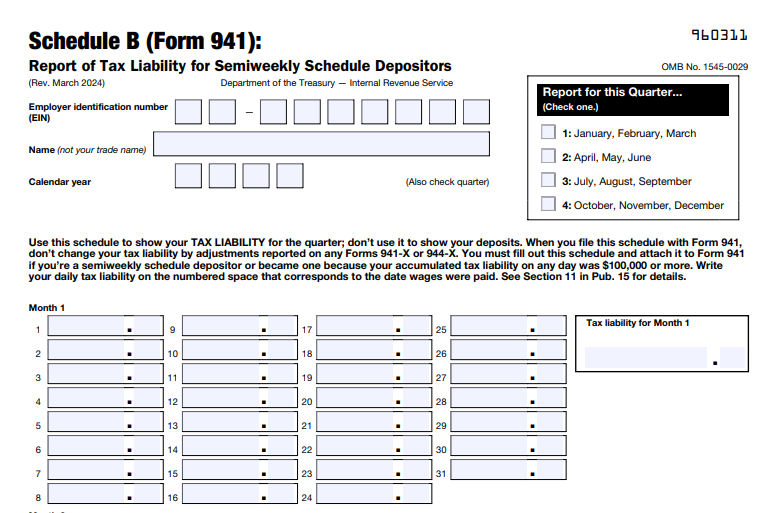
IRS Form 941 Schedule B is an attachment to Form 941, the Employer’s Quarterly Federal Tax Return. It requires employers to report their federal employment tax liabilities on a daily basis for each payroll date within the quarter. Specifically, it covers federal income tax withheld from employees’ wages, as well as both the employer and employee portions of social security and Medicare taxes. It also includes any Additional Medicare Tax withheld on wages exceeding $200,000 in a calendar year.

The primary purpose of Schedule B is to allow the IRS to verify whether you’ve made timely deposits of your employment taxes. It’s not a record of actual deposits—those are tracked through electronic funds transfers—but rather a detailed breakdown of your tax liabilities tied to payday dates. For 2025, the form has been updated with a June 2025 revision, reflecting ongoing adjustments like the removal of lines for COVID-19-related credits that are no longer applicable after 2023.

Who Needs to File Form 941 Schedule B?

Not every employer filing Form 941 needs to attach Schedule B. You’re required to file it if you’re classified as a semiweekly schedule depositor. This classification applies if:

  • You reported more than $50,000 in employment taxes during the lookback period (for 2025, this is July 1, 2023, to June 30, 2024).
  • You accumulated a tax liability of $100,000 or more on any single day in the current or prior calendar year (this triggers the “next-day deposit rule” and makes you a semiweekly depositor for the rest of the year and the following year).

If you become a semiweekly depositor mid-quarter, you must complete Schedule B for the entire quarter. However, skip it if your total tax liability on Form 941, line 12, is less than $2,500 for the quarter. Note that this form isn’t used with Form 944 (annual filers); those employers use Form 945-A instead if they’re semiweekly depositors.

Special considerations for 2025 include thresholds for certain employees: Social security and Medicare taxes apply to household employees paid $2,800 or more and election workers paid $2,400 or more in cash or equivalent.

IRS Form 941 (Schedule B) Download and Printable

Download and Print: IRS Form 941 (Schedule B)

How to Fill Out IRS Form 941 Schedule B: Step-by-Step Instructions

Filling out Schedule B is straightforward but requires accuracy to avoid penalties. Here’s a detailed walkthrough based on the official 2025 instructions:

  1. Enter Your Business Information: At the top, provide your Employer Identification Number (EIN), business name, and address. Ensure this matches exactly what’s on your Form 941 or Form 941-X.
  2. Specify the Calendar Year and Quarter: Enter the year (e.g., 2025) and check the box for the relevant quarter, such as January to March for Q1.
  3. Report Tax Liability by Date: The form is divided into three monthly sections, each with 31 lines corresponding to calendar days. Enter your tax liability on the line for the date wages were paid (not when they were accrued or deposited).
    • Example: If you pay wages on April 4 and April 18, 2025, enter the liabilities on Month 1 (April), lines 4 and 18.
    • For bonuses or irregular payments, add them to the regular payday liability on the appropriate date.
    • If you hit the $100,000 threshold mid-quarter (e.g., on April 25), start reporting from that date onward.
  4. Calculate the Total Liability: Sum up all entries for the quarter. This total must match the amount on Form 941, line 12. If it doesn’t, double-check your calculations.
  5. Handle Adjustments for Credits: If claiming the qualified small business payroll tax credit for increasing research activities (up to $500,000 for tax years after 2022), reduce your employer social security tax liability first (capped at $250,000 per quarter) on the first applicable payday, then Medicare if excess remains. Don’t reduce below zero, and carry forward any unused credit.

For visual clarity, here’s a simple table outlining the monthly structure:

Month in Quarter Dates Covered Key Notes
Month 1 (e.g., Jan/Apr/Jul/Oct) Lines 1–31 Report liabilities on payday dates
Month 2 (e.g., Feb/May/Aug/Nov) Lines 1–31 Adjust for short months (e.g., Feb has 28/29 days)
Month 3 (e.g., Mar/Jun/Sep/Dec) Lines 1–31 Total must align with Form 941

Deposit Rules for Semiweekly Schedule Depositors

As a semiweekly depositor, your deposit schedule is stricter than monthly depositors. Deposits must be made electronically via EFTPS or similar systems. The rules are:

  • If payday is Wednesday, Thursday, or Friday, deposit by the following Wednesday.
  • If payday is Saturday, Sunday, Monday, or Tuesday, deposit by the following Friday.

If you accumulate $100,000 or more in liability on any day, deposit by the next business day. Holidays and weekends extend the deadline to the next business day. For last-minute issues, use the same-day wire payment option through your financial institution.

Deadlines and Filing Requirements for 2025

Attach Schedule B to Form 941 and file by the last day of the month following the quarter (e.g., April 30 for Q1 2025). If you’ve made full, timely deposits, you get an extra 10 days. Electronic filing is recommended to avoid errors. Use the March 2025 revision of Form 941 for all quarters unless updates are announced.

Penalties for Non-Compliance

Failing to file Schedule B or deposit on time can lead to severe penalties. The IRS may impose an “averaged” failure-to-deposit (FTD) penalty if Schedule B is incomplete. Additionally, a 100% trust fund recovery penalty could apply to responsible persons if trust fund taxes (income, social security, Medicare) aren’t paid. To correct errors, file an amended Schedule B with Form 941-X.

Common Mistakes and Tips for Success

Common errors include misreporting payday dates, mismatched totals with Form 941, or forgetting to adjust for credits. Tips:

  • Use payroll software to track liabilities automatically.
  • Double-check EIN and business details.
  • Stay updated via IRS.gov for any mid-year changes.

By mastering IRS Form 941 Schedule B, you ensure compliance and avoid costly penalties in 2025. If you’re unsure, consult a tax professional or visit the IRS website for the latest forms and instructions.


IRS Form 8825 – Rental Real Estate Income and Expenses of a Partnership or an S Corporation

IRS Form 8825 - Rental Real Estate Income and Expenses of a Partnership or an S Corporation

IRS Form 8825 – Rental Real Estate Income and Expenses of a Partnership or an S Corporation – In the world of real estate investing, partnerships and S corporations often hold rental properties as key assets. Properly reporting income and expenses from these activities is crucial for tax compliance. IRS Form 8825, titled “Rental Real Estate Income and Expenses of a Partnership or an S Corporation,” serves as the essential tool for this purpose. This form helps entities detail their rental operations, calculate net income or losses, and integrate these figures into their overall tax returns. Whether you’re a real estate investor, tax professional, or business owner, understanding Form 8825 can streamline your filing process and help avoid costly errors.

As we approach the 2025 tax season, staying updated on form changes is vital. This guide covers everything from the basics to advanced filing tips, drawing from official IRS resources and expert insights to ensure accuracy.

IRS Form 8825 - Rental Real Estate Income and Expenses of a Partnership or an S Corporation
IRS Form 8825 – Rental Real Estate Income and Expenses of a Partnership or an S Corporation


What Is IRS Form 8825 and Its Purpose?

IRS Form 8825 is specifically designed for partnerships and S corporations to report income and deductible expenses from rental real estate activities. It captures details like gross rents, other related income, and various expenses, ultimately calculating the net rental real estate income or loss. This net figure flows to Schedule K of Form 1065 (for partnerships) or Form 1120-S (for S corporations), where it’s distributed to partners or shareholders via Schedule K-1.

The form’s primary goal is to provide a clear breakdown of rental operations, ensuring compliance with passive activity rules and other tax provisions. It’s not for individual taxpayers—sole proprietors or single-member LLCs report rental income on Schedule E of Form 1040 instead. By using Form 8825, entities can accurately reflect how rental properties impact their overall taxable income, potentially qualifying for deductions that reduce tax liability.

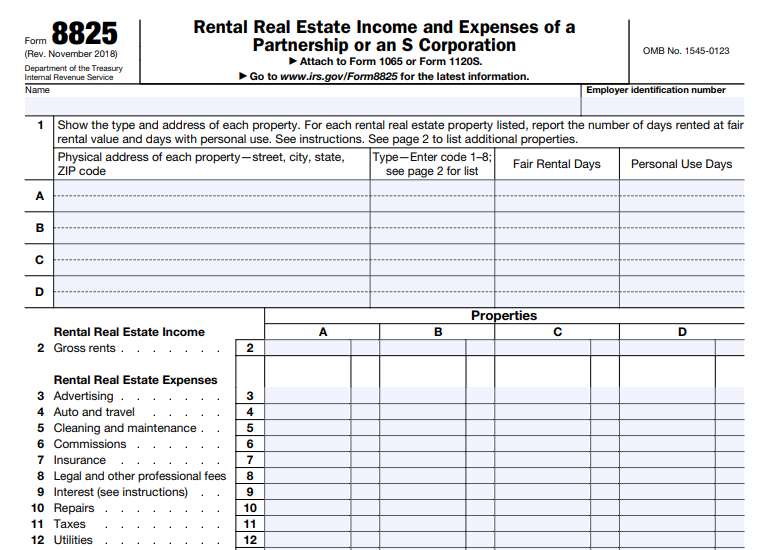
Example of IRS Form 8825 (Source: IRS official draft for illustrative purposes).

Key Updates to Form 8825 for the 2025 Tax Year

The IRS has introduced several modifications to Form 8825 for tax years beginning in 2025, based on draft releases. These changes aim to increase transparency, especially for larger entities, without altering what expenses are deductible.

  • Separation of Income Types: Gross rents and “other income” (e.g., late fees, application fees, tenant reimbursements, or amenity income like parking or laundry) must now be reported separately on Lines 2a and 2b. This applies to all filers and helps the IRS better categorize revenue streams.
  • New Schedule A (Form 8825): Entities required to file Schedule M-3 (typically those with $10 million or more in assets) must use this new schedule to break down “other deductions” on Line 17 into 20 specific categories, such as asset management fees, contract services, and prepayment penalties. Non-M-3 filers can still lump these into Line 17 without the schedule.
  • Expanded Property Information Codes: A new Column (c) on Line 1 requires codes (A through I) for transactions like acquisitions, dispositions, or basis adjustments (e.g., Code A for nontaxable contributions under sections 721 or 351). This is mandatory only for M-3 filers.
  • Form Layout Enhancements: Page 2 now accommodates four additional properties, allowing up to eight per form without extra pages in some cases.

These updates reflect the IRS’s push for more granular reporting in pass-through entities, particularly those with complex rental portfolios. Always use the December 2025 revision for 2025 filings, and check IRS.gov for final versions.

Who Must File IRS Form 8825?

Partnerships (filing Form 1065) and S corporations (filing Form 1120-S) engaged in rental real estate activities must attach Form 8825 to their returns. This includes entities that:

  • Own and rent out properties like apartments, commercial spaces, or vacation homes.
  • Receive flow-through income or losses from rental activities in other partnerships, estates, or trusts.

If your entity has no rental income but incurs related expenses (e.g., from a property under renovation), you may still need to file to report losses. However, do not use Form 8825 for trade or business activities, portfolio income, or non-real estate rentals—these go elsewhere on the return.

Passive activity limitations apply, so consult the instructions for Form 1065 or 1120-S. If multiple activities exist under these rules, attach statements to Schedule K and K-1s detailing net income/loss per activity.

What Information Do You Need to Report on Form 8825?

Form 8825 requires a per-property breakdown in columns A through H (up to eight properties per form; use multiples for more). Key sections include:

Property Details (Line 1)

  • Physical address.
  • Property type code (1-8, e.g., 2 for multi-family residence).
  • Other information code (A-I, for M-3 filers).
  • Fair rental days and personal use days (per section 280A).

Income (Lines 2a-2c)

  • Gross rents (Line 2a).
  • Other rental-related income (Line 2b).
  • Total income per property (Line 2c).

Expenses (Lines 3-18)

Deductible costs like advertising, insurance, repairs, depreciation, and more. Total expenses per property on Line 18, with net income/loss on Line 19.

Summary and Additional Items (Lines 20-23)

  • Totals across all properties.
  • Net gains/losses from property dispositions (from Form 4797).
  • Flow-through items from other entities.

Report everything accurately, as underreporting can trigger audits.

Step-by-Step Guide: How to Fill Out IRS Form 8825

Filling out Form 8825 involves gathering records like lease agreements, expense receipts, and depreciation schedules. Here’s a detailed walkthrough:

  1. Enter Entity Information: At the top, input the partnership or S corporation’s name and EIN.
  2. List Properties (Line 1): Detail each property’s address, type code, other info code (if applicable), fair rental days, and personal use days.
  3. Report Income (Lines 2a-2c): Enter gross rents on 2a and other income on 2b for each column. Sum to 2c.
  4. Detail Expenses (Lines 3-17):
    • Line 3: Advertising costs.
    • Line 4: Auto and travel.
    • Line 5: Cleaning/maintenance.
    • Line 6: Commissions (not including mortgage or sales).
    • Line 7: Insurance (property/casualty).
    • Line 8: Interest (may require Form 8990 for limitations).
    • Line 9: Legal/professional fees.
    • Line 10: Repairs (not capital improvements).
    • Line 11: Taxes (real estate; check deductibility).
    • Line 12: Utilities.
    • Line 13: Wages/salaries.
    • Line 14: Depreciation (attach Form 4562 if needed).
    • Lines 15-16: Reserved.
    • Line 17: Other deductions (use Schedule A for M-3 filers).
  5. Calculate Per-Property Totals (Lines 18-19): Sum expenses (18) and subtract from income (19).
  6. Complete Summary (Lines 20-23):
    • 20a/b: Total income/expenses across properties.
    • 21: Net from Form 4797.
    • 22a/b: Flow-through items and entity details.
    • 23: Overall net; transfer to Schedule K, Line 2.

If you have more than eight properties, attach additional forms and combine totals on one.

IRS Form 8825 Download and Printable

Download and Print: IRS Form 8825

Common Rental Real Estate Expenses and Reporting Tips

Deductible expenses on Form 8825 include everyday costs of operating rental properties. Here’s a breakdown:

Expense Category Examples Reporting Notes
Advertising Marketing to attract tenants Line 3; fully deductible if ordinary and necessary.
Insurance Property, liability coverage Line 7; exclude title insurance (add to basis).
Repairs vs. Improvements Fixing leaks (repair) vs. new roof (improvement) Line 10 for repairs; capitalize improvements and depreciate on Line 14.
Depreciation Wear and tear on buildings Line 14; use MACRS rules, attach Form 4562 for new assets.
Interest Mortgage payments Line 8; subject to section 163(j) limits—file Form 8990 if applicable.
Other Deductions Management fees, utilities Line 17; detail on Schedule A if required.

Tip: Distinguish repairs from improvements to avoid IRS reclassification. Keep detailed records for at least three years.

Special Rules for Partnerships and S Corporations

  • Passive Activity Limitations: Rental activities are generally passive; losses may be limited based on participation. Group activities appropriately but report per property on Form 8825.
  • Self-Rental and Personal Use: Code self-rentals as 7; track personal days to comply with section 280A.
  • Flow-Through Items: Report net from K-1s on Line 22a.
  • M-3 Filers: Mandatory use of Schedule A and codes for enhanced scrutiny.

Consult a tax advisor for complex scenarios like basis adjustments or section 1031 exchanges.

  • Form 4562: For depreciation details.
  • Form 4797: Sales of business property.
  • Form 8990: Business interest expense limitations.
  • Schedule M-3: If assets ≥ $10M, triggers Schedule A.
  • Additional Statements: For passive activity breakdowns.

Attach these to your Form 1065 or 1120-S as needed.

Tips for Accurate Filing and Avoiding Common Mistakes

  • Gather Documentation Early: Use accounting software to track per-property data.
  • Double-Check Calculations: Ensure totals on Lines 20-23 match all pages.
  • Avoid Mixing Categories: Separate gross rents from other income; don’t deduct non-allowable items like federal taxes.
  • Stay Updated: Monitor IRS.gov for final 2025 forms—drafts are for reference only.
  • E-File for Efficiency: Platforms like TaxZerone simplify electronic filing with Form 1120-S.
  • Common Pitfalls: Forgetting to attach Form 4562, misclassifying expenses, or ignoring interest limits.

By following these steps, you can minimize audit risks and maximize deductions.

Conclusion: Mastering Form 8825 for Tax Success

IRS Form 8825 is a cornerstone for partnerships and S corporations managing rental real estate. With the 2025 updates emphasizing detailed reporting, proactive preparation is key. Whether you’re handling a single apartment building or a portfolio of commercial properties, accurate completion ensures compliance and optimizes your tax position. For personalized advice, consult a certified tax professional. Stay informed, file on time, and leverage rental deductions to support your real estate ventures.


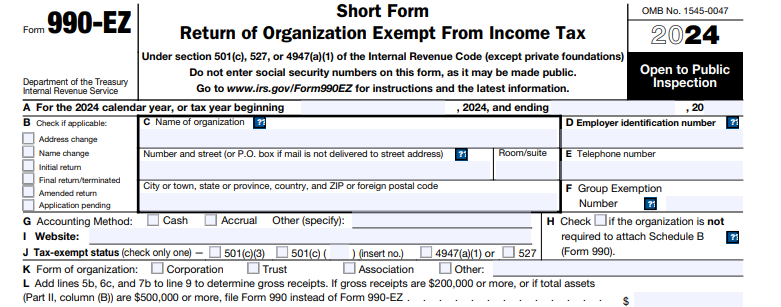
IRS Form 990-EZ – Short Form Return of Organization Exempt from Income Tax

IRS Form 990-EZ - Short Form Return of Organization Exempt from Income Tax

IRS Form 990-EZ – Short Form Return of Organization Exempt from Income Tax – IRS Form 990-EZ is the shortened annual information return that many small to mid-sized tax-exempt organizations file with the Internal Revenue Service (IRS). This form ensures compliance with federal tax-exempt status requirements while providing less detailed reporting than the full Form 990. Understanding Form 990-EZ helps nonprofits maintain transparency, avoid penalties, and preserve their exempt status.

IRS Form 990-EZ - Short Form Return of Organization Exempt from Income Tax
IRS Form 990-EZ – Short Form Return of Organization Exempt from Income Tax


What Is IRS Form 990-EZ?

The IRS requires Form 990-EZ, titled Short Form Return of Organization Exempt from Income Tax, from certain tax-exempt organizations, nonexempt charitable trusts, and section 527 political organizations under Internal Revenue Code section 6033. It reports financial activities, governance, and compliance to the IRS and the public.

Unlike the full Form 990Form 990-EZ is streamlined for smaller organizations, typically spanning four pages plus required schedules. The IRS makes filed returns publicly available (with some redactions), promoting accountability for nonprofits.

Who Must File Form 990-EZ?

Most organizations exempt under section 501(a), including 501(c)(3) charities, as well as section 527 political organizations and certain trusts, must file an annual return unless exempt.

Eligibility for Form 990-EZ specifically applies to organizations that:

  • Have gross receipts less than $200,000, and
  • Have total assets less than $500,000 at the end of the tax year.

Organizations exceeding these thresholds must file the full Form 990. Smaller organizations with gross receipts normally $50,000 or less can file Form 990-N (e-Postcard) instead.

Exceptions include:

  • Private foundations (must file Form 990-PF).
  • Sponsoring organizations of donor-advised funds.
  • Certain controlling organizations or those operating hospital facilities (must file full Form 990 regardless of size).
  • Group returns (must use full Form 990).

Organizations eligible for Form 990-N or Form 990-EZ can voluntarily file a more detailed form if preferred.

Key Differences: Form 990 vs. Form 990-EZ

Aspect Form 990-EZ Form 990
Length 4 core pages + schedules 12 core pages + more schedules
Eligibility Gross receipts < $200,000
Total assets < $500,000
Gross receipts ≥ $200,000 or assets ≥ $500,000
Detail Level Basic revenue/expense summary Detailed statements, reconciliations, and governance info
Required Schedules Fewer (e.g., A, B, C, O common) More extensive schedules
Best For Small to mid-sized nonprofits Larger or more complex organizations

Form 990-EZ reduces administrative burden while still requiring key financial and operational disclosures.

Filing Deadline for Form 990-EZ in 2025

The due date is the 15th day of the 5th month after the end of your organization’s tax year.

  • For calendar year organizations (January 1 – December 31, 2025): May 15, 2026.
  • For fiscal year filers: Calculate 4 months + 15 days after year-end.

If the due date falls on a weekend or holiday, it shifts to the next business day.

You can request an automatic 6-month extension by filing Form 8868 before the original deadline (no reason needed).

Failure to file for three consecutive years results in automatic revocation of tax-exempt status.

IRS Form 990-EZ Download and Printable

Download and Print: IRS Form 990-EZ

How to File Form 990-EZ

Since the Taxpayer First Act (2019), electronic filing is mandatory for Form 990-EZ for tax years ending July 31, 2021, and later. Paper filing is no longer accepted except in rare hardship cases.

Steps to e-file:

  1. Gather financial records, board information, and activity descriptions.
  2. Use IRS-approved e-file software or an authorized provider.
  3. Complete the form, including required schedules (e.g., Schedule A for 501(c)(3) public charity status, Schedule B for contributors).
  4. Have an authorized officer sign electronically.
  5. Transmit to the IRS and receive acceptance confirmation.

Many nonprofits use third-party platforms for ease, error checks, and schedule support.

Required Schedules and Common Attachments

Common schedules for Form 990-EZ filers include:

  • Schedule A: Public charity status and support (required for most 501(c)(3)s).
  • Schedule B: Contributors (if contributions exceed thresholds).
  • Schedule C: Political/lobbying activities.
  • Schedule O: Supplemental narrative explanations.

Ensure all parts (I–V, and VI for 501(c)(3)s) are complete.

Penalties and Best Practices

Late filing can incur penalties starting at $20 per day, escalating for larger organizations. Incomplete returns may be rejected.

Tips:

  • Review prior returns for consistency.
  • Avoid including Social Security numbers (redacted if needed).
  • Use Schedule O for clear explanations.

For the latest 2025 forms and instructions, visit the official IRS pages: About Form 990-EZ and Instructions for Form 990-EZ.

Timely and accurate filing of Form 990-EZ helps your organization stay compliant and focused on its mission. Consult a tax professional for complex situations.


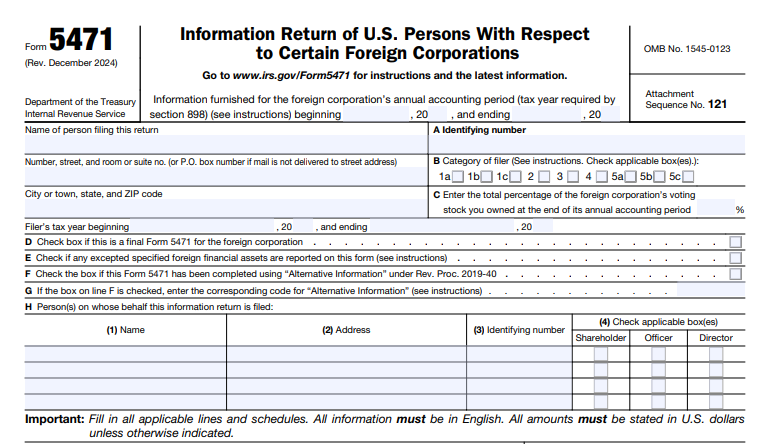
IRS Form 5471 – Information Return of U.S. Persons With Respect To Certain Foreign Corporations

IRS Form 5471 - Information Return of U.S. Persons With Respect To Certain Foreign Corporations

IRS Form 5471 – Information Return of U.S. Persons With Respect To Certain Foreign Corporations – In an increasingly globalized economy, many U.S. citizens, residents, and entities find themselves involved with foreign corporations. Whether you’re an officer, director, or shareholder, navigating U.S. tax obligations is crucial to avoid hefty penalties. IRS Form 5471, officially titled “Information Return of U.S. Persons With Respect To Certain Foreign Corporations,” plays a pivotal role in this process. This guide breaks down everything you need to know about Form 5471 for tax year 2025, including filing requirements, deadlines, penalties, and recent updates. We’ll draw from official IRS sources and expert insights to ensure accuracy and compliance.

IRS Form 5471 - Information Return of U.S. Persons With Respect To Certain Foreign Corporations
IRS Form 5471 – Information Return of U.S. Persons With Respect To Certain Foreign Corporations


What Is IRS Form 5471?

Form 5471 is an information return required by the IRS to report U.S. persons’ interests in certain foreign corporations. Unlike a traditional tax return that calculates owed taxes, this form provides the IRS with detailed data on foreign entities to enforce tax laws under Internal Revenue Code (IRC) sections 6038 and 6046. It’s essential for transparency, helping the IRS track income, earnings, and transactions that might impact U.S. tax liabilities, such as those related to Controlled Foreign Corporations (CFCs).

The form requires attachments like various schedules that detail financials, taxes paid, earnings and profits (E&P), transactions, and more. For 2025, the form has been revised as of December 2025, incorporating updates to reflect new legislation and reporting needs.

Who Must File Form 5471?

Not every U.S. person with international ties needs to file Form 5471. The requirement applies to specific “U.S. persons,” which include U.S. citizens, residents, domestic partnerships, corporations, estates, and trusts. You must file if you fall into one of the following categories of filers:

  • Category 1: U.S. shareholders of a Specified Foreign Corporation (SFC) or CFC under certain conditions. Note: Exceptions exist if no U.S. shareholder owns stock attributable to the filer.
  • Category 2: U.S. persons who become officers or directors of a foreign corporation where a U.S. person acquires stock meeting a 10% ownership threshold.
  • Category 3: U.S. persons acquiring stock that results in 10% ownership or additional stock increasing ownership by 10%.
  • Category 4: U.S. persons controlling a foreign corporation for an uninterrupted period of at least 30 days during the tax year.
  • Category 5: U.S. shareholders owning at least 10% of a CFC’s voting power or value.

These categories ensure the IRS captures information from those with significant control or ownership. For startups or expats with foreign entities, this form is particularly relevant to report offshore operations.

Filing Requirements and Deadlines for 2025

Filing Form 5471 is tied to your U.S. tax return deadline. Attach it to your Form 1040 (for individuals), Form 1120 (for corporations), or other applicable returns. Key deadlines for tax year 2025 include:

  • Individuals: April 15, 2026 (or June 17, 2026, if living abroad).
  • Corporations: March 17, 2026.

Extensions for your main tax return automatically extend Form 5471’s deadline. Electronic filing is encouraged for accuracy and speed. If you’re a Category 1 filer, you might be exempt under certain conditions, but always verify with IRS instructions.

Key Schedules and Information Required

Form 5471 isn’t filed alone; it includes multiple schedules based on your situation. Here’s a breakdown:

  • Schedule E: Reports taxes paid or accrued by the foreign corporation.
  • Schedule G-1: Details cost-sharing arrangements.
  • Schedule H: Current earnings and profits.
  • Schedule I-1: Income inclusions for U.S. shareholders.
  • Schedule J: Accumulated E&P.
  • Schedule M: Transactions between the foreign corporation and related parties.
  • Schedule O: Organization, reorganization, or stock acquisitions/dispositions.
  • Schedule P: Previously taxed E&P (PTEP).
  • Schedule Q: Income, deductions, taxes, and assets by income groups.
  • Schedule R: Distributions from foreign corporations.

For 2025, a new Schedule H-1 has been introduced to report a CFC’s adjusted net income or loss for Corporate Alternative Minimum Tax (CAMT) purposes. Gather documents like financial statements, ownership records, and transaction logs to complete these.

Penalties for Not Filing or Late Filing Form 5471

Non-compliance can be costly. The IRS imposes a $10,000 penalty per foreign corporation per annual accounting period for failure to file a complete and timely Form 5471. If the failure continues after IRS notification, additional $10,000 penalties apply every 30 days, up to $50,000 per return. There are also potential penalties under section 6707A for failing to report certain transactions.

Recent court rulings have debated the IRS’s authority to assess these penalties, with some decisions affirming assessment rights under Section 6038(b). Penalty relief may be available for reasonable cause, but don’t rely on it—proactive filing is key.

Recent Changes to Form 5471 for Tax Year 2025

The IRS continues to update Form 5471 to align with evolving tax laws. For 2025:

  • New Schedule H-1: Replaces the prior Worksheet H-1 for CAMT reporting.
  • One Big Beautiful Bill Act (OBBBA) Impacts: Effective for CFC years after December 31, 2025, this modifies CFC ownership rules, transition rules for dividends, and repeals certain deferral elections under Section 898.
  • §987 Reporting Revisions: Updates to how currency gain/loss is reported on the form.

These changes stem from broader tax reforms, including the 2025 Tax Act, which introduces significant shifts for international taxation. Consult the latest IRS instructions (Rev. December 2024) for full details.

IRS Form 5471 Download and Printable

Download and Print: IRS Form 5471

How to File Form 5471 Step-by-Step

  1. Determine Your Category: Review IRS instructions to confirm if you qualify.
  2. Gather Information: Collect foreign corporation details, including EIN (if applicable), financials, and ownership data.
  3. Complete the Form and Schedules: Use tax software or consult a professional for accuracy.
  4. Attach to Your Tax Return: File electronically via e-file or mail if necessary.
  5. Seek Professional Help: For complex situations, work with a tax advisor specializing in international tax.

Tools like Bloomberg Tax Workpapers can streamline preparation.

Conclusion

Mastering IRS Form 5471 is vital for U.S. persons with foreign corporation ties to maintain compliance and avoid penalties. With updates for 2025 emphasizing new schedules and legislative changes, staying informed is more important than ever. If you’re unsure about your obligations, consult a tax professional or visit the IRS website for personalized guidance.

Frequently Asked Questions (FAQs)

What happens if I forget to file Form 5471?

You could face a $10,000 penalty per corporation, with additional fines for continued non-compliance.

Is Form 5471 required for all foreign investments?

No, only for specific ownership or control levels in foreign corporations.

Are there any exemptions for small shareholders?

Yes, thresholds like 10% ownership apply, and some categories have exceptions.

How do recent tax laws affect Form 5471?

The OBBBA and other 2025 reforms introduce changes to CFC rules and new reporting requirements.

For more details, refer to official IRS resources or trusted tax advisors. This guide is for informational purposes and not tax advice.


IRS Form 3115 – Application for Change in Accounting Method

IRS Form 3115 - Application for Change in Accounting Method

IRS Form 3115 – Application for Change in Accounting Method – In the ever-evolving world of tax compliance, businesses and individuals often need to adjust their accounting practices to better align with IRS regulations, improve financial reporting, or adapt to new business realities. IRS Form 3115, officially titled “Application for Change in Accounting Method,” serves as the key document for requesting such changes. Whether you’re switching from cash to accrual basis, updating depreciation methods, or making inventory adjustments, this form ensures your transition is IRS-approved and properly documented. This SEO-optimized guide covers everything you need to know about Form 3115, including eligibility, filing steps, and the latest 2025 updates, drawing from official IRS sources and recent revenue procedures.

IRS Form 3115 - Application for Change in Accounting Method
IRS Form 3115 – Application for Change in Accounting Method


What Is IRS Form 3115 and Why Is It Important?

IRS Form 3115 is the formal application taxpayers use to request permission from the IRS to change either their overall method of accounting (e.g., from cash to accrual) or the accounting treatment of specific items (e.g., inventory valuation or depreciation). Accounting methods determine when income and expenses are recognized for tax purposes, directly impacting your taxable income and tax liability.

Changing methods without IRS consent can lead to penalties, audits, or disallowed deductions. Form 3115 provides a structured way to make these changes, often resulting in a Section 481(a) adjustment to prevent income or expense duplication or omission. Common reasons to file include complying with new tax laws, correcting impermissible methods, or optimizing for business growth—such as small businesses qualifying for cash method under inflated gross receipts thresholds (up to $31 million in 2025).

For example, if your business has grown and now exceeds the threshold for cash accounting, you might need to switch to accrual using Form 3115. This form is essential for farmers, manufacturers, retailers, and service providers alike.

Who Needs to File Form 3115?

Any taxpayer—individuals, corporations, partnerships, or estates—must file Form 3115 if they intend to change their accounting method for federal income tax purposes. This includes:

  • Businesses Switching Overall Methods: Such as from cash to accrual (or vice versa) under Section 446, especially for those hitting the $31 million gross receipts test in 2025.
  • Depreciation or Amortization Changes: Updating methods for assets like buildings, vehicles, or intangibles under Sections 167 or 168.
  • Inventory-Related Adjustments: Changing valuation methods, LIFO to FIFO, or complying with uniform capitalization rules under Section 263A.
  • Specific Item Treatments: Like advance payments, research expenditures, or bad debts.

Exemptions apply for certain elections that don’t require Form 3115, such as some de minimis rules, but most substantive changes mandate it. Qualified small taxpayers (average annual gross receipts of $31 million or less) often benefit from reduced filing requirements for many changes.

Automatic vs. Non-Automatic Accounting Method Changes

Accounting method changes fall into two categories:

Automatic Changes

These don’t require advance IRS approval—just file the form, and it’s considered granted if eligibility is met. They cover hundreds of scenarios listed in Rev. Proc. 2025-23, each with a Designated Change Number (DCN). Examples include:

  • DCN 7: Depreciation changes under Section 168.
  • DCN 122: Overall cash to accrual.
  • DCN 265: Capitalizing research expenditures under Section 174 (effective for years after 2021).

Eligibility rules include no similar change in the prior five years and not being in the final year of business (with exceptions). Automatic changes often provide audit protection.

Non-Automatic Changes

These require IRS consent via advance ruling and involve a user fee (e.g., $12,600 standard, reduced for small entities). File as early as possible in the change year. Use if the change isn’t listed as automatic.

Step-by-Step: How to File IRS Form 3115

Filing Form 3115 involves careful preparation. Here’s a breakdown:

  1. Determine Your Change Type: Review Rev. Proc. 2025-23 for DCNs and eligibility.
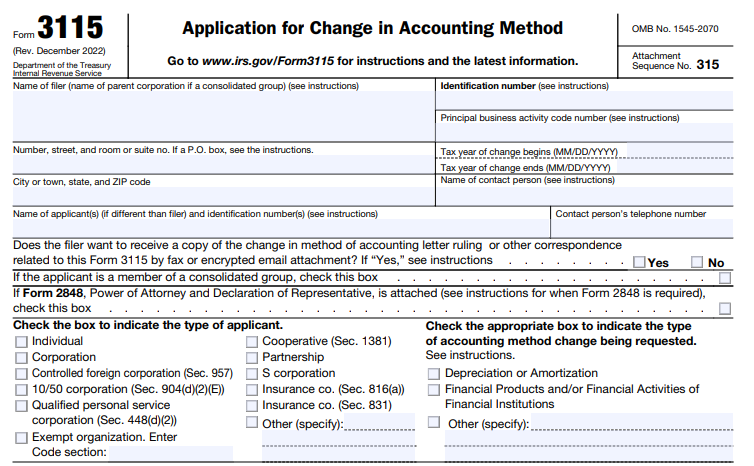
  2. Complete the Form: Use the December 2022 revision. Key sections include:
    • Part I: For automatic changes (enter DCN).
    • Part II: General info, prior changes, and audit disclosures.
    • Part IV: Section 481(a) adjustment calculation.
    • Schedules A-E: Specific to change type (e.g., Schedule E for depreciation).
  3. Gather Documentation: Attach explanations, computations, and supporting authorities.
  4. File Copies:
    • Original: Attach to your timely filed tax return (including extensions) for the year of change.
    • Duplicate: Mail to IRS National Office (Ogden, UT for automatic) no earlier than the first day of the change year.
  5. Pay User Fee if Non-Automatic: Via Pay.gov.
  6. Electronic Filing: Not available; paper only.

For concurrent changes, use one form. Consult a tax professional for complex cases.

IRS Form 3115 Download and Printable

Download and Print: IRS Form 3115

Understanding the Section 481(a) Adjustment

A core component of Form 3115 is the Section 481(a) adjustment, which accounts for differences in income/expenses under old vs. new methods to avoid double-counting.

  • Positive Adjustment: Spread over four years (or shorter if de minimis).
  • Negative Adjustment: Taken entirely in the change year.
  • Cut-Off Basis: Used for some changes (no adjustment for prior years).

Compute it in Part IV and attach a detailed statement.

Deadlines, User Fees, and Where to File

  • Automatic Changes: File by the return due date (with extensions). Duplicate no later than that date. No user fee.
  • Non-Automatic: File during the change year; user fees apply ($300–$59,500 based on type).
  • Late Filings: Possible six-month extension for automatic under certain conditions.

Mail duplicate to: Internal Revenue Service, Attn: CC:PA:LPD:DRU, Room 5336, 1111 Constitution Ave. NW, Washington, DC 20224 (non-automatic) or Ogden for automatic.

2025 Updates: Rev. Proc. 2025-23 and Beyond

The IRS released Rev. Proc. 2025-23 on June 9, 2025, updating the automatic changes list by removing obsolete items and incorporating Section 174 research expenditure changes. Key highlights:

  • Effective for Forms 3115 filed on/after June 9, 2025, for years ending on/after October 31, 2024.
  • New DCN 272: Allowance charge-off method for regulated financial companies.
  • Transition rules for pre-June filings: No refiling needed if duplicate was submitted under prior proc.
  • Enhanced guidance for SRE expenditures (DCN 265/271), requiring capitalization over 5/15 years.

Check IRS.gov for post-2025 developments, as legislative proposals could allow immediate expensing for domestic research.

Common Mistakes When Filing Form 3115

Avoid these pitfalls:

  • Missing DCN or eligibility checks.
  • Incomplete Section 481(a) computations.
  • Late duplicate filing.
  • Not attaching required schedules or statements.
  • Ignoring concurrent change requirements.

Working with a CPA can help ensure accuracy.

Final Thoughts on IRS Form 3115

Navigating IRS Form 3115 can seem daunting, but it’s a powerful tool for tax optimization and compliance. With the 2025 updates in Rev. Proc. 2025-23, more changes qualify as automatic, simplifying the process for many taxpayers. Always use the latest form and instructions from IRS.gov, and consider professional advice for your specific situation. By filing correctly, you can minimize tax burdens and avoid costly errors. For more details, visit the official IRS page on Form 3115.


IRS Form 8938 – Statement of Specified Foreign Financial Assets

IRS Form 8938 - Statement of Specified Foreign Financial Assets

IRS Form 8938 – Statement of Specified Foreign Financial Assets – In an increasingly globalized world, many U.S. taxpayers hold financial assets abroad, whether through investments, retirement accounts, or business interests. To ensure compliance with tax laws and combat tax evasion, the IRS requires certain individuals and entities to report these holdings using IRS Form 8938, also known as the Statement of Specified Foreign Financial Assets. This form is a key component of the Foreign Account Tax Compliance Act (FATCA), which aims to increase transparency in international financial dealings.

If you’re a U.S. citizen, resident alien, or certain domestic entities with foreign assets, understanding Form 8938 is crucial to avoid hefty penalties. In this comprehensive guide, we’ll cover everything you need to know about who needs to file Form 8938, the reporting thresholds, what assets qualify, step-by-step filing instructions, and more. Whether you’re an expat, investor, or business owner, staying informed can help you navigate tax season smoothly for the 2025 tax year.

IRS Form 8938 - Statement of Specified Foreign Financial Assets
IRS Form 8938 – Statement of Specified Foreign Financial Assets

What Is IRS Form 8938 and Its Purpose?

IRS Form 8938 is an information reporting form used by U.S. taxpayers to disclose specified foreign financial assets that exceed specific value thresholds during the tax year. Introduced under FATCA in 2010, it helps the IRS track offshore assets and ensure that income from these sources is properly reported on U.S. tax returns.

Unlike other forms, Form 8938 doesn’t calculate taxes owed—it’s purely for disclosure. However, failing to file it when required can lead to significant penalties, even if all taxes on the assets have been paid. The form must be attached to your annual tax return, such as Form 1040, and is due by the standard filing deadline (typically April 15, or later with an extension).

For the 2025 tax year, there are no major structural changes to Form 8938 based on current IRS guidance, but taxpayers should always check for updates on the official IRS website. It’s designed to complement other reporting requirements, like the Report of Foreign Bank and Financial Accounts (FBAR), but covers a broader range of assets.

Who Needs to File Form 8938?

Not every U.S. taxpayer with foreign assets must file Form 8938. Filing is required only if you are a “specified person” and the total value of your specified foreign financial assets exceeds the applicable reporting threshold.

Specified persons include:

  • U.S. citizens and resident aliens.
  • Nonresident aliens who elect to file jointly with a U.S. spouse.
  • Certain bona fide residents of U.S. territories (e.g., American Samoa or Puerto Rico) in limited cases.
  • Specified domestic entities, such as closely held corporations, partnerships, and trusts where at least 50% ownership is held by specified individuals.

If you meet these criteria and your assets hit the thresholds (detailed below), you must file. Note that even if you’re living abroad, you may still qualify as a specified person under U.S. tax rules.

Reporting Thresholds for Form 8938 in 2025

The Form 8938 filing thresholds depend on your filing status, marital status, and whether you live in the U.S. or abroad. These thresholds are based on the aggregate value of all specified foreign financial assets—either on the last day of the tax year or the highest value at any point during the year (whichever is greater).

Here’s a breakdown in the table below for clarity:

Filing Status Living in the U.S. (Last Day / Anytime During Year) Living Abroad (Last Day / Anytime During Year)
Unmarried or Married Filing Separately $50,000 / $75,000 $200,000 / $300,000
Married Filing Jointly $100,000 / $150,000 $400,000 / $600,000

These thresholds have remained consistent into 2025, with no adjustments noted in recent IRS updates. For specified domestic entities, the threshold is generally $50,000 on the last day or $75,000 anytime, regardless of location.

To determine if you’ve exceeded the threshold, sum the maximum fair market value of all qualifying assets during the year, converted to U.S. dollars using appropriate exchange rates.

What Are Specified Foreign Financial Assets?

Specified foreign financial assets include a wide range of holdings outside the U.S. that are held for investment purposes. These are divided into two main categories: financial accounts maintained by foreign financial institutions and other foreign assets not held in such accounts.

Examples include:

  • Financial Accounts: Bank deposits, custodial accounts, cash-value insurance policies, or annuities issued by foreign institutions.
  • Other Assets:
    • Stocks or securities issued by non-U.S. companies.
    • Interests in foreign partnerships, trusts, or estates.
    • Bonds, notes, or other debt instruments from foreign issuers.
    • Derivative contracts like swaps or options with foreign counterparties.
    • Interests in foreign entities, such as corporations or hedge funds.

Exclusions apply to assets used in a trade or business, certain U.S.-based accounts (even if holding foreign securities), and assets already reported on other IRS forms like Form 3520 or 5471. Real estate is generally not reportable unless held through a foreign entity.

For valuation, use the fair market value in U.S. dollars, often based on year-end statements or exchange rates from the U.S. Treasury.

How to File IRS Form 8938: Step-by-Step Guide

Filing Form 8938 involves attaching it to your tax return. Here’s a simplified step-by-step process based on IRS instructions:

  1. Gather Information: Collect details on all specified foreign assets, including maximum values, account numbers, and income generated.
  2. Complete Identifying Info: Enter your name, TIN, and type of filer (individual or entity).
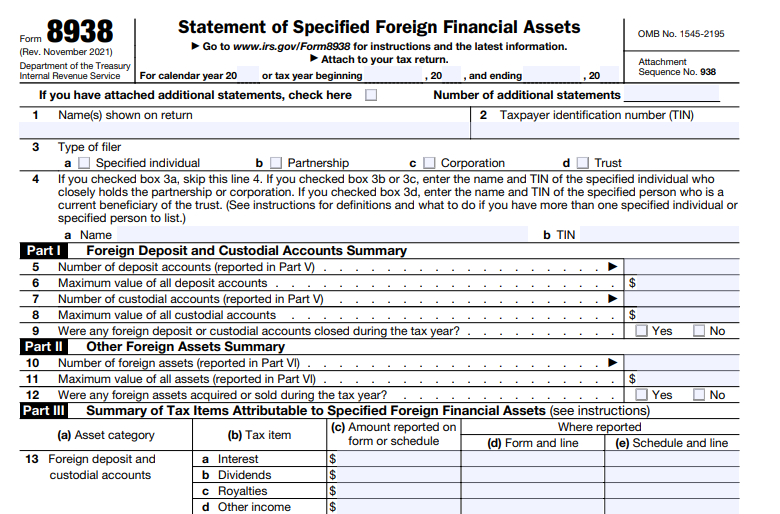
  3. Part I & II: Summaries: Report the number and total value of foreign deposit/custodial accounts and other assets.
  4. Part III: Tax Items: Summarize interest, dividends, gains, and other income from these assets.
  5. Part IV: Exceptions: Note if assets are reported on other forms to avoid duplication.
  6. Parts V & VI: Details: Provide specifics for each account or asset, including descriptions, values, and foreign currency info if applicable.
  7. Attach and File: Submit with your Form 1040 or equivalent by the due date, including extensions. Electronic filing is recommended.

If you have multiple assets, use continuation sheets. For joint filers, report the full value but file only one form.

Penalties for Not Filing Form 8938

Non-compliance with Form 8938 filing requirements can be costly. The initial penalty for failure to file is $10,000 per year. If the IRS notifies you and you continue to fail, additional penalties of $10,000 per 30 days can apply, up to a maximum of $50,000.

Accuracy-related penalties (up to 40% of underpaid tax) may also apply if underreporting is willful. In cases of fraud, criminal penalties could be imposed. To mitigate risks, consider the IRS’s streamlined compliance procedures if you’ve missed filings in prior years.

IRS Form 8938 Download and Printable

Download and Print: IRS Form 8938

Key Differences Between Form 8938 and FBAR

Many taxpayers confuse Form 8938 with the FBAR (FinCEN Form 114). While both involve foreign asset reporting, they differ significantly:

  • Thresholds: FBAR triggers at $10,000 aggregate in foreign accounts anytime during the year; Form 8938 has higher thresholds.
  • Assets Covered: FBAR focuses on financial accounts; Form 8938 includes broader assets like stocks and contracts.
  • Filing: FBAR is filed separately with FinCEN by April 15 (auto-extension to October); Form 8938 attaches to your tax return.
  • Penalties: FBAR penalties can reach $100,000+ for willful violations; Form 8938 starts at $10,000.

You may need to file both if thresholds are met—filing one doesn’t excuse the other.

Frequently Asked Questions About IRS Form 8938

Here are answers to common queries based on IRS FAQs:

  • Do I report foreign real estate on Form 8938? No, unless held through a foreign entity like a corporation.
  • What if my assets are in a U.S. brokerage? If the account is U.S.-based, even holding foreign stocks, it’s generally not reportable.
  • Can I e-file Form 8938? Yes, through most tax software or IRS e-file systems.
  • What about foreign pensions? Report if they qualify as specified assets; value based on your beneficial interest.
  • Are there relief programs for late filings? Yes, check IRS streamlined procedures for non-willful violations.

For personalized advice, consult a tax professional, as this guide is for informational purposes only. Always refer to the latest IRS publications for the most current rules.

By understanding and complying with IRS Form 8938 requirements, you can avoid penalties and ensure your foreign assets are properly disclosed. If you suspect you need to file, start gathering your documents early for the 2025 tax season.